
A Khata vs B Khata: The Complete Bangalore Property Guide
A Khata vs B Khata: The Complete Bangalore Property Guide
Categories
- Articles
- Market Insights
- News
Recent Posts
Articles / 07 Sept 2026
How to Check Property Registry Online in UP (Free)
Market Insights / 04 Sept 2026
Noida Circle Rates 2026: Sector-Wise Complete List

Market Insights / 02 Sept 2026
Best Home Loan Rates in India 2026: Full Comparison

Articles / 01 Sept 2026
Free Property Verification: Check Before You Invest
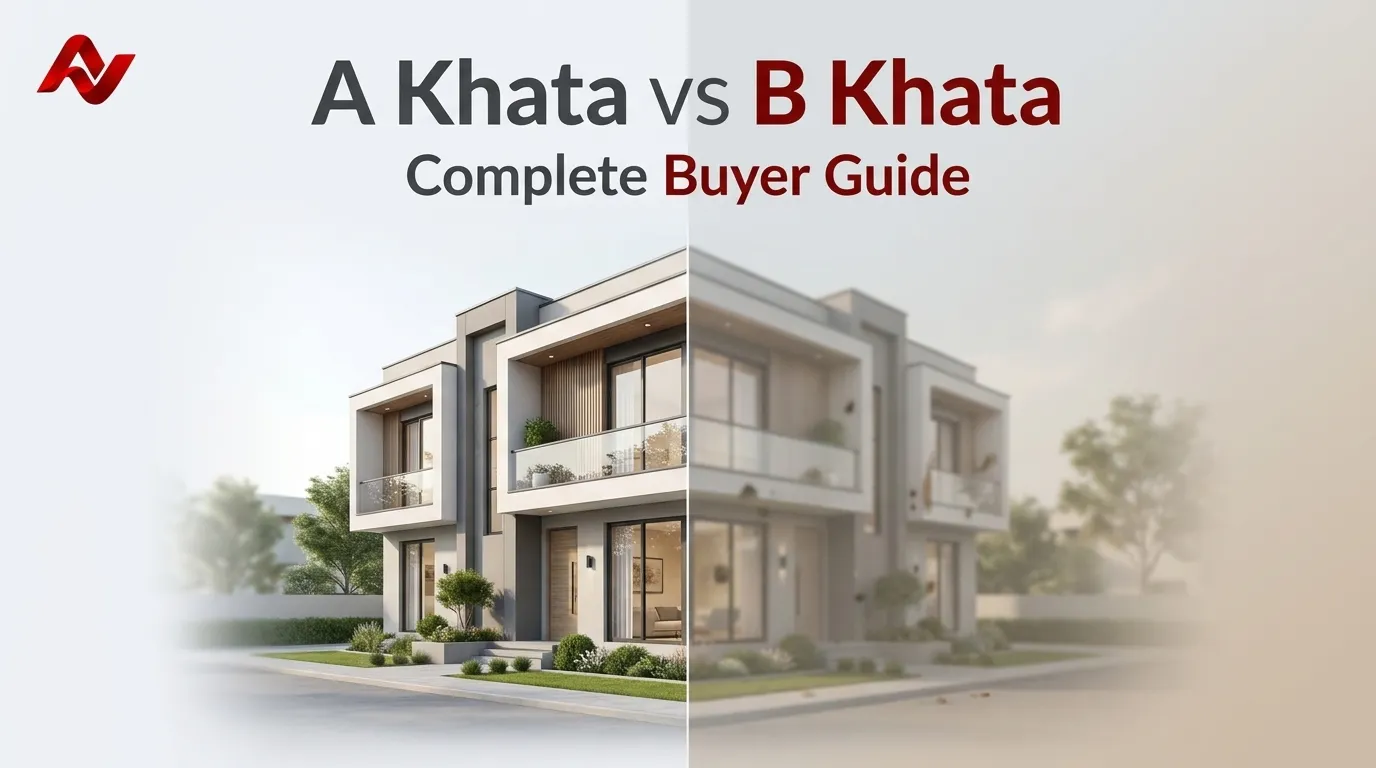
Buying a home in Bangalore? Our A Khata vs B Khata guide reveals the legal risks, loan issues, and conversion steps you need to know before signing any cheque.
A Khata vs B Khata Properties: Complete Buyer Guide
Buying a house in Bangalore is often an emotional rollercoaster, especially when you encounter the cryptic legal terms 'A Khata' and 'B Khata' for the first time. If you’ve spent any time browsing property listings in Electronic City, Sarjapur, or Whitefield, you’ve likely noticed that some flats are significantly cheaper than others in the same area. Often, the hidden reason behind this price gap is the type of Khata the property holds. While real estate agents might brush it off as a minor technicality, for a homebuyer, this distinction determines everything from your loan eligibility to the very legality of your home.
Here’s the thing: I’ve seen countless buyers get tempted by a "budget-friendly" luxury apartment only to realize three months later that no nationalized bank will touch it with a ten-foot pole. Most buyers ignore the paper trail because the building looks beautiful and the amenities are world-class. But in the eyes of the Bruhat Bengaluru Mahanagara Palike (BBMP), the look of the building doesn't matter nearly as much as the approvals filed in their records. You don't want to wake up ten years from now to find your property listed in a "demolition drive" because of a B Khata status you failed to investigate.
Table of Contents
- What Exactly is a Khata and Why Does it Exist?
- A Khata: The Gold Standard of Property Ownership
- B Khata: The Story of Temporary Legal Status
- The DC Conversion and Betterment Charges
- Home Loans and Financial Restrictions
- Detailed Comparison: A Khata vs B Khata
- Pros and Cons of Buying B Khata
- Practical Tips for Verifying Property Documents
- Common Mistakes Buyers Make in Bangalore
- Conclusion: Should You Ever Buy B Khata?
- Frequently Asked Questions
What Exactly is a Khata and Why Does it Exist?
A Khata is essentially a legal document that identifies a property owner and records their tax obligations to the municipal corporation. The word 'Khata' literally means 'account' in Kannada. It’s an assessment of the property for the purpose of paying property tax. It’s important to clarify that a Khata is not a title deed; it doesn't prove ownership (your Sale Deed does that), but it proves that you are the person responsible for the property in the government's tax records. Without a Khata, the BBMP doesn't officially recognize your property as an entity it can collect taxes from.
For example, if you buy a plot in a newly developed area, you need to apply for a Khata transfer so the tax bills come in your name. In Bangalore, the system was bifurcated in 2007 to handle the massive influx of properties that were built on agricultural land without proper "DC Conversion" or without adhering to building bylaws. This led to the creation of two registers: the primary register (A Khata) and a secondary register (B Khata). Most buyers ignore the origin story, but understanding it is the only way to safeguard your investment.
A Khata: The Gold Standard of Property Ownership
Holding an A Khata certificate means your property is fully compliant with all municipal bylaws and has all the necessary building approvals. This document is your ticket to a hassle-free life as a homeowner. It signifies that the land has been converted from agricultural to residential use (DC Conversion), the building plan was sanctioned by the BBMP or BDA, and you have an Occupancy Certificate (OC) and a Commencement Certificate (CC). In short, it’s the "Clean Chit" from the government.
When you have an A Khata, you can sleep peacefully. You’ll have access to government-provided water and electricity connections without having to pay "informal" premiums. Most importantly, your property value will appreciate steadily. If you ever decide to sell, you’ll find a line of buyers because an A Khata property is considered a "safe" asset. For instance, a 2BHK with an A Khata in Indiranagar will always command a much higher price and sell faster than a similar-sized property nearby that lacks this documentation.
B Khata: The Story of Temporary Legal Status
The B Khata was introduced as a temporary measure by the BBMP to collect taxes from properties that had minor or major legal deviations. Before 2007, properties with violations were simply not taxed. The government realized it was losing out on massive revenue, so they created the 'B register.' If you have a B Khata, it means you are paying your taxes, and the BBMP recognizes your existence, but it does not mean your building is legal. It’s a subtle but dangerous distinction that many developers use to mislead innocent buyers.
Here’s a real scenario: A buyer named Ramesh bought a beautiful flat in a North Bangalore suburb. The building was massive, had a pool, and was 20% cheaper than the neighboring project. Ramesh was told "B Khata hai, but don't worry, everyone here has it." Two years later, when Ramesh tried to get a bank loan for his daughter's education using the property as collateral, every single bank refused. They told him that in their view, the property was "unauthorized." B Khata is essentially the government saying, "We’ll take your tax money for now, but we don't approve of how you built this."
The DC Conversion and Betterment Charges
One of the most common reasons a property is stuck in the B Khata category is the lack of a proper DC Conversion. DC Conversion is the process of getting the District Commissioner’s approval to use agricultural land for residential or commercial purposes. If a developer skips this step to save money or time, the property can never get an A Khata. To fix this, owners often have to pay "Betterment Charges" to the BBMP, which are essentially fines meant to compensate for the lack of infrastructure planning in the area.
You’ll often hear about the "Akrama Sakrama" scheme in Bangalore. This is a proposed government plan to regularize B Khata properties by collecting a one-time penalty fee. However, this scheme has been stuck in legal battles for years. For example, if you are buying a B Khata property today hoping that Akrama Sakrama will fix everything tomorrow, you are gambling with your life savings. Most buyers ignore the fact that even if the scheme is implemented, the penalties can be as high as 10-15% of the property value.
Home Loans and Financial Restrictions
The biggest financial impact of a B Khata property is the absolute unavailability of loans from nationalized banks like SBI, PNB, or even major private players like ICICI and HDFC. If you're a salaried individual looking to leverage a home loan, B Khata is almost always a dead end. Nationalized banks have strict risk-assessment protocols; they only lend to A Khata properties because they want a clear, marketable title they can sell if you default. They see B Khata as a liability that might be demolished or legalized with a heavy fine they don't want to track.
So, how do people buy B Khata properties? They usually go to Non-Banking Financial Companies (NBFCs) or co-operative banks. But here is the catch: these lenders will charge you an interest rate that is 2% to 5% higher than the market rate. Over a 20-year tenure, that extra 3% interest can cost you ₹30-40 Lakhs extra on a ₹60 Lakh loan. For example, while your friend might be paying an EMI at 9%, you might be stuck at 12.5%. When you add this extra cost to the "cheap" B Khata price, you’ll realize you aren't saving any money at all.
Detailed Comparison: A Khata vs B Khata
To simplify your decision-making, it’s essential to look at these two documents side-by-side. The differences aren't just legal; they affect your daily lifestyle and future wealth.
| Feature | A Khata Property | B Khata Property |
|---|---|---|
| Legal Status | Fully legal and compliant | Unauthorized/Temporary register |
| DC Conversion | Mandatory and complete | Often missing or incomplete |
| Bank Loans | Available from all banks (Lowest Rates) | Only from NBFCs (Higher Rates) |
| Resale Value | High appreciation and demand | Lower value; harder to sell |
| Approvals (OC/CC) | Must have OC and CC | Usually lacks OC and CC |
| Civic Amenities | Full access to BWSSB/BESCOM | Connections often via penalties |
| Future Risk | Zero risk of municipal action | Risk of fines or demolition |
Pros and Cons of Buying B Khata
While A Khata is clearly superior, thousands of people still buy B Khata properties every year in Bangalore. You might wonder why. The primary reason is accessibility. In some prime areas where A Khata plots are priced at ₹12,000 per sq ft, B Khata plots might be available for ₹6,000. For a middle-class family that has cash in hand but a limited budget, this looks like the only way to own a piece of the city.
The Pros
- Price Advantage: These properties are 25-40% cheaper than their legal counterparts.
- Location: Often, B Khata properties are located in established urban pockets where A Khata land is no longer available.
- Tax Participation: Since you are paying tax, the BBMP cannot easily claim you are a squatter or illegal occupant in the social sense.
The Cons
- No Civic Recourse: If the road in front of your B Khata house is broken, the BBMP might refuse to fix it because the layout is technically unauthorized.
- Hard to Sell: You can only sell to a "cash buyer" or someone willing to pay high interest to an NBFC.
- Trade-off on Safety: Since B Khata buildings often ignore bylaws, they might lack proper fire escapes or structural setbacks.
Practical Tips for Verifying Property Documents
Don't just take the developer's word for it; you must verify the Khata extract and certificate yourself at the local BBMP office. A Khata "Extract" is a document that lists the property's area, location, and purpose (residential/commercial), while the "Certificate" proves that the Khata is in the owner's name. I’ve seen cases where developers show a fake A Khata certificate to buyers. You can verify this online on the BBMP's 'Sakala' or 'E-Swathu' portals for properties in the city outskirts.
Another tip: Look at the "Khatoni" and "Pahani" records if the land was recently agricultural. These records will tell you if the land has any pending litigations. For example, if you are buying a flat in a B Khata layout, check if the developer has at least applied for DC Conversion. If they haven't even started the process, the chances of that B Khata ever becoming an A Khata are slim to none. Always hire a local property lawyer who speaks the local language and can read the original Kannada documents.
Common Mistakes Buyers Make in Bangalore
One of the biggest mistakes is assuming that a "G-Property" (Gram Panchayat property) is the same as an A Khata property. Many layouts on the outskirts of Bangalore like Hennur or Hoskote have Gram Panchayat approvals. While these are okay for the short term, the moment the area falls under the BBMP limit (which is happening rapidly), your Gram Panchayat Khata becomes a B Khata automatically unless it has a DC Conversion. Most buyers ignore this "urban expansion" risk.
Another mistake is falling for the "Akrama Sakrama" trap. Brokers will tell you, "Sir, next year conversion ho jayega" (Sir, it will get converted next year). They’ve been saying this since 2014. Never buy a property based on a *future* government policy that hasn't been signed into law. Buy based on the reality of the papers in your hand today. If it's B Khata today, treat it as a B Khata for the next 20 years in your financial calculations.
Conclusion: Should You Ever Buy B Khata?
If you are a first-time homebuyer with a stable salary, my advice is to stay away from B Khata properties entirely. The mental peace of knowing your home is 100% legal is worth the extra ₹15-20 Lakhs you might pay for an A Khata flat. Real estate is the most significant investment you will likely ever make; don't let the "discount" blind you to the massive financial and legal risks that come with a B Khata status. An A Khata home is an asset; a B Khata home is often a liability dressed in luxury.
However, if you are a seasoned investor with high risk-appetite and plenty of cash, B Khata plots can offer massive returns *if* the area eventually gets regularized. But this is purely speculative. For 99% of people, the "A Khata" is the only path to a secure future. Remember, your home should be your sanctuary, not a source of constant anxiety about government notices and bank rejections. Be smart, verify your documents, and always prioritize legality over amenities.
Frequently Asked Questions
Tags
Tags
Top 5 Best Properties in Delhi NCR This Week
Handpicked properties with best price & location
Popular in Greater Noida
Top-rated residential & commercial projects across Greater Noida