
Affordable Housing Policies in India: Recent Updates & Buyer Guide
Affordable Housing Policies in India: Recent Updates & Buyer Guide
Categories
- Articles
- Market Insights
- News
Recent Posts

Articles / 07 Sept 2026
How to Check Property Registry Online in UP (Free)
Market Insights / 04 Sept 2026
Noida Circle Rates 2026: Sector-Wise Complete List

Market Insights / 02 Sept 2026
Best Home Loan Rates in India 2026: Full Comparison

Articles / 01 Sept 2026
Free Property Verification: Check Before You Invest
Dreaming of your first home? Our expert guide decodes India's latest affordable housing policies, from PMAY 2.0 updates and 1% GST benefits to tax secrets that can save you lakhs.
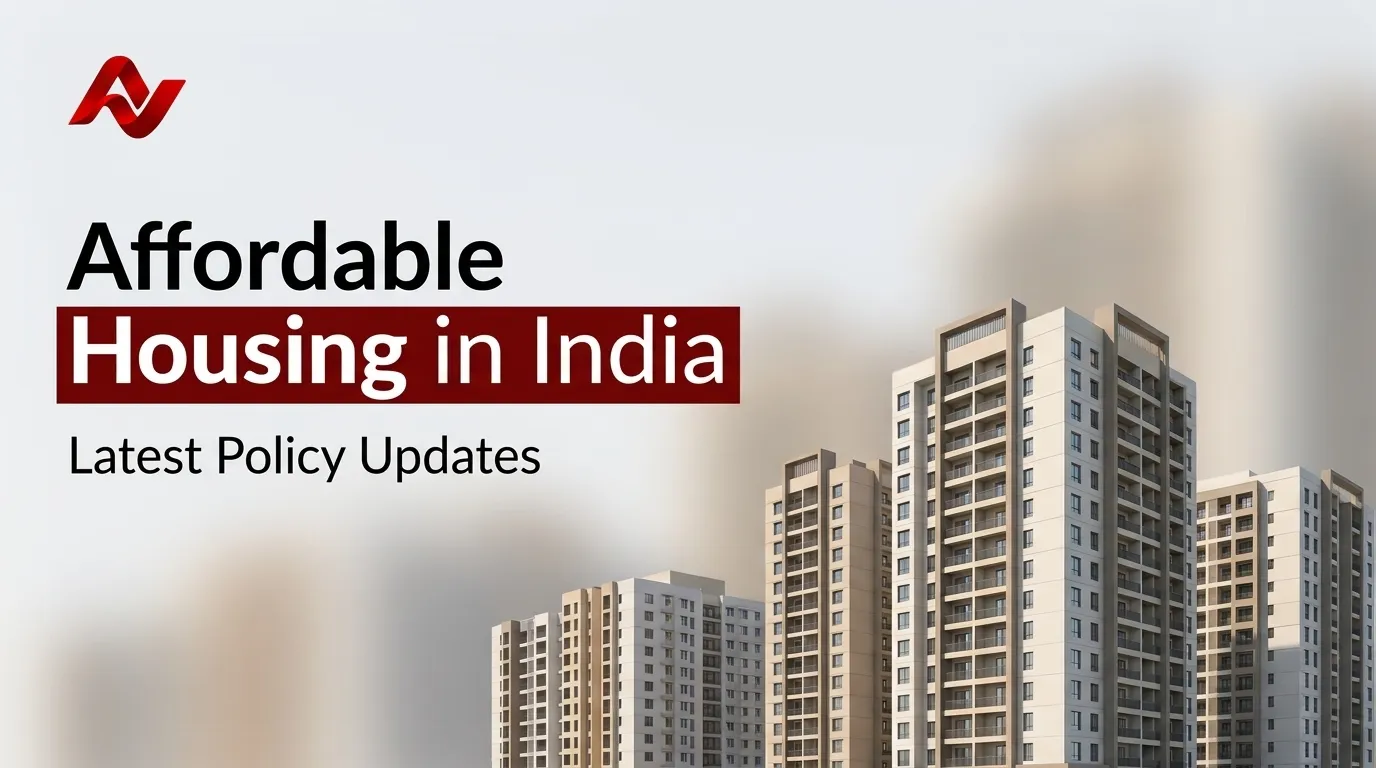
Affordable Housing Policies in India: Recent Updates Explained
Affordable housing has emerged as the cornerstone of India's real estate growth story, backed by aggressive government mandates and a vision to provide a roof for every citizen. For millions of middle-income families in cities like Mumbai, Delhi, and Bangalore, owning a home was once a distant dream, often sidelined by skyrocketing prices and inaccessible interest rates. However, the landscape is shifting. With the extension of the Pradhan Mantri Awas Yojana (PMAY) and new interest subvention schemes, the government is essentially putting money back into the buyer's pocket. If you are a first-time buyer today, you aren't just looking for a flat; you are navigating a complex grid of subsidies, tax rebates, and GST benefits that can collectively save you lakhs of rupees.
Here’s the thing: most buyers ignore the policy fine print and end up paying "market rates" for properties that actually qualify for government-backed savings. I’ve seen seasoned investors and first-time buyers in Gurgaon and Pune miss out on the CLSS (Credit Linked Subsidy Scheme) benefits simply because they didn't know the carpet area limits or income brackets had been updated. In this comprehensive guide, we will strip away the bureaucratic jargon to explain what the latest affordable housing policies mean for your home-buying journey. From PMAY 2.0 to the impact of the latest Union Budget, this is everything you need to know to make an informed, cost-effective decision.
Analysis Overview
- The Evolution of PMAY: Understanding PMAY 2.0
- Interest Subvention and CLSS: What's Currently Active?
- Tax Incentives: Sections 80EEA and 24(b) Decoded
- GST for Affordable Housing: The 1% Advantage
- State-Specific Shifts: MHADA, DDA, and Beyond
- Financial Impact: A ₹45 Lakh Home Case Study
- Affordable vs. Mid-Segment: Policy Comparison
- Pros and Cons of Buying under Housing Schemes
- Practical Tips for Eligibility and Application
- Common Mistakes Buyers Make with Subsidies
- Conclusion: The Final Verdict
- Frequently Asked Questions
The Evolution of PMAY: Understanding PMAY 2.0
The launch of PMAY-Urban 2.0 marks a significant shift in India’s housing policy, with a massive target to assist 1 crore urban poor and middle-class families in their quest for homeownership. Unlike its predecessor, which focused heavily on the Economically Weaker Sections (EWS), the 2.0 version is designed to be more inclusive of the Middle Income Group (MIG). The government has recognized that the urban middle class in cities like Mumbai and Bangalore faces a unique squeeze—earning too much for basic subsidies but not enough to bridge the gap in prime city locations. Most buyers ignore the fact that this new phase brings a revamped Interest Subsidy Scheme (ISS) aimed specifically at those buying or constructing houses in urban areas.
The policy now emphasizes "all-weather" housing, ensuring that construction quality meets global standards while maintaining affordability. For you, this means more developer participation in the affordable segment. For example, in many NCR sectors, we are seeing a surge in projects that are specifically designed to meet PMAY 2.0 criteria, offering better amenities than the "basic" affordable flats of the last decade. Relatable commentary: I once knew a buyer in Ahmedabad who hesitated to apply because he thought the process was too cumbersome. He later found out he was eligible for a ₹2.67 Lakh subsidy that he could have used to finish his interiors. Here’s the thing: PMAY isn't just for "low-cost" housing anymore; it’s a strategic tool for the urban middle class to enter the market.
Interest Subvention and CLSS: What's Currently Active?
The Credit Linked Subsidy Scheme (CLSS) remains the most powerful component of the affordable housing policy, offering an upfront subsidy on your home loan interest. Although the original CLSS timelines have faced various extensions and pivots, the core principle remains: reducing the "effective interest rate" for the borrower. For the EWS and LIG segments, the subsidy can be as high as 6.5%, which effectively brings down your 9% home loan to a mere 2.5% in terms of interest outgo. Most buyers make the mistake of thinking this is a "cashback" that arrives years later. In reality, it is a lump sum amount that the government pays to your bank, which immediately reduces your principal balance and monthly EMI.
For the MIG segment, while the guidelines are frequently updated based on the Union Budget, the focus is now on "interest subvention" through a refined portal. For instance, if you are buying a home where the carpet area is within the specified limits (up to 200 sq. m. for certain groups), you could still tap into significant interest savings. Relatable commentary: I’ve seen people in Hyderabad struggle with high EMIs, only to realize months later that they could have applied for a subsidy that would have reduced their loan burden by ₹2 Lakh. Here’s the thing: always check the latest operational guidelines with your bank's nodal officer before signing the loan agreement. Banks often don't advertise these schemes because they involve more paperwork, but for you, it’s literally free money from the government.
Tax Incentives: Sections 80EEA and 24(b) Decoded
The Indian Income Tax Act provides a dual benefit for affordable housing buyers, allowing them to claim deductions on both the interest and the principal component of their home loan. Under Section 24(b), every homeowner can claim a deduction of up to ₹2 Lakh on the interest paid. However, for those buying "affordable" homes (usually defined as properties with a stamp duty value of up to ₹45 Lakh), an additional deduction of ₹1.5 Lakh was introduced under Section 80EEA. While the sunset clause for this specific section has been a topic of debate in recent budgets, the existing beneficiaries continue to save a massive chunk of their taxable income. Most buyers ignore the "total cost of ownership" which includes these tax savings.
When you combine these sections with Section 80C (principal repayment), a family in the 30% tax bracket can effectively reduce their net EMI cost by nearly 20-30%. For example, if you are paying ₹5 Lakh in total annual loan repayments, your tax savings could be over ₹1 Lakh. This makes the "real" interest rate on your home loan much lower than the market rate. Relatable commentary: I spoke to a software engineer in Pune who was worried about a ₹40,000 EMI. Once we calculated his monthly tax savings, his "net outgo" was only ₹32,000—suddenly, the home became affordable. Here’s the thing: don't just look at the bank debit; look at your March salary slip. Affordable housing is as much a tax-saving strategy as it is an investment.
GST for Affordable Housing: The 1% Advantage
One of the biggest financial breakthroughs for affordable housing was the reduction of GST to a nominal 1%, compared to the 5% charged for mid-segment and luxury housing. This 4% difference might sound small, but on a ₹45 Lakh property, it amounts to a direct saving of ₹1.8 Lakh. For a middle-class buyer, that is the cost of their furniture or registration. The catch? The project must meet the definition of "affordable housing" set by the GST Council—which usually involves a combination of carpet area (60 sq. m. in metros and 90 sq. m. in non-metros) and a price cap of ₹45 Lakh. Most buyers ignore this limit and buy a property for ₹46 Lakh, unknowingly triggering the 5% GST bracket and losing nearly ₹2 Lakh in the process.
This policy has forced developers to be more disciplined with their pricing and unit sizing. In cities like Bangalore or Chennai, we see "Right-Sized" homes that are exactly 59.5 sq. m. to ensure the buyer gets the 1% GST benefit. Relatable commentary: I’ve seen buyers in Noida fight over a ₹50,000 discount with the builder, but they completely ignored the fact that their unit was 2 square meters too large to qualify for the 1% GST rate. Here’s the thing: the GST benefit is an "all-or-nothing" rule. If you exceed the carpet area or price limit even by a fraction, you pay the full rate. Always verify the RERA-registered carpet area before you commit to ensure you stay within the 1% zone.
State-Specific Shifts: MHADA, DDA, and Beyond
While central policies provide the framework, state housing boards like MHADA in Maharashtra and DDA in Delhi are the primary executors of affordable housing through lottery-based systems. These boards offer homes at rates that are often 20-40% lower than the prevailing market prices because they own the land. In recent years, these boards have modernized their processes, moving to 100% digital lotteries to eliminate middlemen. For a buyer in a hyper-expensive market like Mumbai, a MHADA flat in an area like Goregaon or Powai is like winning a financial lottery. Most buyers ignore these lotteries because they think "I'll never win," but with the recent increase in supply (like the 4000+ unit lotteries), the odds are better than ever.
In Delhi, the DDA has shifted from a "draw of lots" to a "first-come-first-served" model for many of its inventory-heavy projects in areas like Narela or Rohini. This has made it easier for people to walk in and buy an affordable home without the anxiety of a lottery. Relatable commentary: I once knew a family in Mumbai who stayed in a "chawl" for 15 years. They finally applied for a MHADA lottery and won a 1BHK in a high-rise. Their property value doubled the day they got possession. Here’s the thing: state housing schemes are the only way to get "clean" land titles at subsidized rates in Indian metros. Even if the construction quality is standard, the land value appreciation in these government-allotted societies is historically high. Keep an eye on state housing portal notifications every quarter.
Financial Impact: A ₹45 Lakh Home Case Study
To understand the actual math of affordable housing, let’s look at the financial breakdown of a ₹45 Lakh flat in a city like Pune or Greater Noida for a first-time buyer. This case study assumes the buyer qualifies for the PMAY subsidy and the 1% GST rate. Most people only see the sticker price; they don't see the nearly ₹5 Lakh in total savings provided by government policy.
Agreement Value: ₹45,00,000
GST (at 1%): ₹45,000 (Saves ₹1,80,000 vs. Standard)
PMAY Subsidy (Est.): ₹2,30,000 (Upfront reduction in loan)
Registration & Stamp Duty (6%): ₹2,70,000
Income Tax Savings (Year 1): ~₹80,000 (Combined benefits)
TOTAL EFFECTIVE COST (Net of first-year savings): ₹40,05,000
For example, the government policy essentially reduces your purchase price by nearly 11% before you even move in. Relatable commentary: I’ve seen families in Delhi-NCR who were looking at ₹55 Lakh homes and feeling stressed. When we moved their search to the "Affordable" ₹45 Lakh bracket, the combination of lower price and government subsidies made their EMI so comfortable that they could afford a better car in the same year. Here’s the thing: the ₹45 Lakh "Cap" is a psychological and financial boundary. If you stay under it, the government is your financial partner. If you go over it, you are on your own against market forces.
Affordable vs. Mid-Segment: Policy Comparison
Knowing the difference between an "Affordable" home and a "Mid-segment" home in the eyes of the law is the first step in financial planning. Use this table to decide which category fits your budget and which policy benefits you can claim. These are the current standard benchmarks used by banks and the GST council.
| Feature / Metric | Affordable Housing Unit | Mid-Segment Housing Unit |
|---|---|---|
| Price Cap | Up to ₹45 Lakh (Standard) | Above ₹45 Lakh |
| GST Rate | 1% (No ITC) | 5% (No ITC) |
| Carpet Area (Metros) | Up to 60 sq. m. (~645 sq. ft.) | No Limit |
| PMAY Eligibility | Highly Eligible (EWS/LIG/MIG) | Limited / No Subsidy |
| Sec 80EEA Benefit | Applicable (Extra ₹1.5L) | Not Applicable |
| Bank Interest Rates | Often lower (Priority sector) | Standard Market Rates |
Pros and Cons of Buying under Housing Schemes
The "Affordable Advantage" is clearly financial, but there are trade-offs in terms of location and flexibility that you must weigh carefully. Buying into a government-backed or affordable scheme is a strategic choice. In the Indian context, it’s often the best entry point, but it isn't without its limitations.
The Advantages
- Low Entry Barrier: With lower down-payments and GST, the upfront cash required is much lower.
- Capital Safety: Government-linked projects (DDA/MHADA) or RERA-registered affordable projects have a very low risk of title fraud.
- Priority Lending: Banks are mandated by the RBI to meet "Priority Sector Lending" targets, making them more eager to fund affordable home loans.
- High Appreciation: Because you buy at a subsidized rate, the percentage of growth when you sell is often much higher than luxury properties.
The Disadvantages
- Location Constraints: Affordable projects are often on the city outskirts where land is cheaper, increasing your commute time.
- Locked-in Periods: Some government schemes (like MHADA or PMAY) have a 5 to 10-year "No Sale" clause to prevent speculation.
- Standardized Amenities: You won't get Italian marble or infinity pools; the focus is on functional living.
- Lottery Risk: For the best deals (state boards), you depend on luck rather than just your bank balance.
Practical Tips for Eligibility and Application
The first thing you must do is check your "Household Income" definition, as this is the primary filter for all government subsidies. For PMAY, a household usually means a husband, wife, and unmarried children. If you already own a pucca house anywhere in India in your name, you are disqualified from most subsidies. However, there is a loophole: an adult earning member of the family can be treated as a separate household, even if they live with their parents. Most buyers ignore this and miss out. Relatable commentary: I once helped a 25-year-old IT professional in Bangalore apply for PMAY in his own name while his father owned a house in their village. He got the ₹2.3 Lakh subsidy because he was an independent taxpayer. Verification is your superpower.
Another practical tip: Check the "RERA Project Type." Only projects registered as "Affordable" under specific state policies get the 1% GST benefit. Ask the builder for the "Certificate of Eligibility" for GST. Also, don't wait for the project to be 100% complete. The PMAY subsidy is disbursed in stages for self-construction or linked to the construction of the builder. Here’s the thing: the bank applies for the subsidy on your behalf. If your bank is slow, your subsidy might get stuck in the pipeline. Choose a "Nationalized Bank" (like SBI or PNB) or a major HFC (like HDFC or LIC Housing Finance) as they have the most streamlined portals for government subsidy tracking. Efficiency in documentation is more important than the housewarming party planning.
Common Mistakes Buyers Make with Subsidies
The most expensive mistake is misreporting your "Carpet Area," as even a few extra square inches can move your project from 1% to 5% GST. I’ve seen hundreds of buyers purchase flats that were 61 sq. m. because they liked the "extra balcony space," only to realize they now have to pay ₹2 Lakh extra in GST. Another blunder is ignoring the "Interest Rate Reset" after the subsidy. When the government pays the ₹2.3 Lakh to your bank, your principal drops, but your bank might not automatically reduce your EMI. You have to physically visit the bank and ask them to "Recalculate EMI" based on the lower principal. Most buyers keep paying the same EMI, effectively shortening their tenure—which is good, but doesn't help their monthly cash flow.
Don't fall for "Fake PMAY Registration" promises by local builders. Some small developers use the PMAY logo on their banners to lure buyers, even if the project isn't approved. Always check the official PMAY-U portal or the state RERA website. Also, don't ignore the "Income Certificate" requirements. If you are in the MIG category, your income documents must be consistent across your ITR, bank statements, and PMAY application. Relatable commentary: I once knew a family who missed the subsidy because their ITR showed ₹18,05,000 annual income, just ₹5,000 over the MIG-II limit of ₹18 Lakh! Here’s the thing: precise financial reporting is the key to unlocking government benefits. If you are near a bracket limit, talk to your CA before applying for the loan.
Conclusion: The Final Verdict
Affordable housing policies in India are currently at their most "buyer-friendly" phase, and for a middle-class family, there has never been a better time to transition from renting to owning. The combination of the 1% GST, the PMAY 2.0 interest subvention, and the high competition among developers in this segment has created a "Perfect Storm" of affordability. However, you must move with caution. Real estate is a long-term play, and while the subsidies are a great "Welcome Kit," the location and the quality of the project will determine your happiness over the next 20 years. The best strategy is to find a project that is priced around ₹45 Lakh, has a clear RERA record, and is within 45 minutes of your workplace.
My final piece of advice? Don't let the "Affordable" tag make you complacent about quality. Visit the site, check the construction materials, and talk to people who have already moved into the builder's previous projects. Subsidies are temporary, but a home is permanent. Stay informed about the latest policy updates from the Union Budget and state housing boards. Real estate in India is evolving, and the "Social Contract" between the government and the homeowner is getting stronger. Take that step, lock in your future, and let the policies work for you. Happy house hunting!
Frequently Asked Questions
Tags
Tags
Top 5 Best Properties in Delhi NCR This Week
Handpicked properties with best price & location
Popular in Greater Noida
Top-rated residential & commercial projects across Greater Noida