
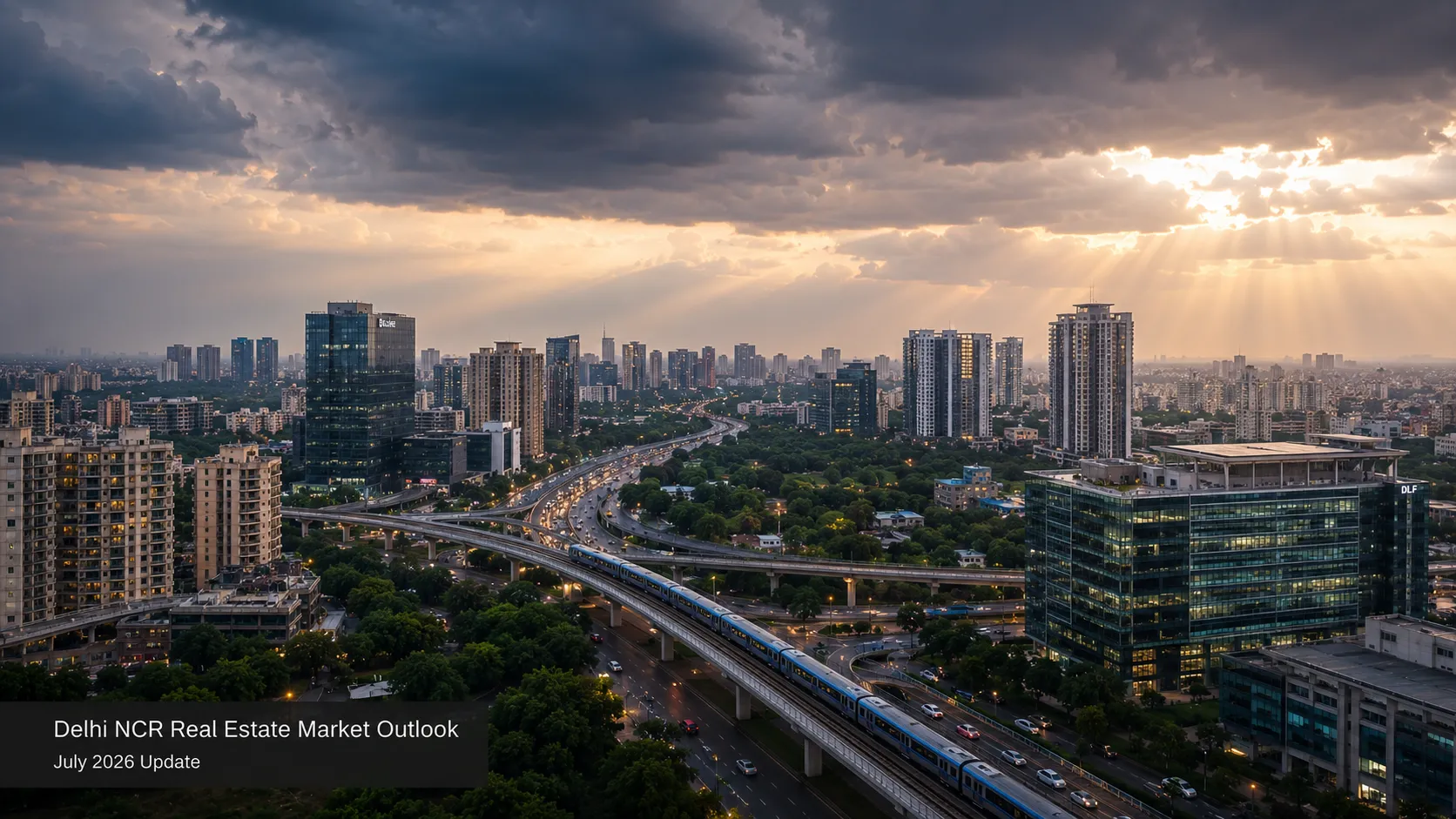
Delhi NCR Real Estate Market Outlook: July 2026 Update
Categories
- Tips
- Guides
- Market Insights
- Articles
Recent Posts

Tips / 28 Sept 2026
How to Check Whether a Plot of Land Is Legally Safe to Buy

Guides / 28 Sept 2026
How to Calculate Rental Yield: Formula and Worked Examples

Guides / 26 Sept 2026
How Much Home Loan Can You Get on Your Salary in 2026?

Guides / 25 Sept 2026
10 Things to Check in a Property Sale Deed Before Registration
NCR sales fell 7% in H1 2026, yet Delhi and Faridabad prices climbed 18% year on year. Here's the city-by-city breakdown of what's actually driving the market, and what it means if you're buying in the second half of the year.
Two things are true about Delhi NCR real estate right now, and they seem to contradict each other. Sales volumes across the region fell roughly 7% in the first half of 2026. And in the same window, prices in Delhi and Faridabad climbed 18% year on year, among the sharpest gains of any major Indian city. That combination, fewer transactions but stronger prices, tells you more about where this market actually stands than either number does on its own.
This isn't a market that's cooling. It's a market that's getting more selective, both in what buyers are willing to pay for and where developers are willing to build. Here's what the mid-2026 data actually shows, city by city, and what it means if you're weighing a purchase in the second half of the year.
Table of Contents
- The Headline Numbers From H1 2026
- Why Did Sales Slow While Prices Kept Rising?
- City by City: Delhi, Gurugram, Noida, Faridabad
- Is Delhi NCR Actually Getting More Affordable?
- Infrastructure Is Still Doing the Heavy Lifting
- The Shift Toward Branded Developers
- What This Means If You're Buying in H2 2026
- The Bottom Line
The Headline Numbers From H1 2026
Start with the numbers that matter most. Knight Frank's H1 2026 data, covered in a BusinessToday report published this month, puts NCR residential sales down about 7% for the first half of the year compared to the same period last year. Inventory overhang has built up in pockets of the market, and developers have responded with construction-linked plans, subvention schemes, and in some cases stamp duty waivers to keep absorption moving.
Yet pricing tells a different story entirely. Delhi recorded average residential prices of roughly ₹26,027 per sq. ft., with Delhi and Faridabad both posting 18% year-on-year price growth, the strongest of any major Indian metro in that data set. Gurugram came in at an average of ₹18,354 per sq. ft. Noida posted more moderate 8% year-on-year growth in the same period, a healthier but less dramatic trajectory than its neighbours.
Why Did Sales Slow While Prices Kept Rising?
This is the part that trips people up. A market where fewer homes are selling but prices are still climbing usually means one thing: buyers haven't disappeared, they've become choosier, and sellers of the right inventory haven't needed to negotiate.
Part of this is a pause in interest rate movement making financing decisions feel less urgent for some buyers, who are waiting rather than rushing. Part of it is genuine supply-side pressure, certain segments and locations have more inventory than current demand can absorb, which is exactly why developers are leaning on payment plans and incentives rather than list-price cuts. The properties that keep commanding premium prices tend to be the ones with clear differentiators: established addresses, branded developers, or a genuine infrastructure story behind them. Everything else is where the slowdown shows up first.
City by City: Delhi, Gurugram, Noida, Faridabad
Delhi posted the strongest price growth in the region at 18% year on year, driven largely by scarcity in established, well-connected pockets where new supply is structurally limited. At roughly ₹26,027 per sq. ft. on average, it remains the most expensive market in NCR.
Gurugram has had a remarkable run. Premium micro-markets rose almost 160% between 2019 and 2024, touching around ₹19,500 per sq. ft. in top corridors, per CBRE's India Residential Market Outlook 2026 covered by The Tribune. 2026 growth has moderated to a more sustainable pace, with CBRE projecting household income growth finally catching up to property price appreciation for the first time since the post-pandemic boom.
Noida posted 8% year-on-year growth, the steadiest and least volatile number among NCR's major markets. That steadiness reflects a broader base of end-user demand rather than pure speculative buying, and it's consistent with the sector-level appreciation seen along the Expressway and Extension corridors through the rest of 2026.
Faridabad matched Delhi's 18% growth, a genuinely notable move for a market that has historically traded at a discount to its NCR peers. Improved connectivity and comparatively lower entry prices appear to be pulling in buyers priced out of Gurugram and Delhi proper.
Is Delhi NCR Actually Getting More Affordable?
Here's a genuinely encouraging data point buried in the CBRE outlook: for the first time since prices took off post-pandemic, household income growth in Delhi NCR is projected to outpace property price appreciation in 2026. That doesn't mean prices are falling. It means the gap between what people earn and what homes cost is narrowing, rather than stretching further apart.
This matters most for Gurugram, which saw some of the steepest price escalation in the country over the last five years. A stabilising affordability picture there, combined with continued infrastructure investment, is one reason CBRE expects sustained end-user demand across both mid and premium segments rather than a speculative pullback.
Infrastructure Is Still Doing the Heavy Lifting
Every major analysis of NCR real estate in 2026 comes back to the same theme: infrastructure is the real driver, not sentiment. The Dwarka Expressway, Noida International Airport at Jewar, the Delhi-Mumbai Expressway, the Regional Rapid Transit System, the Sohna corridor, and ongoing metro network expansion are collectively reshaping which locations count as "well-connected" and which don't.
That reshaping is exactly why previously peripheral locations are pulling in serious end-user and investor interest that simply wasn't there five years ago. A location's price trajectory in NCR right now correlates more closely with its infrastructure timeline than with almost any other single factor.
The Shift Toward Branded Developers
One structural change worth flagging: NCR's residential market is consolidating around trusted, national developers faster than most buyers realise. Between 2022 and Q1 2026, leading national developers launched more than 15,000 residential units across the region. Godrej Properties alone accounted for roughly 47% of NCR's national-developer launch share in that window, followed by Prestige Group at 27% and Sobha at 10%.
The reason isn't hard to guess: buyers who've lived through years of delayed possessions and RERA disputes are now paying a premium for governance, delivery track record, and construction quality, not just location. If you're evaluating a new-launch project anywhere in NCR right now, the developer's delivery history matters as much as the price per square foot.
What This Means If You're Buying in H2 2026
If you're an end-user, the softer sales volume actually works in your favour. Developers offering flexible payment plans and incentives to move inventory means more room to negotiate than the headline price growth numbers suggest, particularly outside the tightest, most established micro-markets.
If you're an investor, the divergence between Delhi and Faridabad's sharp 18% gains and Noida's steadier 8% is worth sitting with. Faster-appreciating markets can mean you've already missed the easiest entry point; steadier markets like Noida often still have room to run as infrastructure projects mature, particularly in corridors near Jewar Airport and expanding metro lines.
The Bottom Line
Delhi NCR's mid-2026 real estate market isn't slowing down so much as it's sorting itself out. Buyers are being more selective, developers are competing harder on delivery and incentives rather than price cuts, and the properties backed by genuine infrastructure and trusted builders are the ones still commanding premium growth. Affordability is quietly improving even as headline prices in Delhi and Faridabad post some of the sharpest gains in the country, and that combination is unusual enough to be worth watching closely through the rest of the year.
Trying to figure out which NCR micro-market fits your budget and timeline in the second half of 2026? Speak with a local expert who tracks these numbers city by city, not just at the regional headline level. #PropertyKaDNA
Tags
Tags
Frequently Asked Questions
About the Author
Admin
Top 5 Best Properties in Delhi NCR This Week
Handpicked properties with best price & location
Popular in Greater Noida
Top-rated residential & commercial projects across Greater Noida