
Developed vs Emerging Localities: Where Should You Invest?
Developed vs Emerging Localities: Where Should You Invest?
Categories
- Articles
- Market Insights
- News
Recent Posts

Articles / 07 Sept 2026
How to Check Property Registry Online in UP (Free)

Market Insights / 04 Sept 2026
Noida Circle Rates 2026: Sector-Wise Complete List

Market Insights / 02 Sept 2026
Best Home Loan Rates in India 2026: Full Comparison

Articles / 01 Sept 2026
Free Property Verification: Check Before You Invest
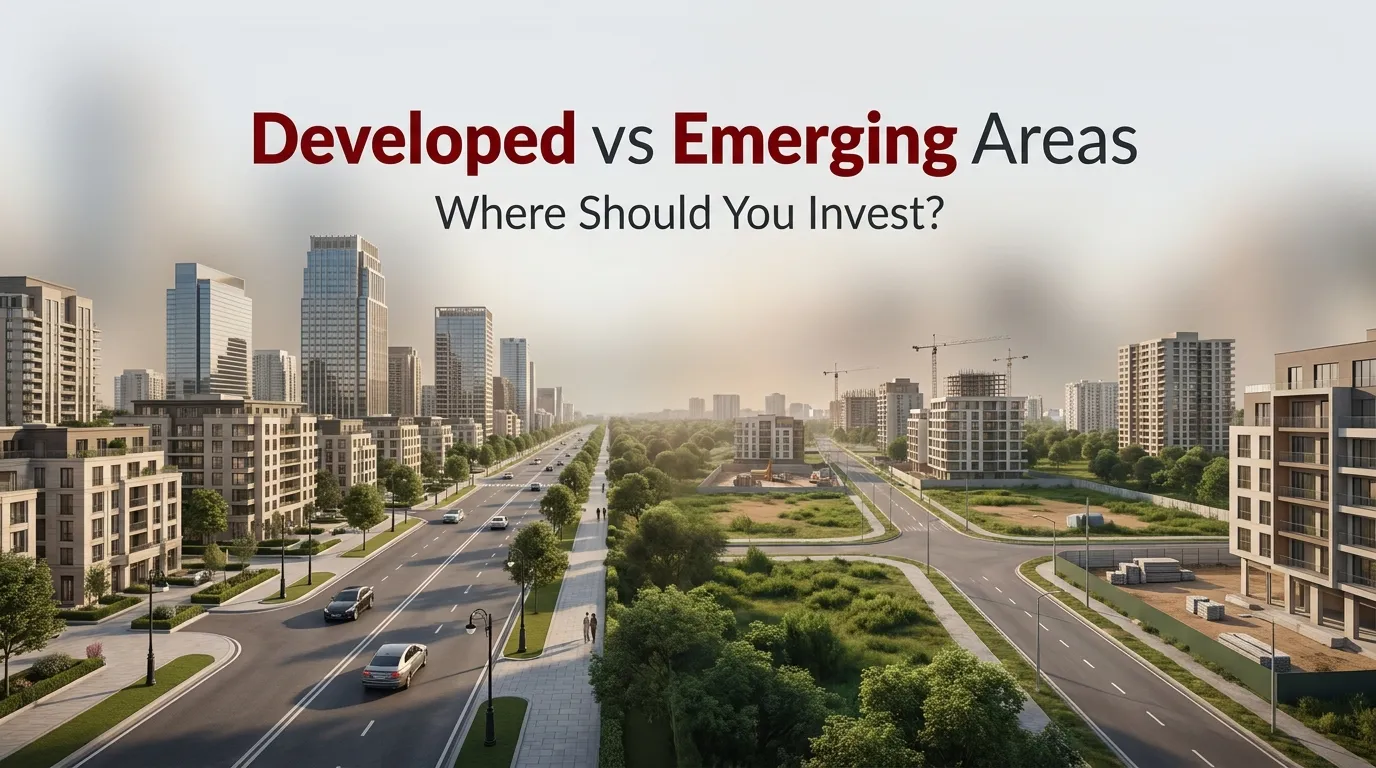
Stuck between the safety of a posh city center and the high-growth potential of the outskirts? We break down the math of Developed vs. Emerging localities to help you decide where to invest your hard-earned money for the best returns.
Developed vs Emerging Localities: Where Should You Invest?
Choosing between a developed locality and an emerging hub is the ultimate crossroads for any real estate investor in India. If you’ve ever scouted for property in Delhi, Mumbai, or Bangalore, you know the drill. On one hand, you have the posh, tree-lined streets of South Delhi or South Mumbai where everything is "settled." On the other, you have the dusty, construction-heavy stretches of the Dwarka Expressway or New Gurgaon that promise "exponential growth." For most buyers, the heart pulls toward the comfort of an established area, but the wallet screams for the potential returns of an emerging one. The reality is that there’s no "one size fits all" answer—your choice depends entirely on whether you value immediate peace of mind or future wealth creation.
I’ve seen many investors dump ₹2 Crore into an old apartment in a prime locality only to see the prices stagnate for a decade. At the same time, I’ve seen people buy plots in the middle of nowhere, hoping for a metro line that never shows up. You’ll need to understand the "lifecycle" of a locality before you sign that cheque. Here’s the thing: real estate isn't just about buying four walls; it’s about buying into the surrounding ecosystem. If the ecosystem is already perfect, you’re paying a premium for it. If it’s still being built, you’re taking a risk on its completion. Let’s dive deep into the mechanics of both so you can decide which path fits your financial goals.
Table of Contents
- The Safety of Developed Pockets: Low Risk, Mature Rewards
- Emerging Zones: Decoding the Infrastructure Arbitrage
- Rental Yield vs. Capital Gains: Picking Your Financial Goal
- Lifestyle Trade-offs: Buzz vs. Construction Dust
- The "Second-Inning" of Developed Areas: Redevelopment Power
- Connectivity as a Catalyst: The Metro and Highway Effect
- Financial Impact Analysis: A ₹1.5 Crore Case Study
- Comparison: Developed vs. Emerging Metrics
- Advantages and Disadvantages of Each Path
- Practical Tips for Your Next Investment
- Common Mistakes Buyers Make in Timing the Market
- Conclusion: The Final Verdict
- Frequently Asked Questions
The Safety of Developed Pockets: Low Risk, Mature Rewards
Established areas offer the "What You See is What You Get" advantage, providing immediate access to top-tier social infrastructure. Think of localities like Indiranagar in Bangalore, Powai in Mumbai, or Greater Kailash in Delhi. When you move here, you aren't waiting for the roads to be built or the water lines to be laid. The schools are already ranked, the hospitals have been functional for years, and the neighborhood high streets are packed with your favorite cafes. For an end-user who needs to move in tomorrow, these areas are unbeatable. Most buyers ignore the fact that they are paying a heavy "convenience premium" for this stability, but for a family with kids or elderly parents, it's often worth every rupee.
However, these areas come with a "saturation ceiling." Since the land is already developed and utilized, there’s very little room for new large-scale projects. This means the supply is restricted, which keeps the prices high, but it also means the appreciation tends to be slow and steady—often just keeping pace with inflation. For example, if you buy in an old building in a prime city center, your main hope for a big jump in value is a "redevelopment" deal. Otherwise, you’re basically looking at a safe, low-yield asset. Here’s the thing: you aren't investing for 2x returns here; you’re investing for safety and lifestyle stability.
Emerging Zones: Decoding the Infrastructure Arbitrage
Emerging localities are the playgrounds of wealth creators who are willing to bet on the future for massive capital gains. Localities like Sohna in Gurgaon, Electronic City Phase 2 in Bangalore, or the Navi Mumbai Airport corridor fall into this category. These areas usually start with a "Catalyst"—a major infrastructure project like a new airport, a highway, or a tech park. When you buy here, you’re buying into the "Infrastructure Arbitrage" theory. You buy at ₹5,000 per sq. ft. because the road is broken, knowing it will reach ₹12,000 per sq. ft. once the expressway opens. Most people don't have the patience for this, but those who do often see their wealth multiply in a few years.
But let’s be honest: living in an emerging area is tough for the first 3-5 years. You’ll be dealing with construction dust, erratic water supply, and a lack of nearby grocery stores. You might have a 5-star apartment complex, but the moment you step outside the gate, it looks like a rural village. For example, many people who bought in Noida Extension a decade ago had to wait years before the metro and malls actually made the area livable. If you’re a pure investor, this doesn't matter much. But if you’re planning to live there yourself, you need to calculate the "Inconvenience Cost" of your daily commute and basic chores. Most buyers ignore this and end up frustrated.
Rental Yield vs. Capital Gains: Picking Your Financial Goal
Rental yields in India are notoriously low, but developed areas consistently offer more stability and higher occupancy rates. If you own a property in a central business district or a prime residential area, you’ll never struggle to find a tenant. The demand is always high from professionals who want to save time on commuting. In cities like Mumbai or Bangalore, the rental yield in developed areas hovers around 2.5% to 3.5%. While that doesn't sound like much, the "Zero Vacancy" risk makes it a very attractive option for those seeking a steady monthly income. You don't have to worry about the flat lying empty for six months.
In emerging hubs, the rental game is a "Hit or Miss" during the first few years of the locality's development. Often, because many investors buy properties in these areas at the same time, there is a sudden glut of supply. For example, if 10,000 apartments are delivered in a new sector in Gurgaon, the rents will initially be very low because everyone is competing for the same few tenants. You might get a 1.5% yield if you’re lucky. However, once the office spaces nearby become operational, the yields can jump significantly. For instance, the rents in Whitefield (Bangalore) were low for years until the IT parks were fully occupied. Now, it's one of the hottest rental markets. You just have to time your entry right.
Lifestyle Trade-offs: Buzz vs. Construction Dust
Living in a developed area means you’re part of the city’s soul, while emerging areas offer a "planned" but often sterile lifestyle. When you live in an established area, the park you walk in has 20-year-old trees. The milkman knows your name, and there’s a sense of community. But you also deal with narrow roads, parking fights, and old sewage systems that might overflow during the monsoons. I once knew a buyer who moved to a posh old colony for the "vibe" but spent every morning fighting with neighbors over 2 inches of parking space. The glamour of the address fades quickly when you can't park your own car without an argument.
Emerging areas offer "Gated Community Luxury" with wide roads and modern safety features. You’ll have wide internal roads, massive clubhouses, swimming pools, and dedicated parking for your guests. Everything is designed for the modern car-owning Indian family. But the moment you drive out of the gate, you might be surrounded by empty plots and dusty trucks. Most buyers find this isolating. For example, if you want a cup of coffee at 10 PM, in a developed area, you walk 200 meters. In an emerging area, you drive 5 kilometers to the nearest functional mall. You’ll have to decide if you want the "soul" of the city or the "amenities" of a high-rise complex.
The "Second-Inning" of Developed Areas: Redevelopment Power
The real "hidden gem" of developed areas is the potential for redevelopment, which can provide a massive windfall to existing owners. In older city centers like Mumbai or Delhi, many buildings are 40-50 years old. When a developer takes over such a project, they often offer existing owners a brand-new, larger flat along with a significant cash payout or "rent compensation" during the construction period. This is the only way a property in a developed area can suddenly give you 100% returns in 3 years. Most buyers ignore old buildings because they look "shabby," but smart investors look at the "land-to-floor-ratio" (UDS) and the FSI available for that plot.
Here’s the thing: redevelopment is a game of patience and legal hurdles. If even one neighbor objects, the project can be stalled for years. For example, in South Mumbai, there are thousands of buildings stuck in redevelopment limbo. If you are buying an old property for this reason, ensure the society has already signed a "Development Agreement" with a reputable builder. If you buy in a "potential" redevelopment building without any paperwork, you might just be buying an old house that stays old forever. But when it works, it’s like hitting the real estate jackpot without moving an inch from your prime address.
Connectivity as a Catalyst: The Metro and Highway Effect
Connectivity is the single most important factor that turns an emerging area into a developed one. In Indian metros, the distance is measured in "minutes," not "kilometers." A locality 20km away is fine if it’s connected by a high-speed metro or a 6-lane expressway. I’ve seen areas in North Bangalore jump in value by 40% just after the Airport Road was finalized. This is where the "Timing" comes in. If you buy after the metro is already running, you’ve missed the boat. You should buy when you see the pillars being cast. Most buyers are too scared to buy when the area looks like a construction zone, but that’s exactly when the prices are lowest.
For example, let's look at the Dwarka Expressway. People who bought there in 2015-16 were mocked because there were no roads. Today, those same properties are commanding double the price because the highway is functional and the connectivity to Gurgaon and Delhi is seamless. Relatable commentary: I once spoke to a buyer who was waiting for the "bus stop" to come to his new flat. I told him, "Bhai, by the time the bus comes, the price will go up by ₹20 Lakh. Buy the flat now, and use an Uber for two years." Real estate rewards those who can see the future through the dust of the present.
Financial Impact Analysis: A ₹1.5 Crore Case Study
To understand the real impact, let's look at the math of a ₹1.5 Crore investment in both scenarios over a 10-year horizon. This assumes you are an investor looking for the best total return on investment (ROI).
Scenario A: Developed Locality
Your ₹1.5 Crore gets you a 2BHK in a prime area.
* Capital Appreciation: ~6% CAGR. After 10 years, the property is worth ₹2.68 Crore.
* Rental Income: ₹45,000/month (starting). Assuming 5% annual increase, you collect ~₹68 Lakh in rent.
* Total Wealth: ₹3.36 Crore.
Scenario B: Emerging Locality
Your ₹1.5 Crore gets you a premium 3BHK or a villa in an emerging zone.
* Capital Appreciation: ~12% CAGR (due to infrastructure completion). After 10 years, the property is worth ₹4.65 Crore.
* Rental Income: ₹25,000/month (starting). Slower growth initially, you collect ~₹40 Lakh in rent.
* Total Wealth: ₹5.05 Crore.
As you can see, the emerging locality built **₹1.69 Crore more wealth**! However, you had to deal with more construction noise and fewer schools nearby for the first few years. For an investor, Scenario B is the clear winner. For someone wanting to raise kids today, Scenario A is the better life choice.
Comparison: Developed vs. Emerging Metrics
Use this table to quickly identify where your priorities lie. Every investor has a different "DNA," and these metrics help you align with yours.
| Feature | Developed Locality | Emerging Locality |
|---|---|---|
| Primary Goal | Safety, Stability & Lifestyle | Wealth Creation & High Growth |
| Entry Price | High (Premium for infra) | Moderate (Value for money) |
| Capital Gains | Slow & Steady (6-8% avg) | High Potential (12-18%+) |
| Rental Demand | High & Immediate | Developing (Wait 3-5 years) |
| Social Life | Vibrant (Cafes, Malls ready) | Planned (Gated luxury) |
| Risk Profile | Very Low | Moderate (Completion risk) |
| Infrastructure | Established / Crowded | Under-construction / Wide roads |
Advantages and Disadvantages of Each Path
Every location has its own set of "non-negotiable" flaws and hidden benefits. Here is a summary of what you are really signing up for in both scenarios.
Developed Localities Pros
- Time Savings: You get back 2 hours of your life every day by living near work.
- High Liquidity: If you need to sell, you'll find a buyer in weeks, not months.
- Proven Appreciation: The area has a history of holding value even during market crashes.
Developed Localities Cons
- Pricey Entry: You get much less space (sq. ft.) for the same amount of money.
- Congestion: Dealing with old-city problems like traffic and noise daily.
Emerging Localities Pros
- Massive Growth: High ROI potential as the area matures and populates.
- Modern Amenities: You live in a new-age building with smart features and automation.
- Space: You can afford a 3BHK or a Study room which is a luxury in the city center.
Emerging Localities Cons
- Wait Time: You might have to wait years for a simple grocery store to open nearby.
- Legal Risk: Higher chances of project delays or land title issues.
Practical Tips for Your Next Investment
The "3-Mile Rule" is your best friend when investing in an emerging hub. Buy a property within a 3-mile (approx 5km) radius of an existing commercial hub or a major corporate park. For example, if you are buying in an emerging part of Hyderabad, ensure it is within 5km of Gachibowli or HITEC City. People will only move to a new area if it doesn't add more than 20 minutes to their existing commute. Don't go too far into the "wild west" where there is no corporate activity. Most people buy "cheap" land 30km away, only to find no one wants to rent it even after 10 years.
Another tip: Check the "Occupancy Ratio" of the neighborhood. Visit the area at 8 PM. If you see lights in the windows of at least 60% of the surrounding buildings, the area is "mature emerging" and safe to buy. If the buildings look like dark ghosts, the area is still "early emerging" and carries higher risk. Also, always check the water supply source. In many new areas of Bangalore or Gurgaon, societies depend 100% on water tankers. This is a massive recurring cost and a red flag for long-term sustainability. Always prioritize areas with municipal water commitments.
Common Mistakes Buyers Make in Timing the Market
The biggest blunder is buying in a "Dead Emerging" area where the infrastructure projects have been stalled for years. Many people bought in areas like the Yamuna Expressway (near Noida) years ago, expecting a boom. While things are moving now, for 10 years, that capital was dead. You could have earned more in a simple FD. Don't buy based on a brochure that says "Future Airport." Buy when you see the boundary wall of the airport being built. Most buyers ignore the time-value of money. A 100% gain in 15 years is actually a very poor return when you account for inflation.
Another mistake is buying in a developed area that is "In Decline." Just because a locality was posh in 1995 doesn't mean it’s great today. Check for crumbling infrastructure, frequent water-logging, or a shift in commercial activity. For instance, some old central business districts in cities like Kolkata or Chennai have seen a massive exodus of companies to newer hubs. If the companies leave, the rentals drop. Don't be emotional about the "legacy" of an area. Real estate is a numbers game. If the area is getting congested and dirty, it’s time to look elsewhere. Relatable commentary: I've seen people buy "heritage" areas only to realize they can't even get a Zomato delivery easily because of the narrow lanes.
Conclusion: The Final Verdict
The "Right" investment depends on whether you are buying for a home or for a profit. If you are a first-time homebuyer with a family, my advice is to stick to a developed area or a "mature emerging" hub. You don't want your children to grow up in a construction site. The peace of mind and immediate access to schools is worth the slower appreciation. You don't want to spend your best years fighting for water tankers or driving 45 minutes for a loaf of bread. A home is where you live, not just an entry in your portfolio.
However, if you already have a roof over your head and are looking to build a corpus for retirement or your kid's foreign education, head straight for the emerging localities. Do your due diligence, pick a reputable builder, and look for the infrastructure catalysts. Be patient for 5-7 years and let the city grow towards you. In the world of real estate, the patient bird doesn't just get the worm; it gets the whole garden. Take your time, do the field-checks, and don't trust the brochures blindly. Happy investing!
Frequently Asked Questions
Tags
Tags
Top 5 Best Properties in Delhi NCR This Week
Handpicked properties with best price & location
Popular in Greater Noida
Top-rated residential & commercial projects across Greater Noida