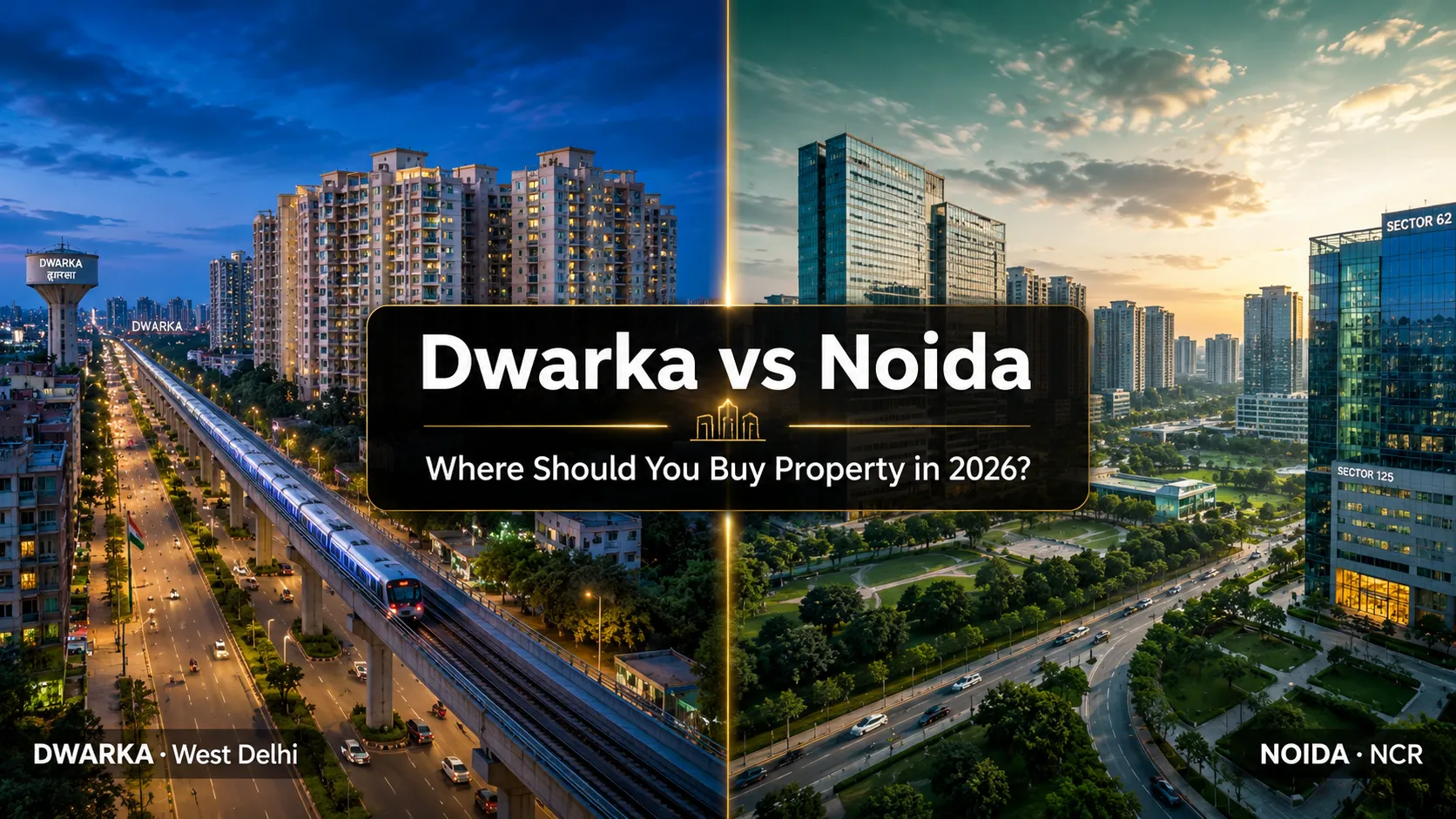
Dwarka vs Noida: Where Should You Buy Property in 2026?
Categories
- News
- Market Insights
- Tips
Recent Posts

News / 22 Sept 2026
New Noida Land Acquisition 2026: List of 37 Villages in Phase 1

Market Insights / 21 Sept 2026
Registry Charges in Delhi 2026: Full Rate Table & Guide

News / 21 Sept 2026
8 Best Property Hotspots in NCR: Where to Actually Buy

Market Insights / 19 Sept 2026
Cost Inflation Index 2026: Full Table and How to Apply It
Dwarka or Noida — which is the smarter property buy in 2026? An honest, locality-by-locality comparison to help you decide based on budget, commute, and lifestyle.
This is probably the most common comparison I hear from buyers in Delhi NCR right now. Someone has a budget — let's say ₹60 to ₹80 lakhs — and two strong options on the table. A resale flat in Dwarka. Or a new project in Noida. Both are well-connected. Both have metro access. Both have functional social infrastructure. So which one actually makes more sense in 2026?
The honest answer is: it depends on who you are and what you're optimising for. But that's not a cop-out — it's genuinely the most useful framing for this decision, because Dwarka and Noida serve different buyer profiles better. Getting this right saves you from buying the wrong thing for your specific situation, which is a mistake that takes ten years and a lot of EMIs to recover from.
Let's compare them properly.
Table of Contents
- The Basic Profile of Each Market
- Connectivity: Closer Than It Looks on a Map
- Property Prices: What Your Budget Actually Gets You
- Real-World Scenario: Same Budget, Very Different Outcomes
- Investment Potential: Which One Grows Better
- Social Infrastructure: Dwarka Has the Edge, But Not by as Much as You'd Think
- Two Mistakes Buyers Make in This Comparison
- So Where Should You Actually Buy in 2026?
- The Bottom Line
The Basic Profile of Each Market
Before getting into specifics, it helps to understand what each location actually is in 2026.
Dwarka is a mature, planned sub-city within Delhi, developed by DDA across 29 sectors. It's been largely built out for over two decades now. The infrastructure is established — schools, hospitals, markets, metro connectivity — and the residential character is settled and stable. What you're buying in Dwarka is almost always resale or secondary market inventory. New launches are rare because the land is simply not available.
Noida is a planned industrial and residential city in Uttar Pradesh, under the Noida Authority. Unlike Dwarka, it has active new development across multiple sectors — from established zones like Sector 62 and Sector 93 to newer corridors like Sector 150 and the Greater Noida West belt. You can buy resale, under-construction, or ready-to-move across a wide range of price points.
That structural difference matters more than most buyers initially realise.
Connectivity: Closer Than It Looks on a Map
Both locations are well-served by the Delhi Metro. Dwarka has the Blue Line running through it, with multiple stations from Dwarka Sector 21 all the way to Dwarka Mor — connecting directly to Rajiv Chowk, Connaught Place, and onward to east Delhi and Noida. The Blue Line also terminates at Dwarka Sector 21, which connects to the Airport Express Line.
Noida is served by the Blue Line as well — Noida City Centre, Sector 62, Electronic City — and the Aqua Line connects Noida to Greater Noida. Road connectivity via the Noida Expressway, DND Flyway, and NH-9 gives Noida strong access to Delhi, Gurugram via the ring road, and Greater Noida.
For someone working in central Delhi — the Connaught Place, Kasturba Gandhi Marg, or Barakhamba Road belt — Dwarka has a meaningful commute advantage. You're inside Delhi, on a direct metro line, without crossing a state border.
For someone working in Noida, Greater Noida, or along the expressway corridor, the equation flips completely. Buying in Dwarka and commuting to Sector 62 daily is a significant time commitment. Noida makes obvious sense.
The commute question should be the first filter you apply, not the last.
Property Prices: What Your Budget Actually Gets You
This is where the comparison gets interesting.
In Dwarka in 2026, a 3 BHK in a DDA or society flat typically ranges from ₹90 lakhs to ₹1.5 crore depending on the sector, floor, and condition. The ₹60 to ₹80 lakh range gets you a 2 BHK in most sectors, often in an older building that may need renovation on top of the purchase price.
In Noida, the same ₹60 to ₹80 lakh budget gets you considerably more in terms of square footage — often a 2 BHK or even a 3 BHK in a gated society with a clubhouse, pool, gym, and covered parking. In sectors like Sector 137 or Sector 150 along the expressway, this budget lands you in a properly maintained, well-amenitised apartment. In more established sectors like Sector 62, you're looking at 2 BHK options with a better location premium.
The per-square-foot gap between Dwarka and comparable Noida sectors is roughly 20% to 35%, depending on micro-location. That's real money — and for many buyers, it's the difference between stretching uncomfortably and buying confidently within their means.
Real-World Scenario: Same Budget, Very Different Outcomes
Consider a couple in their early thirties — both working professionals, one in Connaught Place, one working remotely. Budget: ₹75 lakhs.
In Dwarka Sector 6, that budget gets them a 2 BHK in a DDA flat — around 900 sq ft, decent location, established neighbourhood, direct Blue Line metro access. The flat needs some renovation. Maintenance is managed by the RWA.
In Noida Sector 137, the same ₹75 lakhs gets them a 2 BHK in a gated high-rise society — around 1,150 sq ft, clubhouse, pool, covered parking, 24x7 security. The expressway is minutes away.
In this specific case, Noida is probably the smarter buy. The remote-working spouse has no fixed commute to factor in. The Connaught Place commuter faces a longer metro journey from Noida — but gains 250 sq ft of living space, modern amenities, and a better apartment overall. That's a trade-off most couples in this situation would take. The only scenario where Dwarka wins for them is if the commute becomes daily and the extra travel time genuinely affects quality of life — which is worth stress-testing before deciding.
Investment Potential: Which One Grows Better
This is where opinions diverge, and I'll give you mine honestly.
Dwarka is a mature market. It doesn't have much new inventory, which keeps demand stable — but it also limits dramatic appreciation. You're unlikely to see Dwarka double in value over five years. What you get instead is steady, inflation-beating growth, strong rental demand from government employees, defence personnel, and airport-adjacent professionals, and extremely low vacancy risk. It's a defensive hold.
Noida has more upside — and more variance. Sectors with confirmed infrastructure progress have historically rewarded buyers who got in early. The risk is higher because Noida's appreciation is more correlated with project-specific quality and location within the city. A well-chosen sector in Noida can significantly outperform Dwarka over seven to ten years. A poorly chosen one can stagnate.
If you're evaluating the numbers seriously, run both options through a real estate return calculator before shortlisting — plug in realistic rent figures, appreciation assumptions, and your actual total cost to get a comparable ROI picture for both locations side by side.
Social Infrastructure: Dwarka Has the Edge, But Not by as Much as You'd Think
Dwarka's social infrastructure is mature. Reputed schools, government hospitals, private multispeciality facilities, shopping complexes, and daily-need markets are all embedded within the sub-city. This is the advantage of a two-decade-old planned township: everything has had time to fill in properly.
Noida varies by sector. Established zones like Sector 62 and Sector 50 are fully comparable to Dwarka in terms of amenity density. Newer sectors like 137 and 150 have schools and hospitals within reasonable driving distance — but not walking distance. For families with young children or elderly parents, this distinction is worth taking seriously.
The gap between them is narrower than it was five years ago. But for social infrastructure as a hard requirement right now, Dwarka still leads.
Two Mistakes Buyers Make in This Comparison
Mistake 1: Letting the Delhi address settle the decision.
There's a psychological comfort in a Dwarka address — it feels established, familiar, government-backed. That comfort is real, but it shouldn't outweigh practical factors like commute time, budget fit, and growth potential. Several buyers overstretched into Dwarka to avoid the "Noida stigma" and ended up with a flat that was too small for their family within three years.
Mistake 2: Ignoring total cost in favour of sticker price.
Noida's lower per-square-foot price can create a false sense of affordability. Registration charges in UP and Delhi differ, maintenance costs in high-amenity gated societies can be significant, and the time cost of commuting adds up. Before committing to either, go through the checklist on important things to verify before finalising a property deal — it covers documentation, RERA status, and builder track record in practical detail.
So Where Should You Actually Buy in 2026?
Buy in Dwarka if:
Your primary commute is to central or west Delhi. Social infrastructure proximity is non-negotiable. You want a stable, lower-risk hold with predictable resale demand. Budget stretches to ₹85 lakhs or above comfortably.
Buy in Noida if:
You work in Noida, Greater Noida, or along the expressway corridor. You want more space for your budget. You're willing to accept a slightly longer infrastructure maturity timeline in exchange for better amenities and appreciation potential. Budget sits between ₹40 to ₹80 lakhs.
If you're still weighing the broader city vs suburb question beyond just these two locations, this comparison of where to invest in Delhi NCR — city vs suburb gives you a wider framework across the full NCR landscape.
The Bottom Line
Dwarka and Noida are both solid choices in 2026 — for different buyers. The mistake is treating this as a general question with a general answer. It's a personal question, and the answer comes from being honest about your commute, your lifestyle, your family's daily needs, and what your budget actually gets you in each location.
Run the numbers. Visit both. Talk to residents who actually live in the localities you're considering — not just brokers who have inventory to move.
Shortlisting between Dwarka and Noida and want a ground-level read on current options in your budget? Speak with a local expert who tracks both markets closely. The right call here isn't about which city sounds better — it's about which one works better for your specific life. #PropertyKaDNA
Tags
Tags
Frequently Asked Questions
Top 5 Best Properties in Delhi NCR This Week
Handpicked properties with best price & location
Popular in Greater Noida
Top-rated residential & commercial projects across Greater Noida