
Gift Deed Stamp Duty in UP for Blood Relations 2026
Categories
- Guides
- Articles
Recent Posts
Guides / 05 Nov 2026
Property Tax in Delhi vs Noida vs Gurugram: Key Differences Explained (2026)

Guides / 03 Nov 2026
How to Choose the Right Plot Size for Your Dream Home
Articles / 03 Oct 2026
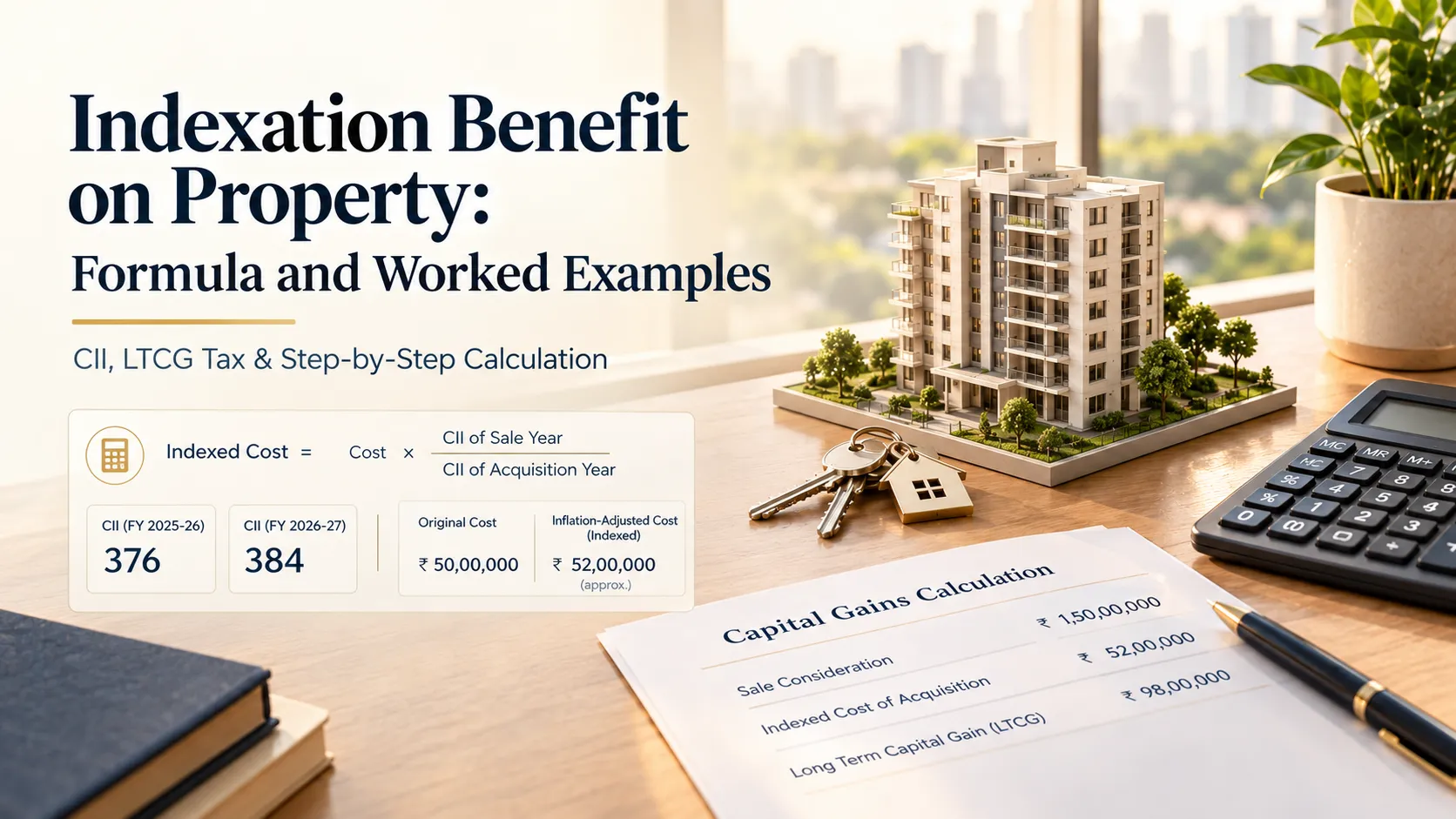
Indexation Benefit on Property: Formula and Worked Examples

Guides / 03 Oct 2026
Noida vs Gurgaon: Which City Is Better for Property Investment?
Gift deed stamp duty in UP swings between a flat Rs 5,000 for blood relatives and a full 7% market-value rate for everyone else, a gap that can run into lakhs. Here's exactly who qualifies, the step-by-step registration process, and the tax angle most families overlook.
Gift deed stamp duty in UP for blood relations is a flat ₹5,000 regardless of the property's market value. The same transfer to someone outside that defined list costs 7% of the property's value, which on a ₹50 lakh flat is ₹3.5 lakhs. That gap is enormous, it is entirely deliberate under UP law, and it is available only if the relationship qualifies and the registration process is followed correctly.
This guide covers the stamp duty rates by relationship type, exactly who qualifies under UP's blood relation concession, who does not, the step-by-step registration process, required documents, and the income tax angle most people overlook until it becomes a problem.
Table of Contents
- What Is a Gift Deed and Why Registration Is Non-Negotiable
- Gift Deed Stamp Duty in UP: The Two Rates That Matter
- Stamp Duty by Relationship Type: Complete Table
- Who Qualifies as a Blood Relative Under UP's Concession
- Who Does Not Qualify for the Concessional Rate
- Worked Example: Blood Relative vs Non-Relative
- Step-by-Step: How to Register a Gift Deed in UP
- Documents Required for Gift Deed Registration in UP
- Income Tax on Gifted Property: What You Should Know
- What Happens When the Donee Sells the Gifted Property Later
- Gift Deed vs Sale Deed vs Will: Which Is Right for Your Situation
- Common Mistakes People Make
- Frequently Asked Questions
- The Bottom Line
What Is a Gift Deed and Why Registration Is Non-Negotiable
A gift deed is a legal document that transfers ownership of property from one person (the donor) to another (the donee) voluntarily, out of love and affection, with no money changing hands. Under Section 17(1)(a) of the Registration Act, 1908, registering a gift deed for immovable property is compulsory. An unregistered gift deed creates no legal title in the donee whatsoever — it is not a lesser version of a valid transfer, it is legally meaningless.
That single fact is worth stating plainly because it trips people up more than any other part of this process: verbally agreeing to "give" someone a property, or having a signed but unregistered document, does not transfer ownership under Indian law.
Gift Deed Stamp Duty in UP: The Two Rates That Matter
Uttar Pradesh applies two very different stamp duty structures depending on the relationship between donor and donee.
| Transfer Type | Stamp Duty | Registration Charge | Total (on ₹50L property) |
|---|---|---|---|
| Blood Relative (defined list) | Flat ₹5,000 + ₹1,000 processing fee | Capped at ₹20,000 | Approximately ₹26,000 |
| Non-Blood Relative or Others | 7% of property market value | 1% of market value | Approximately ₹4,00,000 |
Stamp duty is always calculated on whichever is higher: the declared value or the government-notified circle rate for that locality — the same rule that applies to standard sale deeds.
Stamp Duty by Relationship Type: Complete Table
| Relationship (Donor to Donee) | Qualifies for Concession | Stamp Duty | Registration Charge |
|---|---|---|---|
| Husband to Wife / Wife to Husband | Yes | Flat ₹5,000 | Capped ₹20,000 |
| Parent to Son / Daughter | Yes | Flat ₹5,000 | Capped ₹20,000 |
| Son / Daughter to Parent | Yes | Flat ₹5,000 | Capped ₹20,000 |
| Brother to Brother / Sister | Yes | Flat ₹5,000 | Capped ₹20,000 |
| Grandparent to Grandchild | Yes | Flat ₹5,000 | Capped ₹20,000 |
| Son-in-law / Daughter-in-law | No | 7% of market value | 1% of market value |
| Uncle / Aunt to Nephew / Niece | No | 7% of market value | 1% of market value |
| Cousin to Cousin | No | 7% of market value | 1% of market value |
| Friend or Unrelated Person | No | 7% of market value | 1% of market value |
Note: Confirm the current applicable rates with the Sub-Registrar office or the IGRSUP portal before proceeding, as state government notifications can update these figures.
Who Qualifies as a Blood Relative Under UP's Concession
The concessional flat ₹5,000 stamp duty rate applies specifically to transfers between: spouse, children (son or daughter), parents (father or mother), siblings (brother or sister), grandparents, and grandchildren. This is a defined list under UP's stamp duty rules, not a general "family" category.
Who Does Not Qualify for the Concessional Rate
This is the part most families discover too late. Extended relatives — even those considered close in everyday terms — do not qualify for the blood relation concession under UP law. The following relationships fall under the standard 7% rate.
- Son-in-law and daughter-in-law
- Brother-in-law and sister-in-law
- Uncle, aunt, nephew, and niece
- First cousins and all other cousins
- Step-children (verify with a lawyer — treatment varies)
- Any friend or unrelated person
If the relationship falls outside the defined list, the full 7% stamp duty applies regardless of how close the personal relationship is. Attempting to claim the concessional rate for an ineligible relationship is a registration violation and can result in rejection of the deed, demand for the full stamp duty, and penalties.
Worked Example: Blood Relative vs Non-Relative
Take a property in UP with a circle rate value of ₹50 lakh.
Gifted to a blood relative (example: father to daughter): ₹5,000 stamp duty + ₹1,000 processing fee + registration capped at ₹20,000 = approximately ₹26,000 total
Gifted to a non-blood relative (example: uncle to nephew): 7% of ₹50 lakh = ₹3,50,000 stamp duty + 1% registration (₹50,000) = approximately ₹4,00,000 total
Saving from the blood relation concession on this property: ₹3,74,000
That gap scales with property value. On a ₹1 crore property, the saving is approximately ₹7.5 lakhs. Confirming eligibility before drafting the deed is not a formality it is a financial decision worth taking seriously.
Step-by-Step: How to Register a Gift Deed in UP
- Draft the gift deed. It must clearly state the donor's intent to transfer the property voluntarily, out of love and affection, with no consideration involved, along with full details of both parties and the property including khasra number or flat details.
- Calculate stamp duty. Confirm whether the blood-relative concession applies to your specific relationship. Use the Avorix stamp duty calculator for an accurate estimate, then verify against the IGRSUP portal.
- Pay stamp duty and registration fee online through the IGRSUP portal and book an appointment at the Sub-Registrar office that has jurisdiction over the property's location.
- Appear in person on the appointment date. Both the donor and donee, along with two witnesses, must be physically present at the Sub-Registrar's office with original documents.
- Complete biometric verification. All signatories undergo Aadhaar-based biometric verification, including fingerprint and photograph capture.
- Document review and registration. The Sub-Registrar verifies the deed, confirms stamp duty payment, checks proof of relationship, and registers the document.
- Collect the registered gift deed. A digitally signed certified copy is typically available within a few working days, downloadable through the IGRSUP portal using your application number.
- Apply for mutation. After registration, apply for mutation at the local revenue office to update ownership records in the Khatauni. Mutation does not transfer ownership but ensures the government's records reflect the new owner for property tax and future transactions.
Documents Required for Gift Deed Registration in UP
- Original property documents: previous sale deed, allotment letter, or title documents
- Aadhaar card and PAN card of donor, donee, and both witnesses
- Passport-size photographs of donor, donee, and witnesses
- Proof of relationship: birth certificate, marriage certificate, or any government document establishing the blood relation. This is mandatory when claiming the concessional rate.
- Society NOC or builder NOC if applicable
- Latest property tax receipt with no outstanding dues
- Encumbrance Certificate covering the last 15 years
- Stamped gift deed document (executed on correctly valued stamp paper)
Before finalising the documents, it is advisable to run an independent property verification to confirm the title is clean and no encumbrance exists that could complicate the gift deed registration. The guide on property verification before you invest covers the checks you should run before any transfer, including gifts.
Income Tax on Gifted Property: What You Should Know
Under Section 56(2)(x) of the Income Tax Act, gifts of property received from a "relative" a definition that includes spouse, siblings, and lineal ascendants/descendants are fully exempt from income tax in the donee's hands, regardless of the property's value. Gifts received from someone who does not qualify as a relative under this Income Tax definition are taxable if the fair market value exceeds ₹50,000 in a financial year.
One important distinction: the Income Tax Act's definition of "relative" and UP's stamp duty concession list are governed by separate laws and use slightly different definitions. Qualifying for income tax exemption does not automatically mean you qualify for the concessional stamp duty rate and vice versa. Verify both independently before proceeding.
What Happens When the Donee Sells the Gifted Property Later
This is the question most people never ask at the time of the gift, and it matters significantly for tax planning.
When the donee eventually sells the gifted property, capital gains tax is calculated based on the original cost of acquisition of the donor, not the market value at the time of the gift. The holding period for capital gains purposes is also counted from the date the original donor first acquired the property, not from the date of the gift deed.
This means: if a father purchased a plot in 2005 for ₹10 lakhs and gifts it to his daughter in 2025 when it is worth ₹80 lakhs, and the daughter sells it in 2027 for ₹90 lakhs, her indexed long-term capital gain is calculated on ₹90 lakhs minus the indexed cost of ₹10 lakhs from 2005. The capital gain is significantly higher than if she had "bought" the property at its 2025 gifted value.
This has no bearing on the gift deed decision itself the income tax exemption on receiving the gift still applies but it is relevant for the donee's future tax planning when they decide to sell.
Gift Deed vs Sale Deed vs Will: Which Is Right for Your Situation
| Factor | Gift Deed | Sale Deed | Will |
|---|---|---|---|
| Transfer timing | Immediate on registration | Immediate on registration | Only after donor's death |
| Consideration required | No — voluntary | Yes — must show price paid | No |
| Stamp duty (blood relative) | Flat ₹5,000 | Full stamp duty (6 to 7%) | Nil |
| Registration mandatory | Yes | Yes | No (but advisable) |
| Can be revoked | Very difficult after registration | No | Yes, during lifetime |
| Best suited for | Transferring property to family during lifetime | Commercial transactions | Estate planning for post-death distribution |
A gift deed is the right instrument when you want to transfer property to a blood relative during your lifetime at minimal stamp duty cost. A will is preferable if you want to retain control of the property while you are alive and transfer it only after death. A sale deed is not appropriate for genuine family transfers because it implies commercial consideration that doesn't exist.
Common Mistakes People Make
- Assuming an unregistered gift deed is legally valid. It is not. No registration means no legal transfer of title, regardless of how the document is worded or who signed it.
- Missing the blood-relative concession. Families sometimes pay the full 7% rate simply because they were not aware the flat ₹5,000 rate applied to their specific relationship.
- Claiming the concession for an ineligible relationship. Attempting to use the blood-relative rate for an uncle-nephew or cousin transfer can result in registration rejection and penalties.
- Skipping the society or builder NOC. This requirement applies to gift deeds just as it does to sale transactions, and missing it delays registration.
- Not applying for mutation after registration. The registered gift deed transfers legal ownership. Mutation updates the revenue records. Both steps are needed for a complete transfer.
- Confusing the stamp duty concession with automatic income tax exemption. They are governed by separate laws with separate definitions of "relative". Verify both independently.
Frequently Asked Questions
What is the stamp duty on a gift deed in UP for blood relations?
Stamp duty on a gift deed in UP for blood relations is a flat ₹5,000 plus a ₹1,000 processing fee, regardless of the property's market value. The registration charge is capped at ₹20,000. Blood relations for this purpose include spouse, parents, children, siblings, grandparents, and grandchildren. Extended family members such as in-laws, uncles, aunts, nephews, nieces, and cousins do not qualify and are charged the standard 7% stamp duty on the property's market value.
Can I transfer property to my son without paying full stamp duty in UP?
Yes. A property transfer from parent to son qualifies for the blood relation concession under UP's stamp duty rules. You pay a flat ₹5,000 in stamp duty plus ₹1,000 processing fee and a registration charge capped at ₹20,000 regardless of the property's value. The gift deed must be registered at the Sub-Registrar office with proof of relationship, and both donor and donee must be physically present along with two witnesses.
What documents are needed for gift deed registration in UP?
You need the original property title documents, Aadhaar card and PAN card of both donor and donee, proof of relationship (birth certificate, marriage certificate, or equivalent government document), passport-size photographs of donor, donee, and two witnesses, society or builder NOC if applicable, latest property tax receipts, and an Encumbrance Certificate covering the last 15 years. The gift deed itself must be executed on correctly valued stamp paper before appearing at the Sub-Registrar office.
Is a gift deed to a daughter-in-law or son-in-law eligible for the blood relation concession in UP?
No. A daughter-in-law and son-in-law are not included in UP's defined list of blood relatives for the purpose of the gift deed stamp duty concession. Transfers to them attract the standard 7% stamp duty on the property's market value. Only transfers between spouse, parents, children, siblings, grandparents, and grandchildren qualify for the flat ₹5,000 concessional rate.
Does the donee pay income tax when they receive property as a gift from a blood relative in UP?
No. Under Section 56(2)(x) of the Income Tax Act, property received as a gift from a "relative" — which includes spouse, siblings, and lineal ascendants and descendants is fully exempt from income tax in the donee's hands regardless of the property's value. However, when the donee later sells the gifted property, capital gains tax is calculated based on the original acquisition cost of the donor, not the market value at the time of the gift. This is an important tax planning consideration that should be discussed with a CA before the gift deed is executed.
Can a gift deed in UP be cancelled or revoked after registration?
Revoking a registered gift deed is legally very difficult in India. Once a gift deed is registered and accepted by the donee, it creates an irrevocable transfer of ownership in most circumstances. A gift deed can be challenged or cancelled only through a court order in cases of fraud, coercion, or specific contractual revocation clauses that were included in the original deed. Unlike a will, which can be changed at any time during the testator's lifetime, a registered gift deed is effectively permanent. This is why gift deeds are generally advised only when the donor is certain about the transfer.
The Bottom Line
Gift deed stamp duty in UP offers a genuinely significant concession for family transfers: a flat ₹5,000 versus 7% of market value, but only if the relationship qualifies under the defined list and the registration process is followed correctly. The savings on a mid-value property are typically several lakhs, which makes confirming eligibility before drafting the deed worth the time it takes.
Given that an unregistered gift deed has zero legal standing, and that the wrong relationship classification can result in rejection and penalties, this is a process worth getting right the first time rather than assuming informal understanding is sufficient.
Planning to transfer property to a family member in UP and want to confirm eligibility, calculate the exact cost, and ensure the documentation is in order? Speak with a local expert who works with these transactions regularly. #PropertyKaDNA
Tags
Tags
Frequently Asked Questions
About the Author
Admin