
What Counts as a Good Rental Yield in India?
What Counts as a Good Rental Yield in India?
Categories
- Articles
- Guides
- Market Insights
Recent Posts

Guides / 16 Sept 2026
Prepay or Extend: Cut Your Home Loan EMI or Tenure?

Guides / 16 Sept 2026
Home Loan Interest Rates 2026: Compare 15 Major Banks

Market Insights / 16 Sept 2026
Ganesh Chaturthi Property Deals: Payment Plans Over Freebies

Market Insights / 14 Sept 2026
Property Tax in Noida: How to Calculate and Pay It
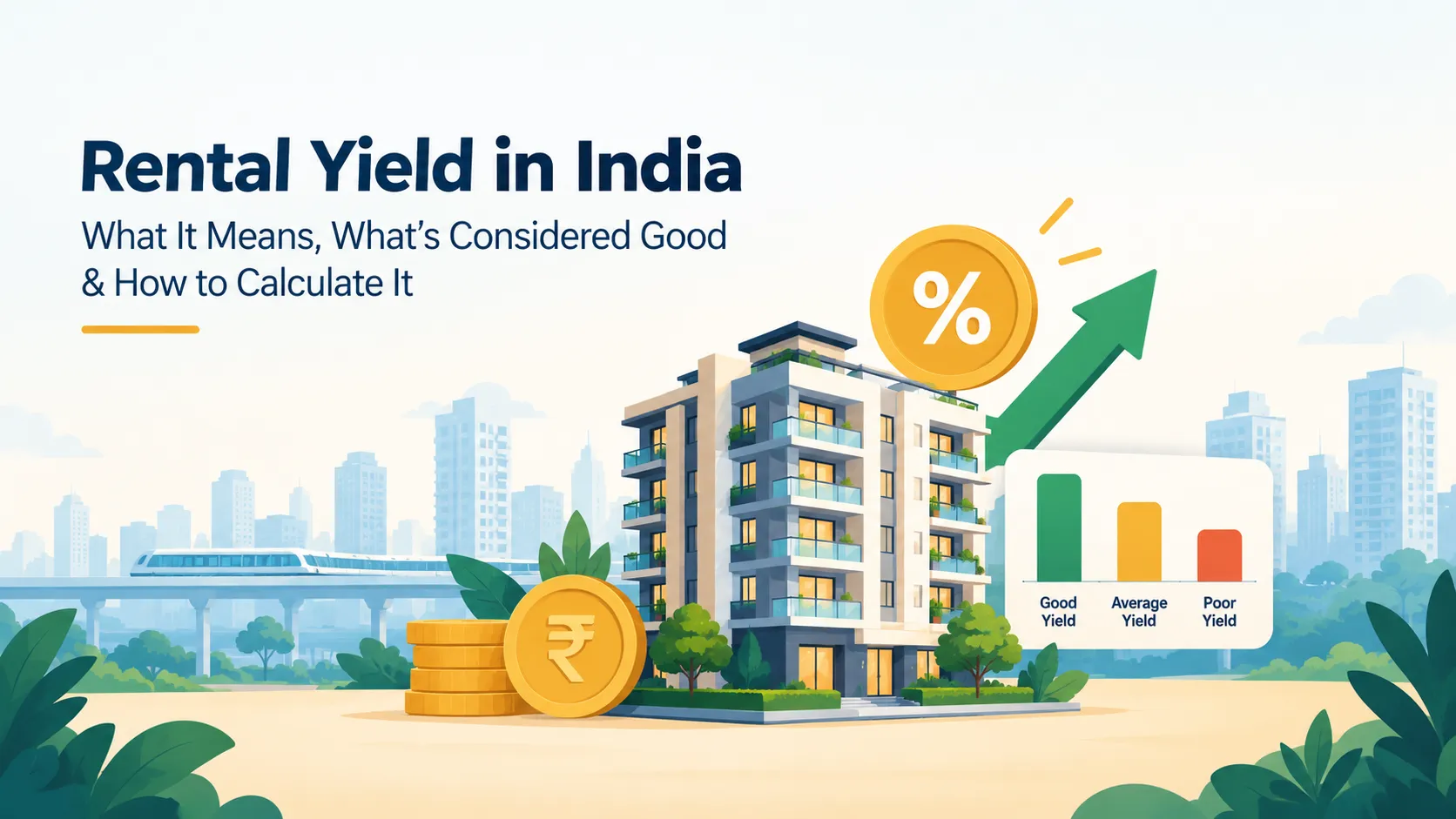
Most property buyers in India never actually calculate their rental yield, and it's usually lower than they'd expect, often below what a fixed deposit pays. Here's the formula, what "good" really means city by city, and why the number alone shouldn't decide whether you buy.
Rental Yield in India is the number most property buyers never actually calculate, and the one that would change several of their decisions if they did. A Good Rental Yield on Property isn't the number a broker quotes you in a sales pitch, it's a specific ratio you can work out in thirty seconds, and it's usually lower than people expect. Property Rental Yield across most Indian cities sits well below what a fixed deposit pays, which is a fact that quietly reframes what "investment property" actually means.
Here's what most articles on this get wrong: they hand you a city-wise table and call it a day, as if the number alone tells you whether a property is worth buying. It doesn't. This one gives you the table, the formula, and the context you need to actually use it.
Table of Contents
- The Number Almost Nobody Checks Before Buying
- How to Calculate Rental Yield
- So, What Actually Counts as Good?
- Rental Yield by City in India
- Residential vs Commercial Rental Yield
- Rental Yield vs Property Appreciation
- How to Increase Your Rental Yield
- What Yield Alone Doesn't Tell You
- The Bottom Line
The Number Almost Nobody Checks Before Buying
Picture buying a fixed deposit that pays you 3% a year, when a savings account down the street pays 6.5%, simply because the FD had a nicer brochure. Nobody would do that with a bank product; the interest rate is printed right there. Yet buyers do the real-estate equivalent constantly, purchasing a flat for the "investment," never working out what it actually rents for as a percentage of the price, and discovering years later that the rent barely covers the maintenance and EMI, let alone functions as a return.
That's the one thing worth remembering from this entire guide: in most Indian cities, rental yield alone is a weak reason to buy a property, it's appreciation that has historically done the heavy lifting, and knowing your yield tells you whether you're buying an income asset or a growth bet dressed up as one. Neither is wrong. Only one of them is what most buyers think they're getting.
How to Calculate Rental Yield
Rental yield calculation is a simple ratio, and it comes in two versions.
Gross Rental Yield = (Annual Rent ÷ Property Value) × 100
Worked example: a ₹1.2 crore two-bedroom flat rented out at ₹32,000 a month.
Annual rent = ₹32,000 × 12 = ₹3,84,000
Gross yield = (3,84,000 ÷ 1,20,00,000) × 100 = 3.2%
Gross yield is the quick number, but it ignores costs. Net rental yield strips those out and gives you the truer picture:
Net Rental Yield = [(Annual Rent − Annual Expenses) ÷ Property Value] × 100
Annual expenses typically include maintenance charges, property tax, insurance, repairs, and an allowance for vacancy between tenants. Net yield usually lands about 1 to 1.5 percentage points below gross yield, so a property advertised at "4% yield" may realistically hand you closer to 2.5–3% once running costs are accounted for. Always ask whether a quoted figure is gross or net, brokers rarely volunteer which one they're using, and the gap changes the answer meaningfully.
So, What Actually Counts as Good?
| Gross Rental Yield | How It's Generally Viewed |
|---|---|
| Below 2% | Weak, the property leans almost entirely on appreciation to justify the purchase |
| 2% – 3% | Below average for most Indian metros, common in high-priced prime areas |
| 3% – 4% | The broad average band across major Indian cities |
| 4% – 5% | Good, often found in strong IT-corridor micro-markets |
| 5%+ | Excellent for residential; standard territory for well-let commercial assets |
These bands shift depending on which report you check, published figures for the same city can vary by a percentage point or more depending on whether they track asking rents or actual transacted rents, and whether they cover the whole city or a specific micro-market. Treat any single number as a starting estimate, not a precise fact, and always verify against actual rental listings in the specific project or street you're considering.
Rental Yield by City in India
Broad, indicative gross residential yield ranges across major Indian cities, current figures vary by source and by micro-market within each city:
| City | Typical Gross Yield Range | Notes |
|---|---|---|
| Delhi / South Delhi | 3.5% – 5.5% | Higher on compact, mid-priced housing stock |
| Kolkata | ~5%+ | Lower property prices lift the ratio |
| Hyderabad | 3% – 5% | Prime IT pockets like Gachibowli and HITEC City run higher |
| Bengaluru | 3% – 4.5% | Deep, consistent IT tenant demand supports yields |
| Pune | 3% – 3.5% | Steady, IT- and education-led rental demand |
| Chennai | 2.8% – 3.5% | OMR IT corridor is the strongest local segment |
| Delhi NCR (Gurgaon / Noida) | 2.5% – 4% | Luxury segments trend toward the lower end |
| Mumbai | 2% – 3% | India's highest property prices push yields to the bottom nationally |
The pattern across nearly every city: the more expensive the entry price, the lower the yield. Mumbai's premium pushes it consistently to the bottom of the yield table even though rents in absolute rupee terms are among the highest in the country, because prices have run up even faster.
Residential vs Commercial Rental Yield
Rental yield for commercial property is structurally higher than rental yield for residential property, and it's worth understanding why before assuming commercial is simply "the better investment."
| Asset Type | Typical Gross Yield |
|---|---|
| Residential apartments | 2% – 5% |
| Retail shops | 5% – 8% |
| Office space (Grade-A) | 6% – 8% |
| Warehousing / logistics | 7% – 10% |
Commercial yields run higher because commercial tenants generally sign longer leases with structured rent escalations, and the asset class carries fewer emotionally-priced buyers competing up the purchase cost the way residential does. The trade-off is real, though: commercial property typically demands a larger upfront ticket size, longer vacancy periods between tenants, and less liquidity if you need to exit quickly. A higher yield on paper isn't automatically the easier or lower-risk choice.
Rental Yield vs Property Appreciation
This is the distinction that resolves most of the confusion around Indian rental yields feeling "too low." Real estate returns in India have historically come from two separate sources, rental income and capital appreciation, and in most residential markets, appreciation has done far more of the work.
That doesn't make yield irrelevant, it makes it a different kind of signal. A low yield in a high-appreciation corridor can still be an excellent long-term investment. But a low yield in a market with flat or uncertain appreciation is a genuine warning sign, you're holding an asset that generates weak income and isn't compensating for it with growth. Before buying for investment, decide honestly which return you're actually underwriting, and don't let a strong appreciation story paper over a yield that would otherwise concern you.
How to Increase Your Rental Yield
- Furnish the unit. Furnished and semi-furnished flats consistently command a meaningful rent premium over bare-shell units in most Indian rental markets.
- Target the right tenant profile. Properties near IT parks, hospitals, and business districts sustain higher and more stable rents than those without a clear tenant base nearby.
- Reduce vacancy periods. Every month a unit sits empty drags down the annual yield; competitive pricing and quick turnaround between tenants matter more than holding out for a slightly higher rent.
- Keep the property well-maintained. Well-kept units justify higher rent and attract more reliable, longer-staying tenants, cutting both vacancy and turnover costs.
- Review rent annually. A modest, regular rent revision, rather than large infrequent jumps, keeps your yield aligned with the local market without triggering tenant churn.
What Yield Alone Doesn't Tell You
A strong yield doesn't confirm clear title, sound project approvals, or a location with genuine long-term demand, and a weak yield doesn't automatically mean a bad investment if appreciation potential is strong. Rental yield is one input into a buying decision, not the whole decision. Run the actual numbers for any property you're evaluating, purchase price, expected rent, running costs, and likely appreciation, through our property ROI calculator before you commit, since the full return picture matters more than any single ratio in isolation.
The Bottom Line
A good rental yield in India generally sits between 3% and 5% for residential property, and 6% and 9% for commercial, but the "good" number for you depends entirely on what you're optimising for. If you need income now, chase yield. If you're underwriting long-term growth in a strong corridor, a lower yield with solid appreciation potential can still be the right call. What you shouldn't do is buy without knowing which case you're actually making.
Before your next property purchase, work out the yield first, not last. If the number surprises you, that's exactly the moment to ask what return you're really underwriting.
Tags
Tags
Frequently Asked Questions
Top 5 Best Properties in Delhi NCR This Week
Handpicked properties with best price & location
Popular in Greater Noida
Top-rated residential & commercial projects across Greater Noida