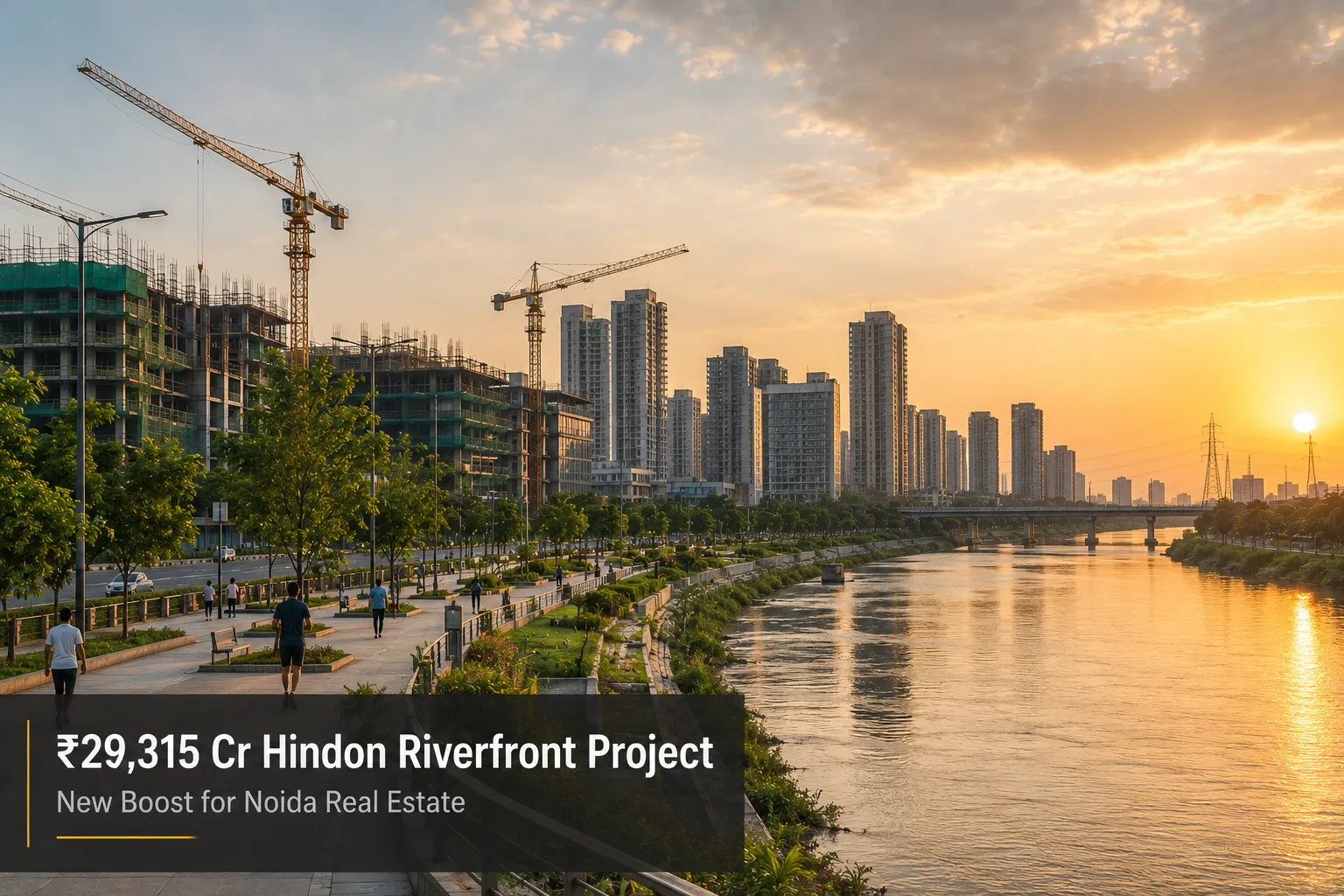
₹29,315 Cr Hindon Riverfront Project: New Boost for Noida Real Estate
Categories
- Tips
- Guides
- Market Insights
- Articles
Recent Posts

Tips / 28 Sept 2026
How to Check Whether a Plot of Land Is Legally Safe to Buy

Guides / 28 Sept 2026
How to Calculate Rental Yield: Formula and Worked Examples

Guides / 26 Sept 2026
How Much Home Loan Can You Get on Your Salary in 2026?

Guides / 25 Sept 2026
10 Things to Check in a Property Sale Deed Before Registration
Noida's proposed ₹29,315 crore Hindon Riverfront Project would transform a 25 km stretch with six-lane roads, green space, and rehabilitation for nearly 10,000 families. Here's what's confirmed, what's still pending government approval, and what it could mean for Noida real estate if it moves forward.
The Hindon Riverfront Project is one of the largest single infrastructure proposals to come out of Noida in years. Noida Real Estate has seen plenty of expressway, metro, and airport-linked announcements over the past few years, but a ₹29,315 crore riverfront development spanning 25 km is a different category of project entirely, closer in scale and ambition to Lucknow's Gomti Riverfront than to a typical road-widening scheme. Hindon Riverfront Noida is currently a proposal, not an approved, funded project, so it's worth understanding exactly what stage it's at before factoring it into any decision about the Noida Property Market.
Here's what the project actually involves, based on details reviewed at a recent Noida Authority meeting, and what it could realistically mean for the surrounding real estate corridor if it moves forward.
Table of Contents
- What Is the Hindon Riverfront Project?
- How Will the 25 Km Stretch Be Developed?
- Where Is the ₹29,315 Crore Actually Going?
- What Happens to the 10,000 Families Living Along the River?
- Is This Really Comparable to Lucknow's Gomti Riverfront?
- What's the Timeline, and What Could Delay It?
- Could This Affect Noida Property Prices?
- Should You Factor This Into a Property Decision Right Now?
- Frequently Asked Questions
- The Bottom Line
What Is the Hindon Riverfront Project?
The Noida Authority is preparing a ₹29,315 crore plan to transform a 25 km stretch along the Hindon River into a structured riverfront development, covering roughly 1,200 hectares of identified land. The proposal was reviewed at a meeting chaired by Noida Authority CEO Krishna Karunesh, and it includes new roads, embankments, landscaped green spaces, broader land development, and rehabilitation for families currently living along the riverbanks. It's explicitly modelled on the Gomti Riverfront in Lucknow, a comparison that gives a useful sense of scale and intent, though not necessarily a guarantee of identical execution or timeline.
How Will the 25 Km Stretch Be Developed?
The project is planned across three phases, covering different segments of the river corridor.
| Phase | Stretch | Length |
|---|---|---|
| Phase 1 (largest) | DSSC road bridge to the Noida-Greater Noida Expressway | ~12 km |
| Phase 2 | Bisrakh road bridge to DSSC road | ~5 km |
| Phase 3 | NH-24/9 to Bisrakh road bridge | ~8 km |
Each phase includes six-lane roads on both sides of the river, alongside walking paths, seating zones, greenery, and recreational facilities for children. Phase 1, the largest segment, runs along a corridor already anchored by the Noida-Greater Noida Expressway, which means its early completion could have the most immediate visibility for residents already living or investing in that belt.
Where Is the ₹29,315 Crore Actually Going?
Land acquisition: ₹15,000 crore (the single largest component)
Land development: ₹7,240 crore
Six-lane road construction: ₹2,425 crore
Embankment work: ₹150 crore
Rehabilitation of affected families: ₹4,000 crore
Land acquisition alone accounts for just over half the entire budget, which is precisely why government approval and funding commitment are the critical next steps, not a technicality. A project this dependent on land acquisition is inherently more exposed to delay than a straightforward road or metro construction proposal, land negotiations, compensation disputes, and occupation-related complications have historically been where similar Indian infrastructure projects lose the most time.
What Happens to the 10,000 Families Living Along the River?
Roughly ₹4,000 crore of the total budget is earmarked specifically for rehabilitating close to 10,000 families currently living along the riverbanks within the project's footprint. This is arguably the most human-facing part of the entire proposal, and realistically one of the more complex to execute cleanly. Worth noting: an earlier land acquisition effort in 2012 secured roughly 200 acres, but that land ultimately couldn't be incorporated into development plans because of unresolved occupation issues, a precedent that suggests rehabilitation and land-clearing timelines here deserve real scrutiny rather than optimistic assumption.
Is This Really Comparable to Lucknow's Gomti Riverfront?
The comparison to Lucknow's Gomti Riverfront is useful as a reference point for the kind of urban transformation being envisioned, wide riverside roads, landscaped public space, and a structured, planned redevelopment of what's currently an underutilised river corridor. But it's worth treating the comparison as directional rather than a guarantee: Gomti Riverfront itself faced cost overruns and construction-quality scrutiny during its own execution. A ₹29,315 crore, 25 km, three-phase project is a considerably larger and more complex undertaking than most comparable single-city riverfront developments in India, which is exactly why the approval, funding, and phased execution details matter more here than the initial announcement.
What's the Timeline, and What Could Delay It?
The project is targeted for completion by 2031, but that timeline is explicitly conditional on government approval and the required statutory clearances, none of which have been finalised yet. Before construction can begin, the proposal needs Uttar Pradesh government approval, followed by a memorandum of understanding between the Noida Authority, Greater Noida Authority, and the irrigation department to coordinate execution across their overlapping jurisdictions.
Given the scale of land acquisition required, and the documented history of rehabilitation complications with earlier, smaller acquisition efforts along the same river, a 2031 completion target should be treated as an ambitious best case rather than a locked delivery date.
Could This Affect Noida Property Prices?
If approved and executed as proposed, a structured riverfront with six-lane roads, green space, and planned public amenities would meaningfully improve the appeal of currently underdeveloped land along the Hindon corridor, the kind of infrastructure upgrade that has historically supported price appreciation in comparable NCR corridors once genuinely delivered. Phase 1's alignment with the Noida-Greater Noida Expressway in particular positions that segment to benefit first and most directly, should the project proceed on schedule.
The honest caveat: this is a proposal awaiting government approval, not a funded, under-construction project. Pricing any property decision today around a 2031 target that still needs land acquisition, an inter-authority MoU, and state government sign-off would be getting ahead of where this project actually stands.
Should You Factor This Into a Property Decision Right Now?
For buyers evaluating property along the broader Hindon corridor today, this is worth tracking as a long-horizon tailwind rather than an immediate catalyst. The more actionable near-term signal is watching for the state government's approval decision and the Noida-Greater Noida-irrigation department MoU, both are the genuine markers of whether this moves from proposal to funded project. Buying purely on the strength of this announcement, before approval, would carry meaningfully more execution risk than buying based on infrastructure that's already under construction or operational.
Frequently Asked Questions
How much will the Hindon Riverfront Project cost?
The proposed budget is ₹29,315 crore, with land acquisition alone accounting for ₹15,000 crore, just over half the total cost. The remaining budget covers land development, six-lane road construction, embankment work, and rehabilitation of affected families.
When will the Hindon Riverfront Project be completed?
The Noida Authority is targeting completion by 2031, but this timeline depends on Uttar Pradesh government approval and several statutory clearances that haven't been finalised yet, including an MoU between the Noida Authority, Greater Noida Authority, and the irrigation department.
Has the Hindon Riverfront Project been approved?
Not yet. As of the latest review, the project has reached the stage where it can be formally taken up for government approval, but it still requires sign-off from the Uttar Pradesh government along with other statutory and project-related clearances before construction can begin.
The Bottom Line
The Hindon Riverfront Project is a genuinely large-scale proposal, ₹29,315 crore across 25 km and three phases, that could meaningfully reshape a currently underutilised stretch of Noida if it clears government approval and proceeds on anything close to its proposed timeline. The land acquisition scale, the rehabilitation of nearly 10,000 families, and the precedent of a 2012 acquisition effort that stalled on occupation issues are all reasons to track this project's approval milestones closely rather than treat the announcement itself as a settled outcome.
Curious how a project like this could affect a specific sector you're evaluating along the Hindon corridor? Book a site visit with us and we'll walk you through what's confirmed versus what's still proposed. #PropertyKaDNA
Tags
Tags
Frequently Asked Questions
About the Author
Admin
Top 5 Best Properties in Delhi NCR This Week
Handpicked properties with best price & location
Popular in Greater Noida
Top-rated residential & commercial projects across Greater Noida