
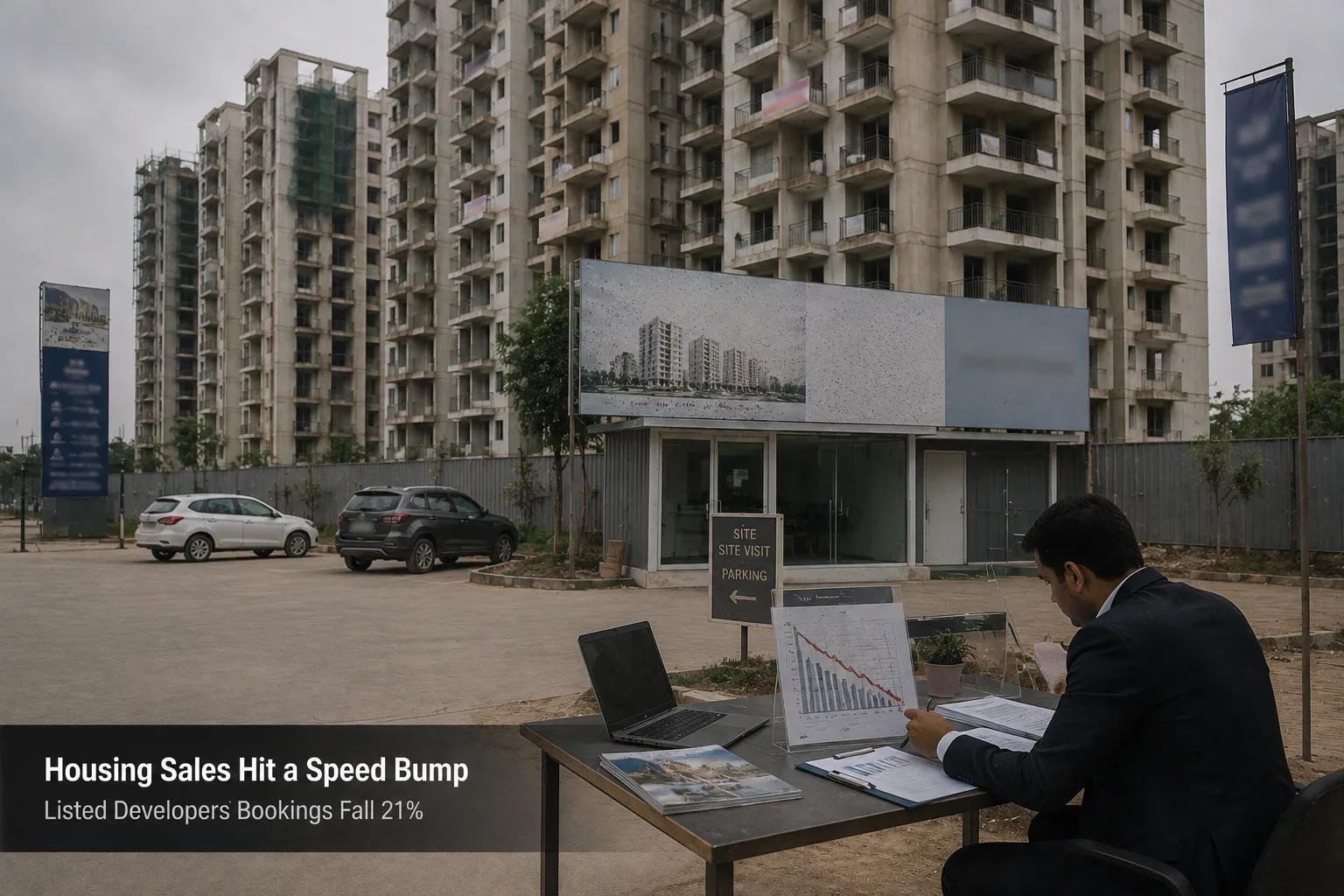
Housing Sales Hit a Speed Bump as Listed Developers' Bookings Fall 21%
Categories
- Tips
- Guides
- Market Insights
- Articles
Recent Posts

Tips / 28 Sept 2026
How to Check Whether a Plot of Land Is Legally Safe to Buy

Guides / 28 Sept 2026
How to Calculate Rental Yield: Formula and Worked Examples

Guides / 26 Sept 2026
How Much Home Loan Can You Get on Your Salary in 2026?

Guides / 25 Sept 2026
10 Things to Check in a Property Sale Deed Before Registration
Listed developer bookings fell 21% to ₹39,964 crore in Q1 FY27, but the headline hides a lopsided story: 19 of 28 developers actually grew, and one company's zero launches account for most of the aggregate decline. Here's what's really happening beneath the number.
When a 21% drop in developer bookings lands in the headlines, the instinct for most buyers is to either panic or celebrate — depending on whether they already own property or are about to buy. Neither reaction is particularly useful. What's more useful is understanding what the data actually says, what it doesn't say, and what it means for someone making a real property decision in Delhi NCR right now.
Here's the honest picture.
Table of Contents
- What Actually Happened — The Numbers in Context
- The DLF Effect: Why One Developer Skews the Whole Story
- 19 Out of 28 Developers Actually Grew
- The Broader Market: Overall Housing Sales Tell a Different Story
- Why the Slowdown Is Happening — The Real Reasons
- What This Means for Buyers in Delhi NCR Right Now
- The Avorix Perspective: Speed Bump, Not Collapse
- Two Mistakes Buyers Make When They Read Headlines Like This
- The Bottom Line
What Actually Happened — The Numbers in Context
India's 28 big listed real estate firms' collective sales bookings fell 21 per cent to nearly ₹40,000 crore in the April-June 2026 quarter, compared to ₹50,900 crore in the year-ago period. That's the headline. It sounds significant. In isolation, it is.
But context changes everything here. The April-June 2025 quarter — the one this data is being compared against — was one of the strongest quarters India's listed real estate developers had seen in years. The industry slowdown is also attributed to a "high base effect," meaning the current quarter's performance is being compared against a very strong period from the previous year. A 21% fall from an exceptional baseline looks alarming. Compared to a normal baseline two years prior, the same numbers would look unremarkable.
That context doesn't make the decline irrelevant. But it completely changes what conclusions you can reasonably draw from it.
The DLF Effect: Why One Developer Skews the Whole Story
Here's something that didn't make it into most of the headlines: a significant portion of the aggregate decline is attributable to one developer's deliberate decision — not to a collapse in market demand.
DLF's bookings fell 94.24% year-on-year to ₹657 crore from ₹11,425 crore in the same quarter last year. This variance is largely technical; the company did not launch any significant new projects during the quarter. In the real estate business, revenue and booking numbers are often "lumpy," meaning they fluctuate based on the specific timing of new property launches rather than a steady, consistent sales rate.
Strip out DLF's deliberate non-launch decision from the aggregate, and the 21% sector-wide decline looks considerably less dramatic. This is not a defence of the headline number — it's an explanation of why aggregate data from developer-reported bookings can be deeply misleading when a small number of large players make timing decisions that swing the collective figure significantly.
19 Out of 28 Developers Actually Grew
The most underreported fact in the coverage of this data: out of 28 developers, 19 reported growth in pre-sales. The majority of India's listed real estate companies grew their bookings year-on-year in the same quarter that the aggregate declined 21%.
That's not a failing market. That's a market where aggregate numbers are being dragged down by a handful of companies with specific, explainable reasons for their declines — delayed launches, regulatory approvals, and strategic decisions — while the majority of the industry continues to sell.
Godrej Properties emerged as the largest listed real estate developer by sales bookings, with sales rising to ₹8,651 crore in Q1 FY27 from ₹7,082 crore a year ago. Lodha Developers' pre-sales rose to ₹4,630 crore from ₹4,450 crore, while Sobha's sales jumped to ₹3,656 crore from ₹2,079 crore.
These aren't marginal improvements. Sobha nearly doubled its bookings year-on-year. Godrej grew 22% in a quarter the aggregate fell 21%. That divergence tells you something important: the market is bifurcating. Strong developers in strong locations are doing well. Weaker positions — or developers who simply didn't launch — are dragging the aggregate down.
The Broader Market: Overall Housing Sales Tell a Different Story
The listed developer booking data covers only 28 companies — a small segment of India's much larger residential market. The broader picture, while not without its own caution signals, is more nuanced.
The Indian residential real estate market faced a cooling phase in the April-June 2026 quarter, with housing sales across the top eight metropolitan areas declining by 6.1% to 91,729 units. This slowdown marks a shift in buyer sentiment, as potential homeowners grow increasingly cautious due to global geopolitical tensions and uncertainty surrounding AI-driven shifts in the tech job market.
A 6% decline in overall sales volumes versus a 21% decline in listed developer bookings. The gap between those two numbers is the DLF effect, the launch timing effect, and the high base effect — all working together. The underlying market is softer than peak 2025 levels. It is not in freefall.
While demand softened, developers continued to bring new supply to the market. New housing launches increased by 6% during the quarter to 89,161 units. Supply is still coming. If demand had genuinely collapsed, you wouldn't see developers continuing to launch. That disconnect between the headline booking decline and the continued launch activity is itself a signal that the industry's own operators believe the demand slowdown is temporary rather than structural.
Why the Slowdown Is Happening — The Real Reasons
The data points to three genuine, separable reasons for the softer numbers. Understanding which of these applies to your buying decision matters.
Launch timing and approvals. Delays in launching new projects and obtaining approvals appear to be a major reason behind the fall in bookings during the first quarter of FY27. This is a supply-side issue, not a demand-side one. When developers don't launch, there's nothing to book. This tells you nothing about what buyers want to buy — only that fewer options were made available to them in this specific quarter.
Global uncertainty and buyer caution. Developers have noted that global economic uncertainties and geopolitical events have made both the industry and homebuyers more cautious. This is real. AI-related job anxiety in India's tech sector — which is a significant driver of NCR housing demand — is creating a cohort of potential buyers who are employed today but uncertain about their employment landscape in two to three years. That uncertainty pushes fence-sitters to wait rather than commit.
Affordability pressure. Demand slowdown, buyers getting priced out of affordable housing is cited explicitly in analyst commentary. Property prices in NCR's established corridors have risen faster than income growth over the last three years. That gap — between price and affordability — is the most structural of the three factors, and the one that doesn't resolve simply when global uncertainty clears.
What This Means for Buyers in Delhi NCR Right Now
For buyers actively evaluating property in Noida, Greater Noida, Gurugram, or Delhi, this data has specific implications — none of which are panic-inducing, but all of which are worth thinking through.
Negotiation room exists. A quarter where aggregate bookings fall 21% and developers are sitting on more inventory than they'd like is a quarter where motivated sellers and developers are more open to negotiation than they were six months ago. Buyers who come in with researched, data-backed offers — knowing what comparable properties have sold for recently — have more leverage than they did during the peak 2025 period.
Project quality selection matters more now. When the market bifurcates — strong developers growing, weak ones declining — the gap between a good project and a mediocre one widens. Choosing a developer with a clean track record, RERA compliance, and genuine construction progress becomes more important in a softening market than in a rising one. In a bull market, even average projects get carried up. In a flat or softening market, quality separates.
End-user demand is holding better than investor demand. The decline is disproportionately concentrated in the premium and ultra-premium segments — the categories most exposed to investor caution and global uncertainty. The mid-segment and affordable housing segment, which drives demand in corridors like Greater Noida West and Noida's expressway belt, is showing more resilience. Pune recorded a sharp 21% decline in sales, followed by Ahmedabad with a 20% drop. Mumbai and Delhi-NCR also saw a 7% reduction in transactions. Delhi-NCR's 7% decline is measurably softer than other major markets — suggesting the corridor's end-user demand base provides more stability than cities more exposed to speculative or investor buying.
The Avorix Perspective: Speed Bump, Not Collapse
At Avorix, we track the Noida and Greater Noida market at the project and society level — not just the aggregate data. What we observe on the ground in August 2026 is consistent with what the data says: the market is softer than peak 2025, but it hasn't broken.
Serious end-users — buyers who need a home for their family and have the financial capacity to commit — are still buying. What's changed is the urgency. The FOMO that drove rapid decisions in 2024 and early 2025 has dissipated. Buyers are taking more time, visiting more properties, and negotiating more carefully. That's not a bad thing. It's a more rational market than the one we were in twelve months ago.
The projects that are selling in this environment share common characteristics: RERA-registered, developers with clean delivery histories, locations with genuine connectivity and social infrastructure, and pricing that reflects current market conditions rather than peak-cycle optimism. Those fundamentals don't change with a quarterly booking decline.
For first-time buyers who've been waiting for the right moment — a softer market with negotiating room, stable interest rates, and active developer launches is arguably a better entry point than the frenzied 2025 peak. The properties haven't got cheaper in any meaningful sense. But the competition for them has reduced, and the pressure to decide in 48 hours has gone.
Two Mistakes Buyers Make When They Read Headlines Like This
Mistake 1: Treating a Supply-Side Story as Demand Collapse
The biggest distortion in this data is treating launch-timing decisions by large developers as evidence that buyers don't want to buy. DLF's ₹657 crore quarter had nothing to do with buyer demand — it had everything to do with the company's choice not to launch anything significant. Reading the aggregate as a demand story misses the mechanism entirely.
Mistake 2: Waiting for a Market Bottom That May Not Come
When market data softens, some buyers shift into "wait for prices to fall" mode. In India's residential market, particularly in NCR, genuine price corrections at the city level are rare and typically short-lived. What happens more often is that transaction volumes soften while listed prices hold — meaning the market quiets without prices dropping materially. Waiting for a 15% price fall that historical data suggests won't come is a way of indefinitely deferring a purchase that makes sense at current prices.
The Bottom Line
Listed developer bookings fell 21% in Q1 FY27. The headline is accurate. The interpretation that India's housing market has collapsed is not. A high base comparison, deliberate launch delays by major developers, global uncertainty creating buyer caution, and affordability pressure in premium segments — these four factors together explain the number without requiring the conclusion that end-user demand has fundamentally broken.
The market is softer. It's also more rational, more negotiable, and — for buyers who are financially ready — more navigable than the peak-cycle pressure cooker of 2024 and 2025. That's not a bad place to be making a considered decision.
Evaluating a property purchase in Delhi NCR and want a ground-level read on where the market actually stands — beyond the headlines? Speak with a local expert who tracks live inventory, developer health, and project-level demand in Noida and Greater Noida daily. #PropertyKaDNA
Tags
Tags
Frequently Asked Questions
About the Author
Admin
Top 5 Best Properties in Delhi NCR This Week
Handpicked properties with best price & location
Popular in Greater Noida
Top-rated residential & commercial projects across Greater Noida