
How to Calculate Rental Yield: Formula and Worked Examples
Categories
- Tips
- Guides
- Market Insights
- Articles
Recent Posts

Tips / 28 Sept 2026
How to Check Whether a Plot of Land Is Legally Safe to Buy

Guides / 26 Sept 2026
How Much Home Loan Can You Get on Your Salary in 2026?

Guides / 25 Sept 2026
10 Things to Check in a Property Sale Deed Before Registration

Market Insights / 24 Sept 2026
5 Real Estate Clauses You Should Never Sign Blindly
Most property investors in India track appreciation but never calculate yield. This guide shows the exact formula for gross and net rental yield, walks through three worked examples across different property types and price points, and explains what the number actually tells you about whether a property is working as an investment or just sitting there looking expensive.
Rental Yield is the one number every broker quotes and almost no buyer checks. Ask about the Property Rental Yield on a flat and you'll hear something like "a solid 4%," said with total confidence and no working shown. Rental Yield Calculation isn't difficult, but the Rental Yield Formula most people learn is the flattering one, and it quietly leaves out the costs that decide what you actually keep. Think of it as the difference between a salary and take-home pay: both are real numbers, but only one of them pays your bills.
So here's the formula, three worked examples with real Indian numbers, and the one idea worth remembering: the yield that matters is the one left after the costs nobody puts in the brochure.
What Is the Rental Yield Formula?
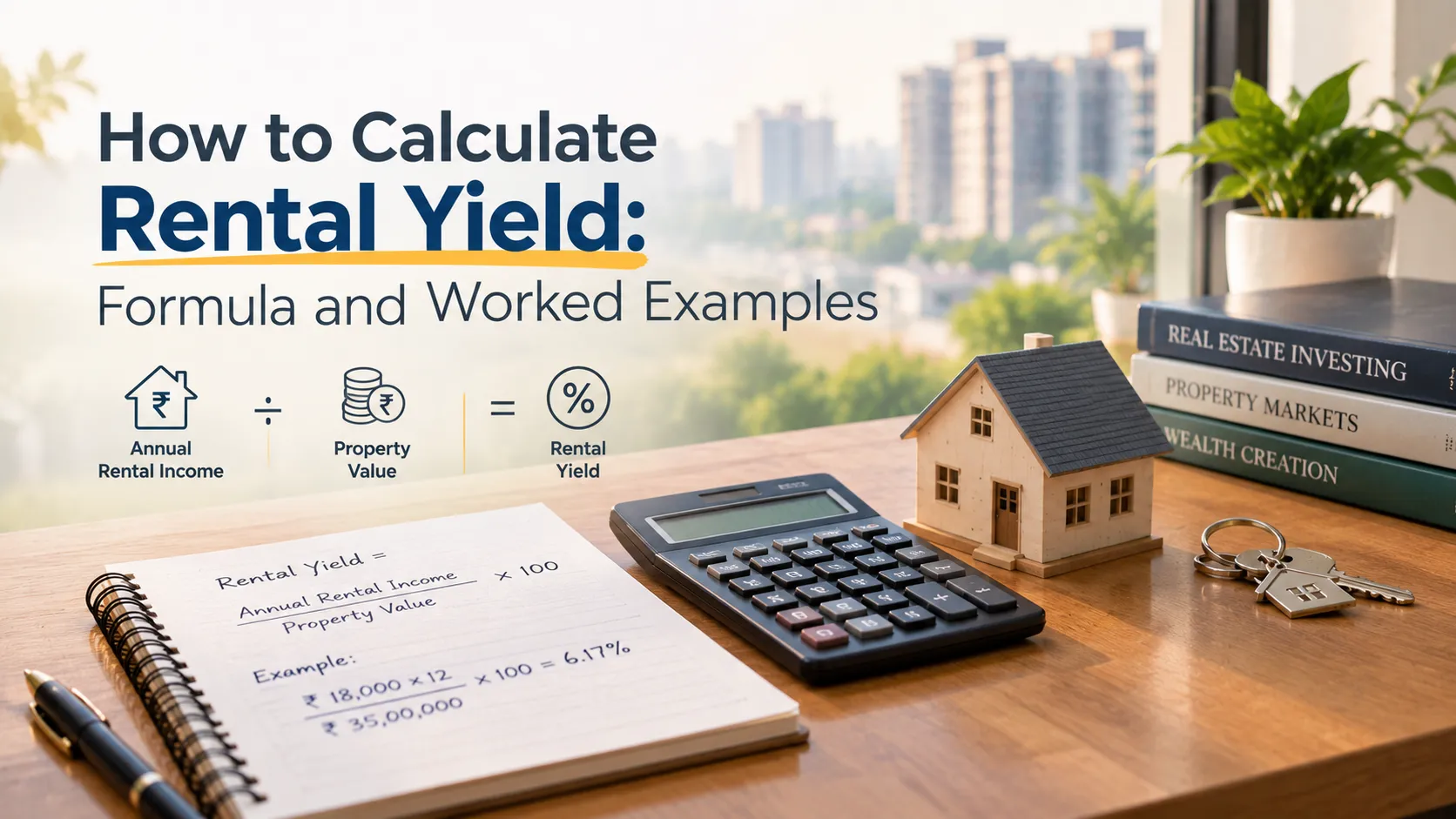
Rental yield is annual rental income divided by property value, multiplied by 100, and it comes in two versions: gross and net. Gross yield ignores costs. Net yield subtracts them, and it's the only one that tells you what the property actually earns.
Gross Rental Yield (%) = (Annual Rent ÷ Property Value) × 100
Net Rental Yield (%) = ((Annual Rent − Annual Costs) ÷ Total Investment) × 100
Annual Rent = Monthly Rent × 12
"Total Investment" is a detail most guides skip. It means the price you paid plus what it cost you to become the owner: stamp duty, registration charges, brokerage, and any interiors you had to add before it could be rented. In Uttar Pradesh, that's roughly 8% on top of the sale price for a male buyer (7% stamp duty plus 1% registration), which is not a rounding error when your yield is 3%.
How Do You Calculate Gross Rental Yield?
Multiply the monthly rent by 12, divide by the property's value, and multiply by 100. This is the fast version, useful for a first pass across many listings, and nothing more.
Worked example 1: a 2 BHK flat in Noida. Property value ₹80,00,000. Monthly rent ₹22,000.
Annual rent = ₹22,000 × 12 = ₹2,64,000
Gross yield = (₹2,64,000 ÷ ₹80,00,000) × 100 = 3.3%
That 3.3% is what a listing or broker would call the yield. It's accurate as far as it goes. It just doesn't go very far.
How Do You Calculate Net Rental Yield?
Add up everything the property costs you in a year, subtract it from annual rent, then divide by your total investment, not just the sale price. The costs that most often get left out are vacancy, repairs, property tax, and brokerage every time you find a new tenant.
Worked example 2: the same Noida flat, net of costs.
| Item | Amount (per year) |
|---|---|
| Annual rent | ₹2,64,000 |
| Vacancy (1 month empty) | −₹22,000 |
| Repairs and upkeep | −₹18,000 |
| Property tax | −₹6,000 |
| Re-letting brokerage (1 month's rent every 2 years) | −₹11,000 |
| Net annual income | ₹2,07,000 |
Total investment = ₹80,00,000 + ₹6,40,000 (stamp duty and registration at 8%) = ₹86,40,000
Net yield = (₹2,07,000 ÷ ₹86,40,000) × 100 = 2.4%
Same flat, same tenant, and the yield has dropped from 3.3% to 2.4%. Neither number is wrong. They answer different questions, and the second one is the one your bank balance agrees with.
How Does Rental Yield Differ for a Commercial Property?
Commercial properties in India typically yield far more than residential ones, often 6-10% or higher, but they come with longer vacancy gaps and a different cost structure. Pre-leased office space in established corridors has been reported at roughly 8-12% gross, and retail formats sometimes higher.
Worked example 3: a shop in a Noida commercial corridor. Property value ₹1,20,00,000. Monthly rent ₹90,000.
| Item | Amount (per year) |
|---|---|
| Annual rent | ₹10,80,000 |
| Vacancy (2 months empty) | −₹1,80,000 |
| Maintenance and repairs | −₹40,000 |
| Property tax | −₹30,000 |
| Net annual income | ₹8,30,000 |
Gross yield = (₹10,80,000 ÷ ₹1,20,00,000) × 100 = 9.0%
Net yield = (₹8,30,000 ÷ ₹1,20,00,000) × 100 = 6.9%
One note on commercial rent: landlords above the registration threshold charge 18% GST on rent, but it's collected from the tenant and passed to the government, so it isn't part of your income or your cost. It just shouldn't be counted in the rent figure you use above.
What Is a Good Rental Yield in India?
Residential rental yields in Indian metros mostly sit between 2% and 4.5%, and anything above that usually signals either a commercial property or a market where prices haven't caught up yet. ANAROCK's 2019 to Q2 2026 data, covered in Business Standard, gives a useful reference point.
| City | Rental Yield, 2019 | Rental Yield, Q2 2026 |
|---|---|---|
| Noida | 3.2% | 3.9% |
| Gurugram | 3.5% | 4.3% |
| Hyderabad | 2.6% | 3.6% |
| Delhi | 2.2% | 3.2% |
These are city-wide averages, so individual sectors will sit above or below them. For a deeper read on what counts as a good yield and where, our guide to a good rental yield in India breaks it down by property type and city.
Is a Higher Rental Yield Always Better?
No. Yield is only half of what an investment property earns you; the other half is appreciation, and the two usually pull in opposite directions. A property yielding 3% in a corridor appreciating 8% a year returns roughly the same as one yielding 7% while appreciating 4%. Which one suits you depends on whether you need income now or are happy to wait for the exit. Noida is a useful case: prices rose 125% between 2019 and Q2 2026 while yields also improved, which is unusual, since rising prices normally squeeze yield.
What Mistakes Do People Make When Calculating Rental Yield?
- Comparing gross yields across properties. Two properties with the same gross yield can have very different net yields once maintenance, vacancy, and tax differ.
- Ignoring acquisition costs. Stamp duty and registration alone can turn a 3.3% yield into a 3.0% one before any running cost is counted.
- Assuming full occupancy. A property that's tenanted 12 months a year is a hope, not a plan. Budget at least one month of vacancy.
- Using the asking rent instead of the achieved rent. Check what similar units in the same society actually rent for, not what owners are listing at.
- Forgetting tax on the income. Rental income is taxable, so your real return is lower still. Check the current rules with a CA, since the tax framework is in transition.
What Should You Do With Your Own Numbers?
Work out net yield on total investment for every property you're seriously considering, and compare on that number only. If you'd rather not build the spreadsheet yourself, the Avorix property ROI calculator does the arithmetic once you enter the price, rent, and costs.
The Bottom Line
Gross yield is the number on the listing; net yield is the number in your account. Run the formula both ways on any property you're weighing and notice how far apart they land. That gap is the honest measure of how much the pitch is flattering the investment. Which property on your shortlist has the widest one?
Comparing a few properties and want a second pair of eyes on the numbers? Talk to us at Avorix Realty and we'll work through the net yield with you. #PropertyKaDNA
Tags
Tags
Frequently Asked Questions
About the Author
Admin
Top 5 Best Properties in Delhi NCR This Week
Handpicked properties with best price & location
Popular in Greater Noida
Top-rated residential & commercial projects across Greater Noida