
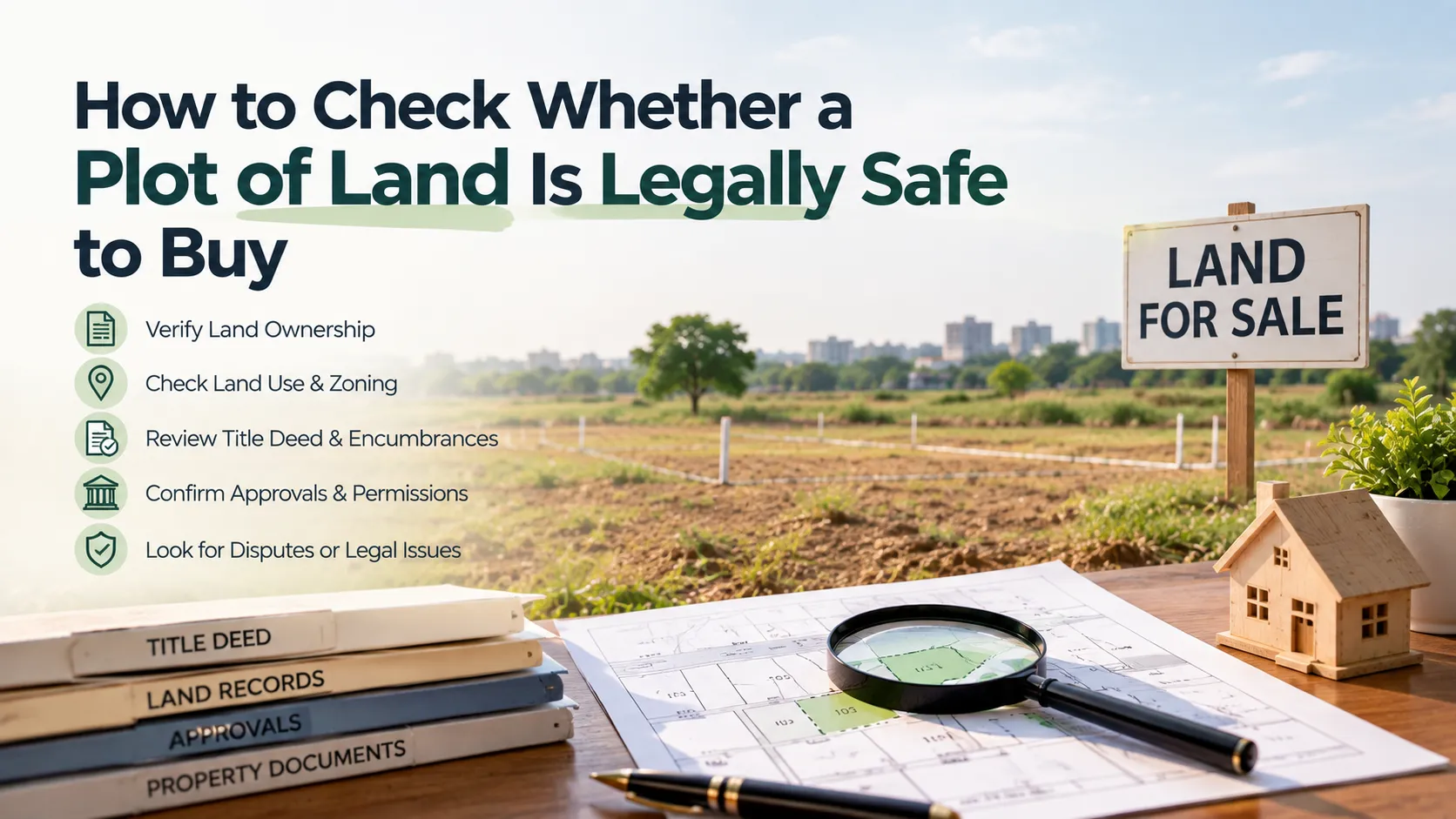
How to Check Whether a Plot of Land Is Legally Safe to Buy
Vivek Mishra
Real Estate Advisor
He helps buyers, investors, and NRIs navigate property decisions with clarity from shortlisting the right location to understanding the legal and financial side of every transaction.
Categories
- Tips
- Guides
- Market Insights
- Articles
Recent Posts
Guides / 28 Sept 2026
How to Calculate Rental Yield: Formula and Worked Examples

Guides / 26 Sept 2026
How Much Home Loan Can You Get on Your Salary in 2026?
Guides / 25 Sept 2026
10 Things to Check in a Property Sale Deed Before Registration

Market Insights / 24 Sept 2026
5 Real Estate Clauses You Should Never Sign Blindly
Buying a plot feels simpler than buying a flat. There is no builder, no society, no RERA registration to verify. That simplicity is exactly what makes it riskier because every check that would normally be done for you is now entirely your responsibility. Here are ten things to verify before any money changes hands.
Buying a plot feels simpler than buying a flat. There is no builder promising possession dates, no society maintenance committee to evaluate, no RERA registration to verify. Just land and a seller. That apparent simplicity is exactly what makes it more dangerous because every check that protects you in a flat purchase is done for you by someone else. With a plot, it is entirely your responsibility, and most buyers do not know what those checks actually are.
Consider what happened to a buyer who purchased a plot in a "developed layout" near Noida, paid full consideration at a price that seemed fair, and received the sale deed. Two years later, when he approached a bank for a construction loan, the bank's legal team flagged something he had never thought to check: the land use classification in the revenue records showed the plot as agricultural. The layout had been created by a private developer who had subdivided agricultural land without obtaining the conversion certificate required to reclassify it as residential. The buyer legally owned the land. He could not legally build on it. The resolution required a land use conversion application, three years of proceedings with the local authority, and a considerable amount of money he had not planned to spend.
A plot without a building is not a simpler purchase. It is a purchase with fewer visible problems and exactly the same number of invisible ones. Here is what to check, document by document, before you agree on a price.
Table of Contents
- 1. Establish the Complete Chain of Title
- 2. Verify Revenue Records and Khatauni
- 3. Pull the Encumbrance Certificate
- 4. Check the Land Use Classification
- 5. Verify Mutation Records
- 6. Check Whether the Layout Is Approved
- 7. Verify Land Acquisition Status
- 8. Physically Verify Boundaries Against Records
- 9. Search for Pending Litigation
- 10. Confirm Conversion Certificate for Non-Agricultural Use
- Red Flags That Should Stop You Immediately
- The Question to Ask Before You Agree on a Price
1. Establish the Complete Chain of Title
The chain of title is the sequence of ownership documents that traces the land from its original grant or allocation through every subsequent sale to the current seller. For residential plots in NCR, this typically needs to go back at least 30 years. For older properties, 60 years is the safer standard.
What you are looking for is an unbroken sequence. Every transfer should be documented by a registered sale deed. Every registered deed should reference the previous one. A gap in the chain — a period where ownership is claimed but no registered document supports it — is a serious problem. It means someone in the ownership history acquired the land without proper documentation, which creates the possibility of competing claims from people who were part of that undocumented transfer.
Ask the seller to provide all original title documents and registered sale deeds going back to the earliest available record. If they cannot produce documents beyond a certain point, find out why before you proceed.
2. Verify Revenue Records and Khatauni
Revenue records are the government's official account of land ownership. In Uttar Pradesh, these are maintained through UP Bhulekh, which provides access to Khatauni records — the document showing the current recorded owner, the land parcel, its area, and its classification.
Look up the plot using its khasra number or plot number, which the seller should be able to provide. The Khatauni entry should show the seller's name as the recorded owner. If it shows a different name — a deceased relative, a disputed partition outcome, or no individual name at all — that discrepancy needs to be resolved before you consider buying. Revenue records are updated through a process called mutation. If the seller inherited or purchased the land recently but mutation hasn't been done, the records will still show the previous owner's name. That is a resolvable issue, but it needs to be resolved before the sale, not after.
3. Pull the Encumbrance Certificate
An Encumbrance Certificate from the registration authority records all transactions registered against the land over a specified period — sales, mortgages, gifts, partitions, and any charges. It is the most reliable way to check whether the land has been used as collateral for a loan that has not been fully repaid.
For UP properties, pull the EC from the IGRSUP portal. Request a minimum 30-year EC. If the EC shows a mortgage that the seller says has been cleared, ask for the registered mortgage release deed. A verbal assurance is not sufficient — only a registered document creates a legal record of the charge being discharged.
An EC that comes back clean across the full period requested, combined with title documents that match the revenue records, is the strongest combination of evidence that the land is unencumbered.
4. Check the Land Use Classification
This is the check that the buyer in the opening story skipped. Land use classification determines what you are legally permitted to do with the land. The three categories that matter most for plot buyers are residential, agricultural, and commercial.
Agricultural land cannot be used for residential construction without obtaining a land use conversion certificate from the relevant state authority. In many states, non-farmers are prohibited from purchasing agricultural land entirely — this restriction varies by state and is worth verifying for the specific jurisdiction where you are buying.
The land use classification appears in the revenue records and should also be reflected in the local authority's master plan. In the NCR, check the relevant development authority — YEIDA, GNIDA, or Noida Authority — for the zone classification of the plot. A plot being marketed as residential must be classified as residential in the master plan, not merely located in an area where residential development is happening around it.
5. Verify Mutation Records
Mutation is the process by which ownership changes are recorded in the revenue department's books after a sale, inheritance, or gift. When someone buys a piece of land and the sale deed is registered, the revenue records still show the old owner until mutation is applied for and completed. Mutation does not by itself confer ownership — the registered deed does that — but it is the step that updates the government's records to reflect the new reality.
Before buying, check whether the seller's name has been mutated into the revenue records following their own purchase or inheritance. If it hasn't, there may be a pending dispute, an incomplete process from the previous transaction, or a situation where the seller's rights are contested by someone else in the family or the previous ownership chain. All of these are problems you want to know about before, not after, you pay.
6. Check Whether the Layout Is Approved
If you are buying a plot within a plotted development or a private layout, check whether the layout itself has been approved by the relevant authority. A developer can create a layout — divide land into plots, name them, market them — without ever obtaining approval from the local development authority or panchayat. Buyers who purchase within unapproved layouts often discover they cannot obtain building plan sanctions, utilities connections, or bank loans for construction on the plot.
Ask the seller or developer for the layout approval letter from the relevant authority. In NCR, this would be YEIDA, GNIDA, Noida Authority, or the relevant district panchayat, depending on jurisdiction. If they cannot produce it, do not assume the layout is approved. Verify directly with the authority before proceeding.
7. Verify Land Acquisition Status
In NCR and across India, government bodies — development authorities, highways, state and central government agencies — periodically acquire private land for infrastructure projects, expressways, metro corridors, and township development. Land that is under acquisition or that has received a notification of acquisition intent can still be sold privately, but the buyer acquires it subject to the acquisition proceedings.
Check whether any acquisition notification has been issued for the specific khasra numbers you are buying. This information is typically available through the relevant district collectorate or development authority. In areas near expressway corridors, airport zones, or planned metro alignments, this check is particularly important — these are the zones where acquisition proceedings are most active.
8. Physically Verify Boundaries Against Records
The documents will tell you the plot's dimensions and boundaries. A physical visit with those dimensions in hand will tell you whether reality matches the records. Take a measuring tape or use a surveyor's measurements to verify the actual plot area against what is stated in the sale deed and revenue records. Check the boundaries on all four sides — what abuts the plot on the north, south, east, and west should match the boundary description in the revenue record.
Encroachment from a neighbouring plot, a road that has been realigned and now cuts into the plot's claimed area, or a difference between the stated area and the measured area are all issues that must be resolved before purchase. After registration, proving that the plot was sold to you at a stated area that is materially different from the actual area becomes a legal dispute.
9. Search for Pending Litigation
Revenue records and encumbrance certificates show what has been officially registered. They do not show court cases. A plot can have a completely clean encumbrance history and still be the subject of a civil suit, an inheritance dispute, or a partition claim filed in a lower court that has not yet resulted in any registered order.
A property lawyer conducting a due diligence search will typically check the local district court records for any pending suits related to the khasra numbers or plot numbers you are buying. This search is part of what comprehensive title due diligence includes and is not something that can be done through online portals alone. If a suit is pending, buying the property transfers that legal risk to you.
10. Confirm Conversion Certificate for Non-Agricultural Use
If the land was previously classified as agricultural and is now being sold as a residential or commercial plot, ask for the land use conversion certificate. This is the document issued by the state revenue or agriculture authority formally reclassifying the land for non-agricultural use. Without it, any construction on the land — even after you have a registered sale deed — may be legally challenged by the authorities as an unauthorised use of agricultural land.
The conversion certificate should be in the original, not a photocopy, and should identify the specific khasra numbers it applies to. Cross-check those khasra numbers against the plot you are buying.
Red Flags That Should Stop You Immediately
Some findings during a plot verification are not just complications — they are signals to walk away until the issue is fully resolved.
- The seller cannot produce original title documents and insists only on providing photocopies.
- The revenue records show an owner other than the seller with no explanation for the discrepancy.
- The encumbrance certificate shows an active mortgage with no registered release deed from the lending institution.
- The land use classification is agricultural and no conversion certificate exists.
- The layout has no approval letter from the relevant development authority or panchayat.
- Any of the khasra numbers fall within an acquisition notification zone.
- The seller resists or deflects requests to pull an independent EC or check revenue records online.
A seller with clean documents and a clear title will almost always cooperate with a buyer's due diligence requests. Resistance to document sharing is not a negotiating posture — it is information about the transaction.
For a comprehensive walkthrough of what full property verification involves beyond the land-specific checks above, the guide on property verification before you invest covers the broader due diligence framework across property types.
The Question to Ask Before You Agree on a Price
Before you discuss price with any plot seller, ask them one thing: can you show me the original title deed and the current Khatauni entry for this khasra number?
A seller who has a legitimate title, who has owned the land properly and has nothing to hide, will produce both without hesitation. The original registered deed establishes their ownership. The Khatauni confirms the revenue records match. Together, those two documents answer the most fundamental question in any land purchase: does this person actually own what they are selling you?
If they can't produce both on the spot, ask when they can. If the answer involves excuses rather than a date, that is the answer. The due diligence process exists to give you information before you commit money. Everything in this guide can be done before a single rupee changes hands. Do it in that order.
The cost of verifying a plot before buying is a few hours and a property lawyer's fee. The cost of discovering a problem after registration is years. #PropertyKaDNA
Tags
Tags
Frequently Asked Questions
About the Author
Vivek Mishra
Real Estate Advisor
He helps buyers, investors, and NRIs navigate property decisions with clarity from shortlisting the right location to understanding the legal and financial side of every transaction.
Top 5 Best Properties in Delhi NCR This Week
Handpicked properties with best price & location
Popular in Greater Noida
Top-rated residential & commercial projects across Greater Noida