
How to Value a Property Before You Make an Offer

Categories
- Guides
- Articles
Recent Posts

Guides / 05 Nov 2026
Property Tax in Delhi vs Noida vs Gurugram: Key Differences Explained (2026)

Guides / 03 Nov 2026
How to Choose the Right Plot Size for Your Dream Home
Articles / 03 Oct 2026
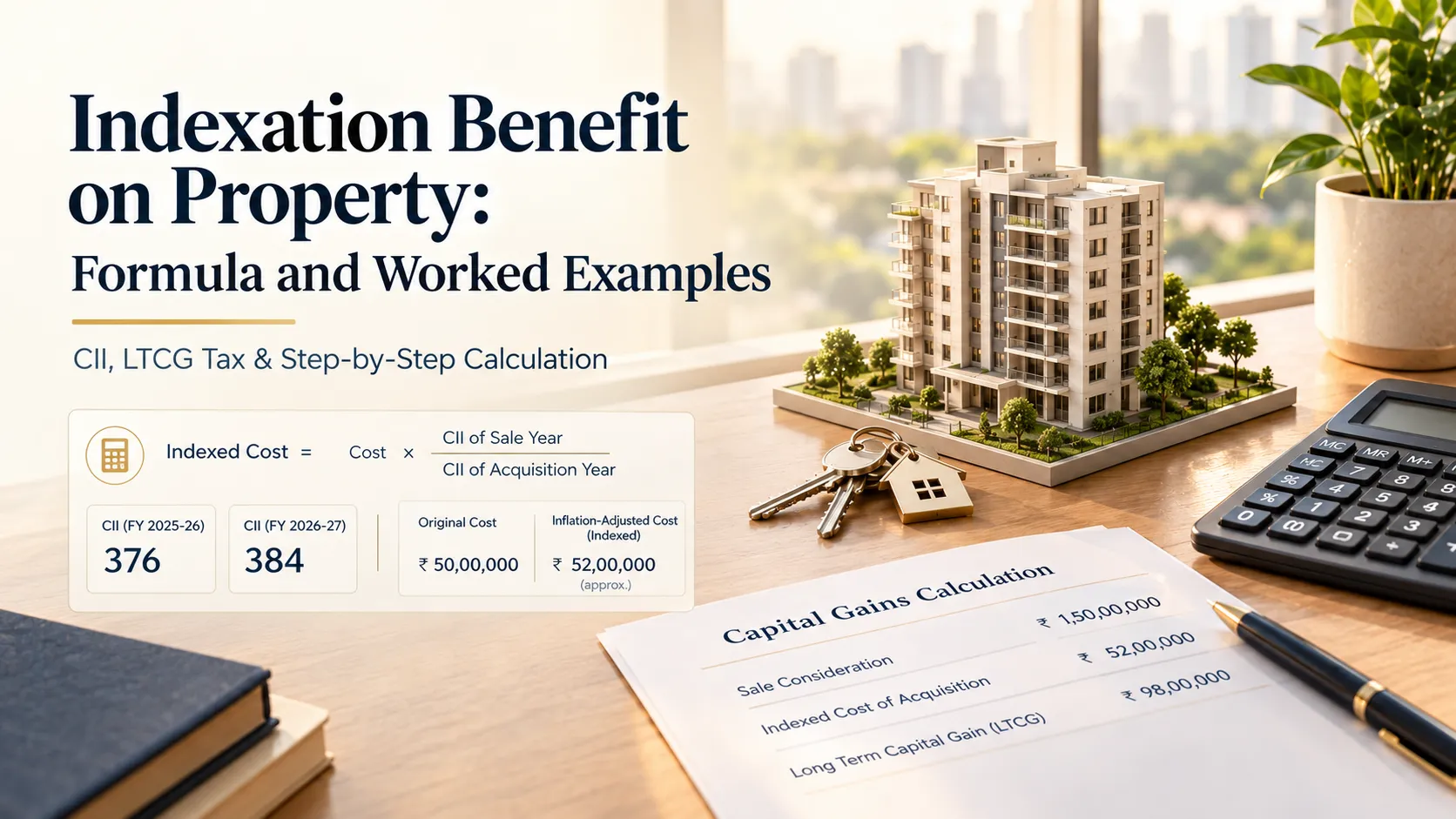
Indexation Benefit on Property: Formula and Worked Examples

Guides / 03 Oct 2026
Noida vs Gurgaon: Which City Is Better for Property Investment?
Before making an offer, learn how to estimate a property's fair value using market rates, comparable properties, location, condition, and other key factors.
By the time most buyers ask "is this price fair?" they've already visited the flat three times, mentally placed their furniture, and told their spouse they love it. At that point, valuation isn't analysis — it's rationalisation. You're looking for reasons to say yes, not for the actual number.
The right time to value a property is before the third visit. Before you're attached. Before the seller's agent senses urgency. The market rate for a property isn't what the seller is asking — it's what comparable properties have actually sold for in the last 90 days. That's the number you need to find before you make any offer. Everything else is negotiation theatre.
Table of Contents
- Why Sellers Ask More Than a Property Is Worth
- Method 1: The Comparable Sales Approach
- Method 2: The Circle Rate Floor
- Method 3: The Cost Approach — For Under-Construction and New Builds
- Method 4: The Income Approach — For Investment Properties
- A Worked Example: Valuing a 3 BHK in Noida Before Making an Offer
- Adjustment Factors — What Moves Value Up or Down
- Red Flags That Tell You a Property Is Overpriced
- The Question to Ask Before Submitting Any Offer
Why Sellers Ask More Than a Property Is Worth
Before getting into how to value a property, it helps to understand why asking prices are almost always above market value — and why that's rational seller behaviour, not dishonesty.
Sellers anchor their price to their own purchase cost plus an expected return. They anchor to what a neighbour got two years ago. They anchor to the price a broker told them to expect. None of these anchors are the current market value — and none of them are your problem to satisfy.
The current market value of a property is determined by one thing: what a ready, willing, and financially capable buyer would pay for it today, given what comparable properties have sold for recently. Not what the seller needs to cover their loan. Not what the area "might be worth" when the metro opens. What it would actually transact for right now.
Your job before making an offer is to find that number independently. Here's how.
Method 1: The Comparable Sales Approach
This is the most reliable method for valuing a residential property, and it's the same approach professional valuers use. The principle is simple: find out what similar properties in the same locality have actually sold for in the last 60 to 90 days, and use those transactions as your reference.
"Similar" means: same locality (ideally same society or street), similar configuration (same number of bedrooms, similar square footage), similar floor and facing, similar age and condition of building. The closer the match, the more reliable the comparable.
Where to find comparable transaction data in India:
- State registration portals: IGRSUP for Uttar Pradesh, DORIS for Delhi, RERA portals for registered projects. Registered sale deeds are public records — the transaction price at which a property was registered is available for lookup in most states.
- Property listing platforms: Check recently sold or delisted properties, not just current listings. Current listings show asking prices. Delisted properties — particularly those that came off the market at a price lower than originally listed — tell you where the market actually transacted.
- Direct enquiry: Speak to residents in the same society. In any active residential society, someone sold a flat in the last year and residents generally know the price. This ground-level data is often more accurate than any portal.
Once you have three to five genuine comparable transactions, calculate the price per square foot (on carpet area — not super built-up) for each. Average them. Apply that average to the carpet area of the property you're valuing. That's your comparable market value.
Rule of thumb: If you can't find three comparable sales in the same locality in the last 90 days, the market in that area is illiquid — which is itself a risk factor you should price into your offer.
Method 2: The Circle Rate Floor
India's state governments set minimum property values — called circle rates or ready reckoner rates — for each locality. These are the minimum values below which a property cannot be registered, regardless of what buyer and seller agree.
The circle rate serves two purposes in your valuation:
As a floor: Your stamp duty will be calculated on the higher of the transaction price or the circle rate. If you're buying below circle rate, you're paying stamp duty on a higher number than you're actually paying. Factor this into your total cost calculation.
As a market signal: In most urban areas, the circle rate is set below market value — the government updates it infrequently and conservatively. A property priced at 2x the circle rate is not necessarily overpriced. A property priced at 4x the circle rate in a slow market warrants scrutiny. The gap between circle rate and asking price, in context, is a data point.
You can check circle rates for Delhi on the Delhi Revenue Department portal, for Uttar Pradesh (Noida/Greater Noida) on the IGRSUP portal, and for other states on their respective stamp and registration department portals.
Method 3: The Cost Approach: For Under-Construction and New Builds
For new launches and under-construction properties where there are no comparable completed sales yet, the cost approach provides a useful cross-check. The logic: what does it cost to build this, plus land cost, plus developer margin?
Construction cost in Delhi NCR for a mid-segment project in 2026 runs approximately ₹2,200 to ₹3,000 per sq ft of built-up area for standard construction, higher for premium finishes. Land cost is the variable, and in established Noida sectors, it's substantial.
If a developer is asking ₹8,500 per sq ft for a flat in a sector where land cost plus construction genuinely supports ₹7,000 to ₹7,500 per sq ft, their margin is 13 to 21% — reasonable. If the same ask is ₹11,000 per sq ft with no material difference in land cost, the pricing requires scrutiny — either it's a premium the location genuinely commands, or it's aspirational pricing that the secondary market hasn't validated yet.
Method 4: The Income Approach — For Investment Properties
If you're buying primarily as an investment — for rental income — the income approach gives you a direct valuation based on what the property can actually earn.
The formula: Annual Rental Income ÷ Expected Rental Yield = Fair Market Value
In Noida's mid-segment market, gross rental yields typically run 3% to 4% for residential property. If a 2 BHK rents for ₹20,000 per month (₹2.4 lakhs annually) and the market yield is 3.5%, the income-based valuation is: ₹2,40,000 ÷ 0.035 = ₹68.57 lakhs.
If the seller is asking ₹85 lakhs for the same flat, the implied yield at that price is 2.82% — below market. Either the rent is understated (check comparable rents, not just current tenants), the property will appreciate faster than the yield suggests, or the price is high relative to its income potential.
The income approach is particularly useful for filtering out properties where appreciation optimism has disconnected the asking price from the underlying income reality.
A Worked Example: Valuing a 3 BHK in Noida Before Making an Offer
You're looking at a 3 BHK in Noida Sector 62 — 1,400 sq ft carpet area, 8th floor, east-facing, 12 years old, asking price ₹1.05 crore. Here's how to arrive at a value before you respond.
Step 1 — Comparables. You find three recent sales in the same sector: a 10-year-old 3 BHK at 1,350 sq ft that sold for ₹93 lakhs (₹6,888 per sq ft), a 14-year-old 3 BHK at 1,450 sq ft that sold for ₹97 lakhs (₹6,689 per sq ft), and a 9-year-old 3 BHK at 1,380 sq ft that sold for ₹96 lakhs (₹6,956 per sq ft). Average: approximately ₹6,844 per sq ft.
Step 2 — Apply to the subject property. 1,400 sq ft × ₹6,844 = ₹95.82 lakhs as the raw comparable value.
Step 3 — Adjust for differences. The 8th floor commands a modest premium over lower floors — add 2% (₹1.92 lakhs). East-facing is slightly preferred in this market — add 1% (₹0.96 lakhs). The property is 12 years old with no renovation — comparable to the others, no adjustment. Adjusted value: approximately ₹98.7 lakhs.
Step 4 — Income cross-check. Similar flats rent for ₹28,000 to ₹30,000 per month. At ₹29,000 average and 3.5% yield: ₹3.48 lakhs ÷ 0.035 = ₹99.4 lakhs. Consistent with the comparable approach.
Conclusion: The property's fair market value is approximately ₹98 to ₹100 lakhs. The seller is asking ₹1.05 crore — a 5 to 7% premium. Your informed opening offer is ₹95 to ₹97 lakhs, with a justified walk-away point at ₹1.02 crore. You now have a number. You didn't get it from the broker. You're not guessing.
If you want to cross-check your valuation quickly without running through every step manually, the Avorix DealScore Calculator analyses a property's price against market indicators and gives you an instant read on whether you're looking at a fair deal, an overpriced one, or a genuine opportunity — before you make your offer.
Adjustment Factors: What Moves Value Up or Down
No two properties are identical, and the comparable approach requires adjustments for the differences. These are the factors that move value in either direction:
Moves value up: Higher floor (generally); corner unit with two open sides; east or north-facing; recently renovated kitchen and bathrooms; covered parking in a society with limited parking; proximity to metro station or school within 500m; lower maintenance charges with a well-functioning RWA.
Moves value down: Lower floor (below 3rd in most markets); west or south-facing in hot climates; overlooking a commercial zone or construction site; building age above 20 years without renovation; society with poor maintenance track record; no covered parking; pending litigation or structural issues.
Each adjustment is a negotiation point — and each one should be something you raise with evidence, not just assertion. "The comparable on the same floor sold for 5% less because it's west-facing and yours is too" is a different conversation from "I think it's overpriced."
Red Flags That Tell You a Property Is Overpriced
It's been listed for more than 90 days. In an active market, well-priced properties don't sit. A listing that's been available for three months without a deal is either overpriced, has undisclosed issues, or both. Ask why it hasn't sold.
The asking price is significantly above circle rate with no demonstrable premium factor. A 3x circle rate premium in South Delhi may be entirely justified. The same premium in a peripheral sector with limited comparable sales is a red flag worth questioning.
The seller won't share registration documents or comparable evidence. A seller confident in their price is usually happy to show you what similar flats sold for. One who resists that conversation is either uninformed or avoiding it deliberately.
The only justification is "this area will develop." Future potential is real — but it's not a substitute for current value. You're paying today's price for today's flat. The future appreciation argument belongs in your investment thesis, not in the seller's valuation logic.
The Question to Ask Before Submitting Any Offer
Before you write a number on an offer, ask yourself one question: At this price, what am I actually paying per square foot of carpet area — and what have comparable carpet areas in this society sold for in the last six months?
If you can answer that with actual data — not estimates, not agent assurances, not "the market is hot right now" — you have a valuation. If you can't answer it, you don't have a valuation yet. You have an emotion with a number attached.
The offer you make from a valuation is a different conversation from the offer you make from enthusiasm. One is negotiable because it's grounded. The other is negotiable only if the seller feels like it — because you have no floor to stand on.
Do the comparable work first. Make the offer second. The sequence matters more than the number. #PropertyKaDNA
Tags
Tags
Frequently Asked Questions
About the Author
Admin