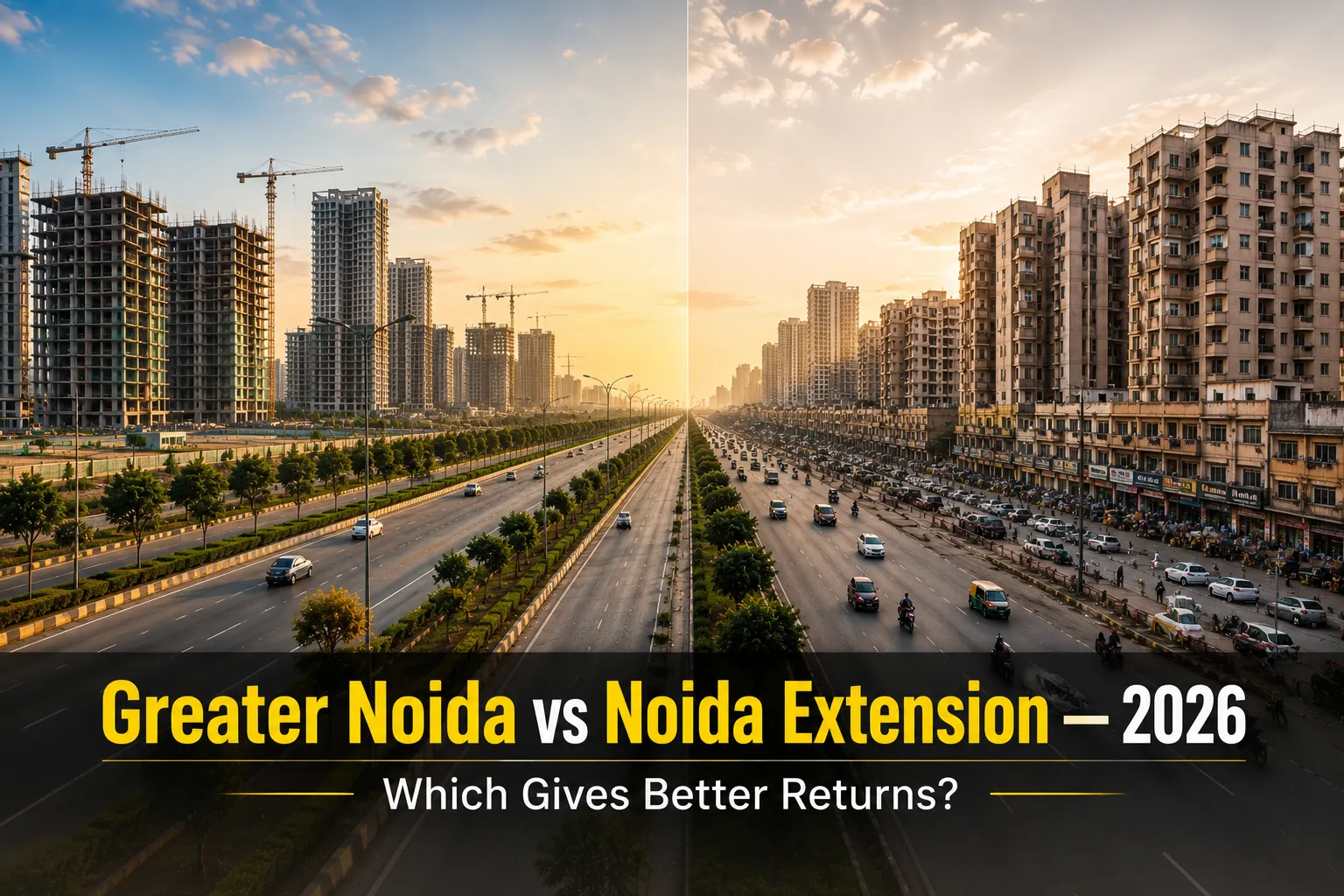
Greater Noida vs Noida Extension: Better Returns 2026?
Greater Noida vs Noida Extension: Better Returns 2026?
Categories
- Market Insights
- Guides
- News
Recent Posts
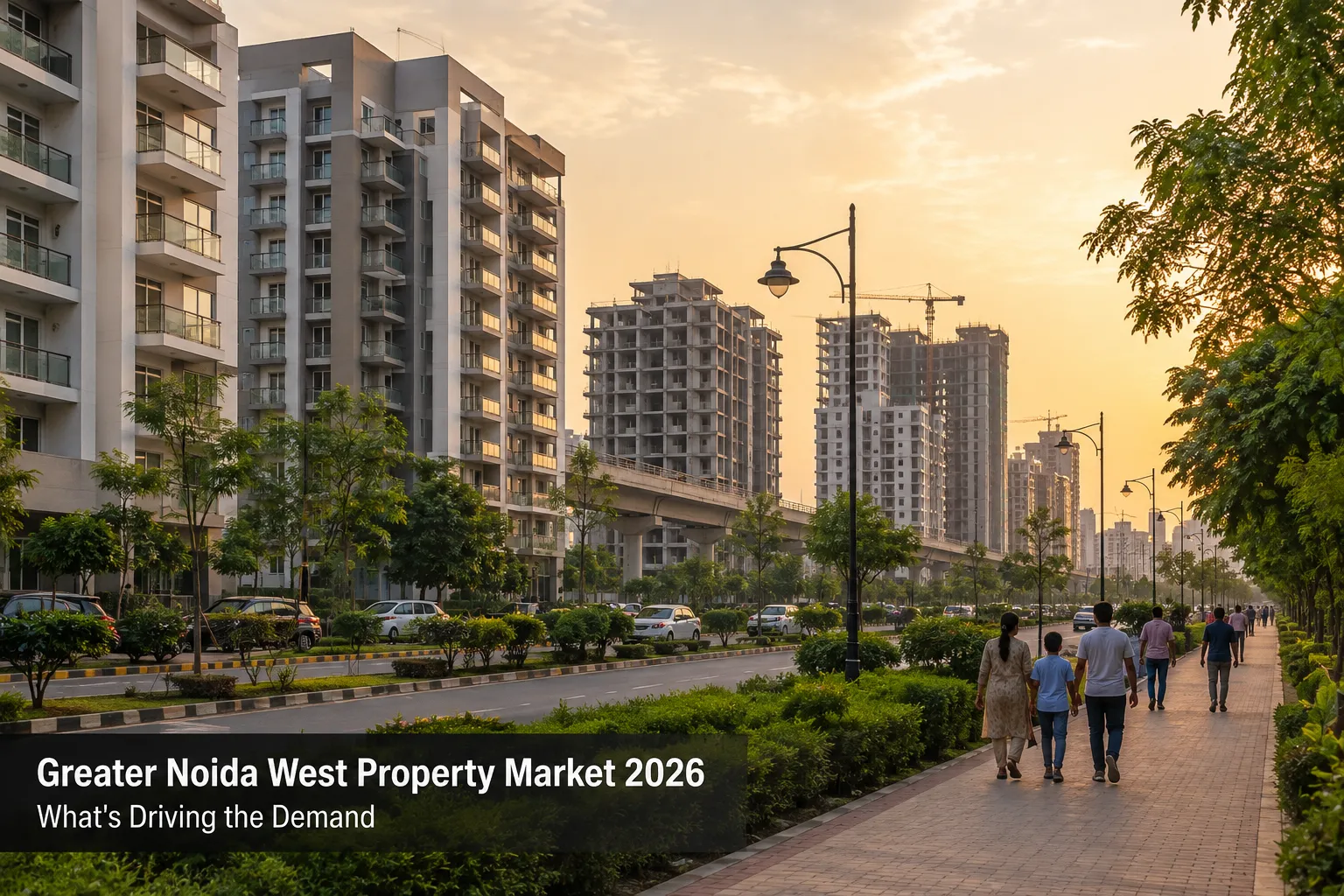
Market Insights / 20 Aug 2026
Greater Noida West Property Market 2026: Demand Drivers

Guides / 19 Aug 2026
Khasra Khatauni UP: How to Find and Read Your Land Record Online

News / 17 Aug 2026
YEIDA New Plot Scheme 2026: Plots Near Noida Airport

Market Insights / 14 Aug 2026
Delhi Master Plan 2047: What It Means for Housing
Both markets have doubled in five years — but which one actually suits your budget, timeline, and returns? Read this article for an honest comparison.
This comparison comes up constantly among NCR property buyers — and for good reason. Both Greater Noida and Noida Extension (officially Greater Noida West) are located in the same broad geography, both fall under the UP jurisdiction, both have seen meaningful price appreciation over the last five years, and both are actively marketed to the same buyer profile. On the surface, they look like two versions of the same story.
They're not.
The differences between these two markets are real, specific, and consequential for your investment decision. This isn't a question with a simple universal answer — but it does have a clear answer once you understand your own buyer profile, investment timeline, and what "better returns" actually means for you. Here's the honest comparison, grounded in current data.
Table of Contents
- The Basic Geography — Don't Confuse Them
- Prices — Where Each Market Sits in 2026
- Five-Year Appreciation — The Numbers Are Striking
- Rental Yield — Consistent Demand vs Family-Driven Tenants
- Infrastructure — The Gap Is Real, But Closing
- The Jewar Airport Factor
- A Real-World Observation — Two Buyers, Same Budget, Different Logic
- Two Mistakes Buyers Make When Comparing These Markets
- So Which One Gives Better Returns?
The Basic Geography — Don't Confuse Them
Before anything else, a clarification that trips up a surprising number of buyers.
Noida Extension is the informal name for Greater Noida West — a planned residential zone that sits between Noida and Greater Noida. It was developed under the Greater Noida Industrial Development Authority, but it has its own distinct character, pricing, and development trajectory.
Greater Noida proper — the areas around Pari Chowk, Alpha, Beta, Gamma sectors, Knowledge Park, and the Yamuna Expressway — is an older, more planned city with a different infrastructure maturity. Wide roads, greenery, and an established base of schools, colleges, and hospitals were built in early, whereas Noida Extension is still catching up on that front.
That maturity gap is the central fact around which everything else in this comparison orbits.
Prices — Where Each Market Sits in 2026
Let's start with the numbers.
Flat prices in Noida Extension range from roughly ₹5,000 to ₹9,250 per square foot, with the average transaction rate sitting around ₹7,757 per sq ft.
In key sectors near Pari Chowk in Greater Noida — like Alpha, Beta, Gamma, and Techzone 4 — the current market rate for ready-to-move flats averages around ₹8,500 to ₹12,500 per sq ft, with luxury projects or expressway-facing properties commanding higher.
So Greater Noida proper runs roughly 10% to 30% higher per square foot than Noida Extension in comparable segments. That gap has two implications: Greater Noida requires more capital to enter, and Noida Extension offers more buying power at the same budget.
For a buyer with ₹60 lakhs, Noida Extension delivers a more spacious 2 BHK or entry-level 3 BHK. The same budget in Greater Noida's better sectors gets you a well-located 2 BHK, but with less room to negotiate.
Five-Year Appreciation — The Numbers Are Striking
This is where the comparison gets genuinely interesting.
Property prices in Noida Extension have moved roughly 3.3% in the last year, 45.4% over three years, and about 101.3% over five years. Greater Noida, meanwhile, has seen close to a 98% rise in average price over the same five-year period.
Both corridors have essentially doubled in five years — a remarkable outcome for markets that were considered mid-tier and somewhat risky back in 2019 and 2020. The parity in five-year appreciation isn't a coincidence; both markets have benefited from the same broad tailwinds: post-pandemic demand recovery, improving infrastructure, and the ongoing Jewar Airport story.
The subtle difference is in how they got there. Noida Extension's appreciation started from a lower base and was more volatile, with sharper swings. Greater Noida's climb was steadier, reflecting a more mature market with less speculative activity.
For investors, that distinction matters more than the headline number. A market that doubles smoothly over five years carries a different risk profile from one that doubles with sharp up-and-down periods and project-specific delays along the way.
Rental Yield — Consistent Demand vs Family-Driven Tenants
The average rental yield in Noida Extension sits around 3%, while well-located, ready-to-move property in Greater Noida is projected to deliver an annual ROI closer to 9% to 11%, driven largely by the Jewar Airport and Film City development.
The tenant profiles are different, and that affects yield reliability. Noida Extension attracts tenants primarily because rents are affordable, so finding someone to occupy a unit usually isn't difficult — but the tenant base tends to be more transient, made up of families and young couples drawn by affordability rather than workplace proximity. Vacancy periods can run longer, and turnover is higher than in employment-adjacent corridors.
Greater Noida's tenant base — anchored by students from its extensive university belt and professionals working in Knowledge Park's IT and institutional zone — tends to stay longer. Lower turnover means lower effective vacancy and more predictable income.
For investors focused specifically on rental yield, Greater Noida's tenant stability matters more than the raw yield percentage suggests on its own.
Infrastructure — The Gap Is Real, But Closing
Greater Noida was planned as a city from the late 1990s onward, and it shows: wide roads, park networks, and a denser mix of schools, colleges, and hospitals already in place. Noida Extension, built faster and denser, is still filling that infrastructure in.
Noida Extension has improved meaningfully over the last five years — roads are better, and social infrastructure like schools, hospitals, and retail continues to fill in. But the gap is real, and buyers who visit both corridors on the same day will notice it.
The closing part matters, though. The proposed Aqua Line extension from Sector 51 to Knowledge Park V spans over 17 km with 11 elevated stations, and is expected to give Noida Extension a sharp mobility advantage once complete. The roughly 11.56 km corridor carries a project cost of around ₹2,254 crore. Once operational, this metro extension would narrow a significant part of the infrastructure gap permanently — and that's essentially the bet Noida Extension investors are making.
The Jewar Airport Factor
Both markets lean on the Jewar Airport story. The real question is which one it benefits more directly.
Greater Noida's real estate market is widely expected to see stronger appreciation as the airport nears completion, with 2025–26 seen as a critical window before prices move further.
Greater Noida sits physically closer to the Jewar Airport site and has a more direct road connection via the Yamuna Expressway. The airport's commercial and employment impact — hotels, logistics, retail, corporate campuses — is expected to radiate outward from that expressway corridor, which runs through Greater Noida proper more than through Greater Noida West.
Noida Extension is adjacent to the story but not directly in its path. It benefits from the general NCR demand growth the airport catalyses, but it isn't a primary beneficiary in the way Yamuna Expressway-adjacent Greater Noida is.
For buyers explicitly betting on Jewar Airport-driven appreciation, Greater Noida is the more direct play.
A Real-World Observation — Two Buyers, Same Budget, Different Logic
Two buyers I spoke with last year — both working with budgets around ₹65 lakhs — made opposite decisions in this exact comparison.
Buyer A chose a 3 BHK in Noida Extension's Sector 1 — 1,350 sq ft, a well-maintained society, for ₹62 lakhs. His reasoning was straightforward: maximum space for his family at an affordable price, with confidence that the metro extension and ongoing infrastructure improvement would do the rest over the next seven to ten years.
Buyer B chose a 2 BHK in Greater Noida near Pari Chowk — 1,050 sq ft, an older but well-established society with Aqua Line metro access, for ₹64 lakhs. Her reasoning centered on stable rental demand from the nearby Knowledge Park employment zone, a tenant base that stays longer, and proximity to the Jewar Airport corridor she expected to appreciate steadily.
Neither was wrong. Both made the right call for their specific situation. The point is that "better return" only has a meaningful answer once you define what better means for you — maximum space, rental stability, capital preservation, or long-term airport-driven appreciation.
Two Mistakes Buyers Make When Comparing These Markets
Mistake 1: Treating all of Noida Extension as one market
Noida Extension spans multiple sectors at very different stages of development. Sector 1 and Sector 4 are relatively mature, while newer pockets toward Bisrakh are still catching up. Buying in a less-developed pocket and expecting returns consistent with the more established parts of Greater Noida West is a common miscalculation.
Mistake 2: Ignoring project-specific RERA history in Noida Extension
Some developers in this corridor carry a delayed-delivery track record. Before buying any under-construction project in Noida Extension, verify RERA registration, check the developer's completion history on previous projects, and don't rely solely on the possession timeline given at the time of booking.
So Which One Gives Better Returns?
The honest answer: it depends on your investment thesis.
Greater Noida and the Yamuna Expressway corridor offer the steepest percentage appreciation for early investors. If your horizon is five to ten years and you want to participate in the Jewar Airport-driven appreciation story while collecting stable rental income from a mature market in the meantime, Greater Noida makes the stronger case.
If your horizon is similar but your budget is tighter, your priority is maximising space, and you're comfortable with infrastructure still maturing around you, Noida Extension's roughly 101% five-year appreciation shows the market can deliver — and its investment profile improves meaningfully once the metro extension becomes operational.
Both markets are worth considering. The wrong choice isn't choosing one over the other — it's buying in either without doing the project-level due diligence that determines whether a specific flat in a specific society actually delivers the returns the locality is capable of.
Comparing properties in Greater Noida and Noida Extension and want a ground-level read on which specific projects and sectors make sense for your budget and timeline in 2026? Speak with a local expert who tracks both markets closely — not just the headline appreciation numbers. The gap between a locality's average return and the return on your specific purchase is where the real decision gets made. #PropertyKaDNA
Tags
Tags
Frequently Asked Questions
Top 5 Best Properties in Delhi NCR This Week
Handpicked properties with best price & location
Popular in Greater Noida
Top-rated residential & commercial projects across Greater Noida