
Indexation Benefit on Property: Formula and Worked Examples
Vivek Mishra
Real Estate Advisor
He helps buyers, investors, and NRIs navigate property decisions with clarity from shortlisting the right location to understanding the legal and financial side of every transaction.
Categories
- Guides
- Articles
Recent Posts

Guides / 05 Nov 2026
Property Tax in Delhi vs Noida vs Gurugram: Key Differences Explained (2026)

Guides / 03 Nov 2026
How to Choose the Right Plot Size for Your Dream Home

Guides / 03 Oct 2026
Noida vs Gurgaon: Which City Is Better for Property Investment?

Guides / 01 Oct 2026
Buying Residential Plots in India: 15 Things to Check First
Indexation on property used to be automatic for every long-term seller. Since Budget 2024, it depends entirely on your purchase date, not your sale date. Here's who still qualifies, the exact formula with current CII values, and two full worked examples showing what the difference is actually worth in rupees.
Indexation on Property used to be a straightforward benefit every long-term property seller in India could count on. Property Indexation isn't automatic anymore, and that single change, made in Budget 2024, is the part most sellers still haven't fully absorbed. A Property Indexation Calculator today has to do more work than it used to, because the first question isn't "what's my indexed cost," it's "do I even qualify for indexation at all." Indexation Benefit on Property now depends entirely on when you bought, not just when you're selling.
Here's what most explainers skip: they walk through the old formula as if it still applies uniformly, or they mention the 2024 change in passing and move on without showing what it actually does to your tax bill. This one walks through both, with full worked numbers.
Table of Contents
- The Rule Most Sellers Haven't Caught Up With
- What Indexation Actually Does
- Who Still Qualifies for Indexation Today
- The Indexation Formula and Current CII Values
- Worked Example 1: Property Bought Before the Cut-Off
- Worked Example 2: Property Bought After the Cut-Off
- How to Decide Which Method Saves You More
- What This Calculation Doesn't Cover
- The Bottom Line
The Rule Most Sellers Haven't Caught Up With
Picture planning a sale for years around a tax benefit you've read about for most of your adult life, confident it'll soften the capital gains bill, only to sit down with your CA and discover the rule changed two budgets ago and may no longer apply to your specific property. That's the exact situation a large number of property sellers in India are walking into right now, because indexation went from a universal, automatic benefit on long-term property gains to a conditional one that depends on your purchase date, almost overnight, with Budget 2024.
That's the one thing worth remembering from this entire guide: indexation on property hasn't disappeared, but it's no longer automatic. If you bought your property before 23 July 2024, you now have to calculate your tax two different ways and take whichever is lower. If you bought on or after that date, indexation isn't available to you at all, regardless of how long you hold the property. Everything below exists to help you work out which group you're in, and what it means in rupees.
What Indexation Actually Does
Indexation adjusts your property's original purchase price upward to account for inflation between the year you bought it and the year you sell it, using a government-notified index called the Cost Inflation Index, or CII. Without this adjustment, a flat bought for ₹20 lakh fifteen years ago and sold today for ₹90 lakh would show a ₹70 lakh "profit" on paper, even though a meaningful chunk of that increase is simply inflation, not real gain. Indexation recalculates the purchase price to reflect what that ₹20 lakh is roughly equivalent to in today's rupees, shrinking the taxable gain to something closer to the real economic profit.
This matters because long-term capital gains tax on property has historically been one of the larger tax bills an individual pays in their lifetime, and indexation was the single biggest lever available to reduce it legally.
Who Still Qualifies for Indexation Today
| Scenario | Indexation Available? |
|---|---|
| Property acquired before 23 July 2024, sold now | Yes, as an option. You can choose between 12.5% without indexation or 20% with indexation, whichever gives lower tax |
| Property acquired on or after 23 July 2024 | No. Only the flat 12.5% rate without indexation applies, regardless of holding period |
| Non-resident sellers | The indexation-comparison option is generally available only to resident individuals and HUFs; non-residents should confirm applicability with a CA |
| Held for 24 months or less | Not applicable. Short-term gains are taxed at slab rates, indexation applies only to long-term capital gains |
The practical effect: if you bought your property a decade ago and are selling it this year, indexation is very much still relevant to you. If you bought it last year, it's already off the table, and your entire LTCG calculation is simply gain multiplied by 12.5%.
The Indexation Formula and Current CII Values
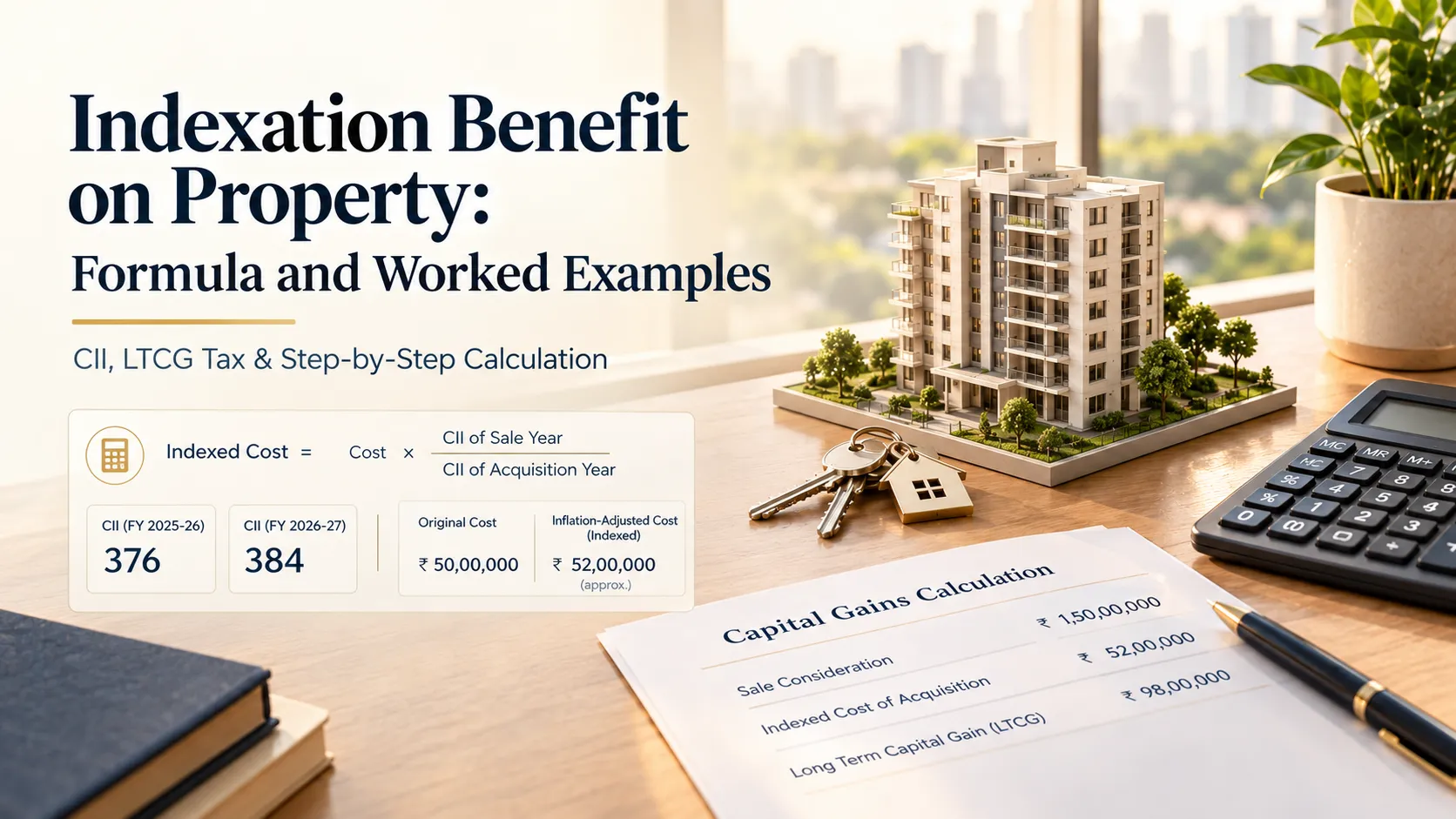
Indexed Cost of Acquisition = Original Purchase Price × (CII of Year of Sale ÷ CII of Year of Purchase)
The Cost Inflation Index uses 2001-02 as its base year, fixed at 100, and is notified by the CBDT each financial year. Recent and current values:
| Financial Year | Cost Inflation Index (CII) |
|---|---|
| 2020-21 | 301 |
| 2021-22 | 317 |
| 2022-23 | 331 |
| 2023-24 | 348 |
| 2024-25 | 363 |
| 2025-26 | 376 |
| 2026-27 | 384 |
Always confirm the exact CII for your relevant financial years against the Income Tax Department's current notification before filing, since figures for the most recent year are sometimes updated after initial publication.
Worked Example 1: Property Bought Before the Cut-Off
Scenario: A flat purchased in FY 2010-11 for ₹30,00,000, sold in FY 2025-26 for ₹95,00,000.
Step 1, Indexed Cost of Acquisition: ₹30,00,000 × (376 ÷ 167) = ₹67,54,491
Step 2, Indexed Gain: ₹95,00,000 − ₹67,54,491 = ₹27,45,509
Tax at 20% with indexation: ₹27,45,509 × 20% = ₹5,49,102
Tax at 12.5% without indexation: Gain = ₹95,00,000 − ₹30,00,000 = ₹65,00,000; Tax = ₹65,00,000 × 12.5% = ₹8,12,500
Result: The indexed, 20% method is lower here, by roughly ₹2,63,398. Since this property was acquired before 23 July 2024, the seller can legally choose the lower figure.
Worked Example 2: Property Bought After the Cut-Off
Scenario: A flat purchased in August 2024 for ₹80,00,000, sold in FY 2026-27 for ₹1,00,00,000, after crossing the 24-month holding period.
Indexation available? No, this property was acquired after 23 July 2024.
Taxable Gain: ₹1,00,00,000 − ₹80,00,000 = ₹20,00,000
Tax at 12.5%: ₹20,00,000 × 12.5% = ₹2,50,000
Result: There's no second calculation to compare against here. The flat 12.5% rate is the only applicable figure, regardless of how long the property is eventually held.
Side by side, these two examples show exactly why purchase date now matters as much as sale price. The first seller got to choose their tax treatment and save a meaningful sum. The second never had that choice to begin with.
How to Decide Which Method Saves You More
- Confirm your acquisition date against 23 July 2024. If your property was bought on or after that date, stop here, only the 12.5% flat rate applies.
- If bought earlier, calculate the indexed gain using the formula above, and apply 20% to it.
- Separately calculate the unindexed gain, sale price minus original purchase price plus eligible improvement costs, and apply 12.5% to it.
- Compare the two tax figures and choose whichever is lower, this is your legal right as a resident individual or HUF for properties acquired before the cut-off date.
- Factor in exemptions under Sections 54, 54EC, or 54F separately, since these can reduce your taxable gain further regardless of which rate method you choose.
Before you commit to a sale timeline, it's also worth projecting how your property's value is likely to move over the next few years, since the gap between the two tax methods tends to widen as the holding period grows. Our property appreciation calculator can help you model that forward view before you lock in a sale date.
What This Calculation Doesn't Cover
This covers the core indexation mechanics, but a full capital gains computation also involves indexing eligible improvement costs separately using the CII for the year the improvement was made, correctly treating inherited or gifted property using the original owner's acquisition date and cost, and applying exemptions under Sections 54, 54EC, or 54F where eligible. Each of these can materially change your final number, and getting any of them wrong on a return involving a large property sale is the kind of mistake worth avoiding. Treat this guide as the framework, and have a chartered accountant run the final figures before you file.
The Bottom Line
Indexation on property didn't vanish in Budget 2024, it narrowed. If you bought before 23 July 2024, you still have a real choice to make, and that choice can be worth lakhs. If you bought after, the calculation is simpler but offers no such lever, every rupee of nominal gain is taxed at 12.5%, inflation or not. Either way, the single most important number before you sell isn't your purchase price, it's your purchase date.
If you're planning to sell a property you've held for several years, check your purchase date against 23 July 2024 before you do anything else. That one date decides which calculation, and which tax bill, actually applies to you.
Tags
Tags
Frequently Asked Questions
About the Author
Vivek Mishra
Real Estate Advisor
He helps buyers, investors, and NRIs navigate property decisions with clarity from shortlisting the right location to understanding the legal and financial side of every transaction.