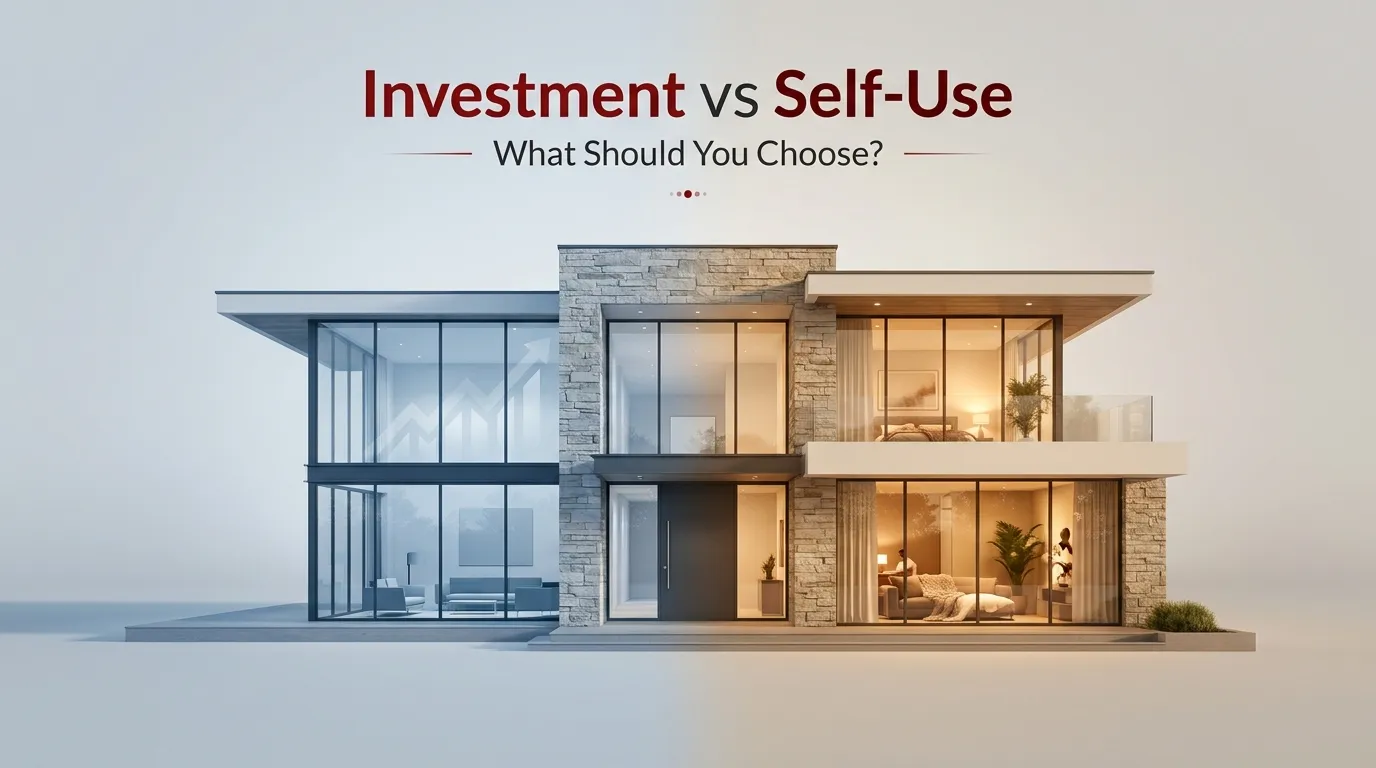
Investment vs Self-Use Property: Which Should Be Your Priority?
Investment vs Self-Use Property: Which Should Be Your Priority?
Categories
- Articles
- Market Insights
- News
Recent Posts

Articles / 07 Sept 2026
How to Check Property Registry Online in UP (Free)

Market Insights / 04 Sept 2026
Noida Circle Rates 2026: Sector-Wise Complete List

Market Insights / 02 Sept 2026
Best Home Loan Rates in India 2026: Full Comparison

Articles / 01 Sept 2026
Free Property Verification: Check Before You Invest
Choosing between Investment vs Self-Use Property is the ultimate real estate dilemma. This guide breaks down ROI vs Emotional value, the "Rent vs Buy" logic in India, and how to prioritize your first purchase for maximum financial freedom.
Investment vs Self-Use Property: What Should Be Your Priority?
Buying a home in India is rarely just a financial transaction; it is a milestone wrapped in emotions, social prestige, and the security of generations. Choosing between investment and self-use depends on your immediate life stage: prioritize self-use if you seek long-term stability and "emotional ROI," but choose investment if you already have a primary residence and want to build wealth through capital appreciation and rental yields. You’ve probably found yourself in a heated dinner-table discussion about whether it’s better to "pay your own EMI" or "let a tenant pay it for you." It’s a classic dilemma that leaves many first-time buyers paralyzed.
Here’s the thing—should you buy that 3BHK in a quiet suburb because your family loves the park nearby, or should you put that money into a 1BHK near a tech hub because the rental demand is skyrocketing? Most buyers ignore the fact that these two goals require completely different locations, budgets, and mindsets. In this guide, we’ll dive deep into the math and the psychology behind this choice to help you decide where your next crore should go.
Table of Contents
- The Fundamental Difference: Emotion vs Logic
- When to Prioritize a Self-Use Property
- The Investor’s Playbook: When ROI Comes First
- Location Strategy: Growth vs Convenience
- The Rent vs Buy Debate in India
- Financial Impact and Cost Analysis
- Comparison Table: Investment vs Self-Use
- Pros and Cons Breakdown
- Practical Tips for Modern Buyers
- Common Mistakes to Avoid
- Conclusion
- Frequently Asked Questions
1. The Fundamental Difference: Emotion vs Logic
Self-use is a lifestyle decision where comfort and sentiment drive the purchase, while investment is a cold, numbers-driven decision focused entirely on profit margins and exit strategies. When you buy a home to live in, you’re looking at the "vibe" of the neighborhood, the quality of the sunlight in the balcony, and how close the nearest grocery store is. You don't mind paying a premium for a "view" because you’ll be looking at it every morning. It’s an asset that serves your soul, but on your balance sheet, it acts more like a liability because it takes money out of your pocket every month for maintenance and EMIs without giving back cash.
Investment properties are the exact opposite. An investor doesn't care if the kitchen is small or if the tiles are a bit dated, as long as the property is 5 minutes away from a Metro station. For an investor, the property is just a vehicle to reach a financial goal. If the numbers don't add up—meaning the rental yield is too low or the area has reached its peak price—an investor walks away. Most buyers make the mistake of "falling in love" with a property they intended to only invest in, leading to poor financial returns.
2. When to Prioritize a Self-Use Property
You should prioritize a self-use property if you have a stable career, a growing family, and the financial "cushion" to handle a long-term home loan without compromising your daily lifestyle. If you are tired of the "no-pets" or "no-drilling" rules of typical Indian landlords, it’s time to look at self-use. Prioritizing your own home makes sense when you are ready to settle in a specific city for at least 7 to 10 years. In India, the transaction costs—stamp duty, registration, and brokerage—are so high that buying a home only to move in two years is a massive loss.
For example, if you're in Bangalore and your kids are starting school, the stability of an owned home outweighs the potential profits of an investment property elsewhere. I’ve noticed a real buyer trend lately: "End-users" are now looking for larger homes post-pandemic. People realize that their home is also their office and sanctuary. If your priority is quality of life and you can afford the 20% down payment without wiping out your emergency fund, self-use should be your first step. It provides a psychological "safety net" that no mutual fund can provide.
3. The Investor’s Playbook: When ROI Comes First
Prioritize investment when you already have a place to stay (or are happy renting) and you want to beat inflation through real estate’s unique ability to offer both regular income and long-term capital growth. An investor looks for "upcoming" areas, not "established" ones. If you buy in a posh, fully developed area of South Mumbai or Central Delhi, your capital appreciation might be stagnant because the prices have already peaked. Instead, an investor looks for the next "New Gurgaon" or "Navi Mumbai."
They look for government announcements—a new airport, a highway extension, or a proposed IT park. For an investor, the best time to enter is during the "pre-launch" or early construction phase, where prices are 15-20% lower than ready-to-move-in properties. Real talk: Most Indian investors are currently shifting toward "Fractional Ownership" or "Commercial Real Estate" for better yields, but residential remains a favorite for its simplicity. If your goal is to fund your child’s foreign education 15 years from now, a well-chosen residential plot in a growth corridor is a smart priority.
4. Location Strategy: Growth vs Convenience
A "Self-Use" location needs established infrastructure like schools and hospitals, whereas an "Investment" location needs "potential infrastructure" that will drive future price hikes. Think about it: A quiet, leafy lane with no shops nearby is perfect for a peaceful retirement (Self-Use). But that same quiet lane might be a terrible investment because no young professional wants to live there. They want to be near the hustle, the pubs, and the office hubs.
In India, we see this play out in cities like Pune or Hyderabad. The "Old City" areas are great for living because of the culture and heritage, but the "New Suburbs" are where the 100% price appreciation happens over five years. For self-use, you're paying for convenience today. For investment, you're paying for the convenience of tomorrow. If you buy in an area where the roads are already perfect and the Metro is already running, you’ve already paid for the appreciation. The profit was made by the guy who bought there when it was just a dusty field.
5. The Rent vs. Buy Debate in India
In most Indian Tier-1 cities, renting is financially cheaper in the short term, but buying is a superior long-term wealth-building tool due to the "forced savings" aspect of an EMI. Let’s look at a typical scenario in a city like Noida or Pune. A flat worth ₹1 Crore might rent for ₹25,000 per month. However, the EMI for that same flat would be around ₹70,000. Financially, you "save" ₹45,000 a month by renting. But here’s what most people forget: In 20 years, your rent will have tripled due to inflation, while your EMI remains stable.
At the end of 20 years, the homeowner has an asset worth perhaps ₹3-4 Crores, while the renter only has a pile of rent receipts. You’ll often hear "financial gurus" say renting is better. But they assume you will take that ₹45,000 "savings" and discipline yourself to invest it in the stock market every single month. Most people don’t. They spend it on a better car or a vacation. Real estate is "forced discipline." It’s much harder to skip an EMI than it is to skip a SIP.
6. Financial Impact and Cost Analysis
The total cost of ownership for self-use includes hidden expenses like interiors and maintenance, while investment costs must be weighed against the "Opportunity Cost" of other assets. Let’s take a real-world Indian example. Suppose you buy a property in a developing pocket of Hyderabad for ₹80 Lakhs. In a self-use scenario, you might spend ₹15 Lakhs on high-end modular kitchens and premium wardrobes. These are "dead costs" that don't increase the resale value proportionately but improve your life.
In an investment scenario, you spend only ₹3 Lakhs on basic "rent-ready" interiors (fans, lights, basic cabinets). Your goal is to hold for 7 years. If the area appreciates at 8% annually, your ₹80 Lakh property is now worth ₹1.37 Crores. Your total gain is the appreciation PLUS the collected rent, minus the interest paid on the loan. Always factor in the 1% TDS and the GST if it's an under-construction property. Interiors for self-use can easily reach 20% of the property cost, whereas for investment, you should cap it at 5%.
7. Comparison Table: Investment vs Self-Use
| Feature | Self-Use Property | Investment Property |
|---|---|---|
| Primary Driver | Comfort, Safety, Family Needs | Capital Growth, Rental Income |
| Location Choice | Close to office/schools | Close to future growth hubs |
| Interior Spend | High (Premium finishes) | Low (Functional & Durable) |
| Tax Benefits | Section 24 & 80C (Highest impact) | Interest set-off against rent |
| Exit Strategy | Rarely sold (Generational) | Sold when target ROI is met |
| Risk Level | Low (Utility value is constant) | Moderate (Market fluctuations) |
8. Pros and Cons Breakdown
Self-Use Pros
- Complete freedom to renovate
- No landlord hassles or moving costs
- Psychological security for family
- Permanent address for all documents
- Highest tax savings (Sec 24/80C)
Self-Use Cons
- Limited professional mobility
- High maintenance & interior costs
- Capital is locked in one asset
- Zero monthly cash inflow
- Emotional attachment hinders selling
Investment Pros
- Dual gains: Rent + Appreciation
- Hedge against high inflation
- Diversifies your financial portfolio
- Exit flexibility (can sell anytime)
- Tenant covers a part of the EMI
Investment Cons
- Management/Maintenance headaches
- Risk of bad tenants or vacancies
- Higher taxes on rental income
- Secondary market liquidity issues
- Lower emotional satisfaction
9. Practical Tips for Modern Buyers
Use the "Rule of 25" for investment where the property price should not exceed 25x annual rent, and follow the "30% Rule" for self-use. This means your EMI should not exceed 30% of your take-home pay. Another key tip is to check RERA: never buy an investment or self-use property that isn't RERA registered. It's your only shield against developer delays. Also, separate your emotions. If you're investing, don't worry about the "direction of the main door" as much as the "direction of the upcoming Metro line."
In the current Indian market, ready-to-move-in inventory often has "hidden" discounts. Don't be afraid to ask for a 5-7% price correction. For cities like Bangalore, ensure you’re getting an 'A' Khata property to avoid legal nightmares later. For self-use, visit the locality at 9 PM. Is it safe? Is it noisy? This is a buyer observation many people miss during daytime visits when everything looks perfect. A property that is perfect for your family might be a mediocre investment, so be clear about your "Why" before you sign that cheque.
10. Common Mistakes to Avoid
The biggest mistake is buying a "self-use" property in a "far-off investment destination" and struggling with a 4-hour daily commute. Another error is the "Emotional Overspend"—taking a larger loan than you can afford just to get a clubhouse view. It turns your dream home into a financial prison. Most buyers look at the EMI but ignore the ₹8,000 monthly Society Maintenance and yearly property tax. Don't buy for the "Future" too early; buying a house for your children who are currently 5 years old is risky as they might want to live in a different city or country.
Avoid trusting "Assured Returns" schemes. Many Indian developers offer 10% assured return schemes, but most of these are traps designed to offload bad inventory. Always prefer physical possession or a track record over paper promises. Finally, don't assume that every property will appreciate. Real estate is micro-local; one street might boom while the next one remains stagnant due to a lack of development or poor maintenance of the colony.
11. Conclusion
The debate between investment and self-use isn't about which is "better"—it's about which one fits your current life stage. If you are paying a huge chunk of your salary in rent and feeling the instability of moving houses every two years, prioritize self-use. The peace of mind of having your own roof is the best "dividend" you'll ever receive. However, if you already have a home or a stable living arrangement and have surplus cash, look at real estate as a strategic investment.
Don't try to mix both; a property that is perfect for your family might be a mediocre investment, and the best investment property might be somewhere you’d never want to live. Real estate is about more than just bricks and mortar—it's about where you feel most secure and how you want to build your legacy. Whether it's for the soul or the bank balance, make sure your priority is backed by data, not just dreams.
Frequently Asked Questions
Tags
Tags
Top 5 Best Properties in Delhi NCR This Week
Handpicked properties with best price & location
Popular in Greater Noida
Top-rated residential & commercial projects across Greater Noida