
Lal Dora Land Explained: Benefits, Risks & Legal Tips for Buyers
Lal Dora Land Explained: Benefits, Risks & Legal Tips for Buyers
Categories
- Articles
- Market Insights
- News
Recent Posts

Articles / 07 Sept 2026
How to Check Property Registry Online in UP (Free)

Market Insights / 04 Sept 2026
Noida Circle Rates 2026: Sector-Wise Complete List

Market Insights / 02 Sept 2026
Best Home Loan Rates in India 2026: Full Comparison

Articles / 01 Sept 2026
Free Property Verification: Check Before You Invest
Confused about buying property in Delhi’s Lal Dora areas? This comprehensive guide explains the 1908 "Red Line" legacy, the legal benefits of building without MCD approval, and the hidden risks of unclear titles. Learn how the PM-UDAY scheme is changing Lal Dora land ownership and how to secure your investment today.
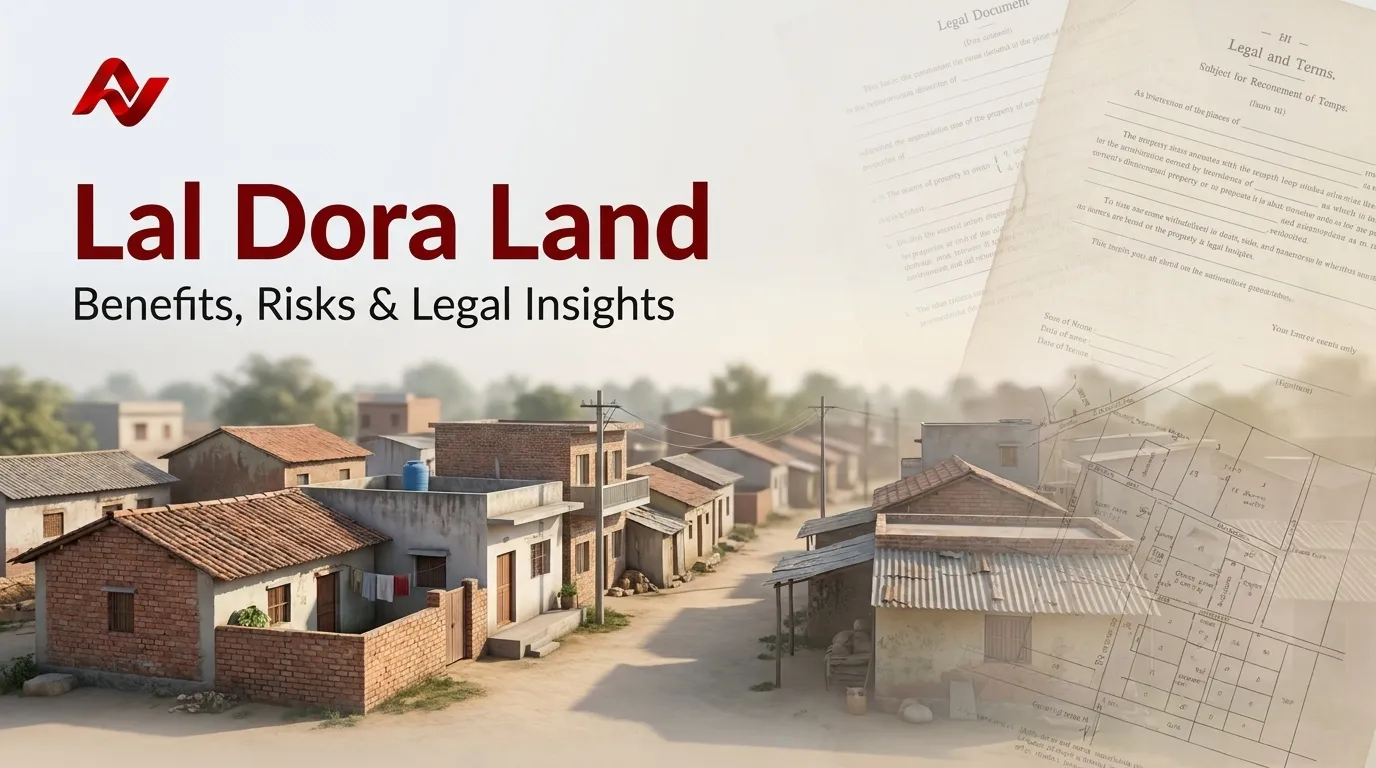
Lal Dora Land Explained: Benefits, Risks & Legal Insights
Lal Dora land is a unique property classification in India that often promises high returns but comes with significant legal baggage. If you’ve ever scouted for property in Delhi’s urban villages like Mehrauli, Chhatarpur, or Munirka, you’ve likely stumbled upon "Lal Dora" plots. These properties are significantly cheaper than DDA-approved flats, yet they remain a mystery to many urban buyers. For a seasoned investor, they represent a goldmine of affordable real estate; for a first-time homebuyer, they can feel like a legal minefield. Understanding the red line (Lal Dora) is not just about history—it's about knowing if your hard-earned money is safe.
Quick Navigation
- The Origin: What Exactly is Lal Dora?
- Legal Status and Municipal Jurisdiction
- Property Registration and the PM-UDAY Scheme
- Financial Impact: Loans, Taxes, and Hidden Costs
- Comparison Table: Lal Dora vs. Freehold
- Advantages and Disadvantages of Investing
- Common Mistakes Buyers Make
- Practical Tips for Safe Buying
- Conclusion & Final Verdict
- Frequently Asked Questions
The Origin: What Exactly is Lal Dora?
The term Lal Dora literally translates to 'Red Thread', a practice started in 1908 by the British to demarcate village habitation from agricultural land. Back then, revenue officials used red threads to mark the "Abadi" area—the part of the village where people lived and kept their livestock—on maps. This line separated the residential clusters from the vast agricultural fields surrounding them. In modern-day Delhi, there are over 360 such villages. While the city has grown around them, the "red line" remains a legal boundary that dictates what rules apply to the land inside.
Here’s the thing: while these areas were once rural, they are now smack in the middle of prime urban hubs. For example, if you walk through Hauz Khas Village, you are walking on Lal Dora land. The village hasn't moved, but the city has swallowed it whole. This creates a strange paradox where a property can be worth crores but technically lacks a standard "sanctioned plan" from the municipality.
Legal Status and Municipal Jurisdiction
One of the biggest draws—and dangers—of Lal Dora land is its exemption from the Delhi Municipal Act's building bylaws. Historically, residents within the red line didn't need to submit building plans for approval to the MCD (Municipal Corporation of Delhi). This is why you see such haphazard construction in these areas—narrow alleys, five-story buildings with zero setback, and cantilevered balconies that almost touch the building across the street. Most buyers ignore this until they face a structural issue or a neighborhood dispute.
However, "exempt from bylaws" doesn't mean "lawless." You still need a No Objection Certificate (NOC) from the Land and Revenue Department if you intend to buy or sell. For instance, I’ve seen many buyers get excited about a 100-sq-yard plot in Chhatarpur, only to realize later that they cannot legally build a high-rise commercial complex there without specific permissions, even if everyone else seems to be doing it. The authorities have started tightening the noose on large-scale commercial violations in these zones.
Property Registration and the PM-UDAY Scheme
Registration of Lal Dora property has traditionally been a grey area, often relying on GPA (General Power of Attorney) rather than a Sale Deed. For decades, these properties were transferred through "Will and GPA" or "Possession Letters." This made ownership hard to track and even harder to prove in court. However, the introduction of the PM-UDAY (Pradhan Mantri - Unauthorised Colonies in Delhi Awas Adhikar Yojana) scheme has been a game-changer. It allows residents of these colonies to apply for ownership rights and get a proper Conveyance Deed.
Don't be fooled by a seller who says, "Registry band hai" (Registration is closed). While standard registry at the Sub-Registrar's office might be restricted for certain non-regularized pockets, many Lal Dora areas are now eligible for formal ownership papers under current government schemes. You'll need to check the "Khasra" number and see if the specific pocket has been mapped by the DDA. Without a clear paper trail, you are essentially buying a "right to sit" rather than a "right to own."
Financial Impact: Loans, Taxes, and Hidden Costs
Obtaining a home loan for a Lal Dora property is notoriously difficult, as most nationalized banks stay away from non-approved constructions. If you're planning to buy using an SBI or HDFC home loan, you'll likely face a rejection unless the property has a clear, regularized title. However, NBFCs (Non-Banking Financial Companies) and private lenders do offer "Lal Dora Loans," but at significantly higher interest rates—often 2% to 4% higher than standard market rates. You'll also likely get a lower LTV (Loan to Value) ratio, meaning you'll need more cash upfront for the down payment.
On the flip side, the property tax benefits are a major win. Properties under 200 square meters in Lal Dora areas are often exempt from house tax. For a middle-class family, this saves thousands of rupees annually. But beware of the hidden costs: infrastructure is often crumbling. You might save on taxes but spend heavily on private water tankers because the Delhi Jal Board line hasn't reached your specific narrow lane yet. I've observed that buyers often forget to factor in these "convenience costs" when comparing prices.
Comparison Table: Lal Dora vs. Freehold
To make a smart decision, you must understand how these properties stack up against standard DDA or private developer freehold properties. The choice usually boils down to a trade-off between price and peace of mind.
| Feature | Lal Dora Property | Freehold / Approved Property |
|---|---|---|
| Pricing | 30% to 50% cheaper than market rate | Higher, based on circle rates |
| Bank Loans | Difficult; mostly through NBFCs | Easily available from all banks |
| Building Laws | Exempt from certain MCD bylaws | Strict adherence to sanctioned plans |
| Property Tax | Often exempt (under 200 sqm) | Mandatory as per municipal slabs |
| Registry | Limited / Via PM-UDAY scheme | Full Sale Deed / Conveyance Deed |
| Infrastructure | Haphazard, often narrow roads | Planned, with parks and wide roads |
Advantages and Disadvantages of Investing
Investing in Lal Dora land is a high-risk, high-reward play that depends entirely on your risk appetite. For many, the central location of these urban villages is the ultimate prize. Imagine living in the heart of South Delhi for the price of a flat in a distant suburb like Greater Noida.
The Advantages
- Unmatched Affordability: You can often find land at ₹40,000 per sq. yard in areas where the neighboring colony is asking for ₹2.5 Lakh per sq. yard.
- Commercial Potential: Many Lal Dora areas allow mixed-use. You can live on the first floor and run a boutique or office on the ground floor without heavy commercial conversion charges.
- Strategic Location: Most "Lal Dora" villages in Delhi are now surrounded by posh colonies, metro stations, and business districts.
The Disadvantages
- Legal Vulnerability: Without a clear "Sanctioned Plan," there is always a lingering risk of demolition if the building is found to be structurally unsafe or encroaching on public land.
- Poor Resale Liquidity: Because of the loan issues, the pool of buyers for your property is much smaller. Most buyers want "clean" properties.
- Lack of Civic Planning: Parking is a nightmare. Garbage collection is inconsistent. Sewage lines are often choked due to over-construction.
Common Mistakes Buyers Make
The most common mistake I see is buyers relying solely on a "Lal Dora Certificate" as proof of current ownership. A Lal Dora certificate only proves that the land falls within the village boundary; it does not prove that the person selling it to you actually owns that specific patch of land today. I’ve dealt with cases where a single plot was sold to three different people using the same old certificate and fake possession letters.
Another blunder is ignoring the "Chain of Documents." In Lal Dora properties, the history of who owned it before the current seller is vital. If there is a gap in the records from 10 years ago, a random relative could show up tomorrow claiming their share. Most buyers skip this due diligence because they are blinded by the low price. They assume that if electricity and water bills are in the seller's name, the title is clear. That’s a dangerous assumption—utilities do not prove ownership in a court of law.
Practical Tips for Safe Buying
If you’ve decided to take the plunge, you must treat the verification process like a forensic investigation. Don't just take the broker's word for it. They are incentivized to close the deal, not protect your life savings.
- Verify the "Khatoni": Check the revenue records (Khatoni) at the Tehsildar's office. This will tell you the original allotted owner and any existing mortgages or litigations.
- Check PM-UDAY Status: See if the property is already registered on the DDA portal for ownership rights. If it is, the path to a clear title is much easier.
- Physical Measurement: Ensure the dimensions on the ground match the papers. Encroachment is rampant in these areas; you don't want to buy 100 yards only to find 15 yards are actually part of a public drain.
- NOC from SDM: Always insist on a fresh No Objection Certificate from the Sub-Divisional Magistrate for the transfer of land.
Conclusion & Final Verdict
Lal Dora land is not for the faint-hearted or the "safe" investor, but it remains one of the last few ways to own land in Delhi without being a billionaire. If you are a first-time homebuyer looking for a peaceful, planned lifestyle, stick to DDA flats or RERA-approved projects. However, if you are a savvy investor who knows how to navigate the local Tehsildar's office and is looking for long-term capital appreciation or rental yields, Lal Dora property in a well-connected village can be a goldmine.
My advice? Hire a specialized property lawyer who has experience specifically with Delhi's revenue land. A few thousand rupees spent on a legal search today can save you lakhs in litigation tomorrow. Remember, in the world of Lal Dora, the "Red Line" can either be a boundary of protection or a warning sign—it all depends on your due diligence.
Frequently Asked Questions
Tags
Tags
Top 5 Best Properties in Delhi NCR This Week
Handpicked properties with best price & location
Popular in Greater Noida
Top-rated residential & commercial projects across Greater Noida