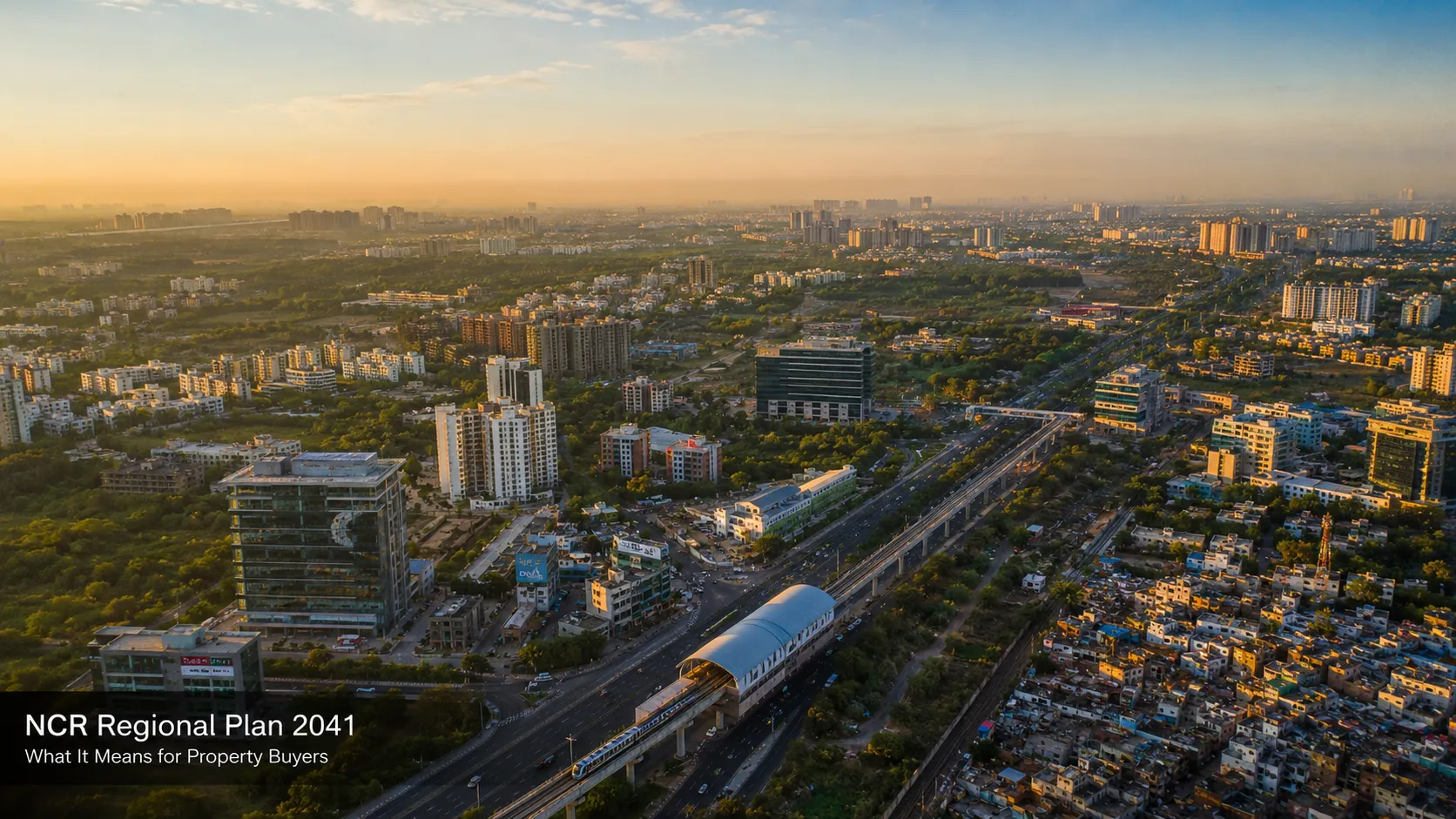
NCR Regional Plan 2041: What It Means for Property Buyers
Categories
- News
- Market Insights
- Tips
Recent Posts

News / 22 Sept 2026
New Noida Land Acquisition 2026: List of 37 Villages in Phase 1

Market Insights / 21 Sept 2026
Registry Charges in Delhi 2026: Full Rate Table & Guide

News / 21 Sept 2026
8 Best Property Hotspots in NCR: Where to Actually Buy

Market Insights / 19 Sept 2026
Cost Inflation Index 2026: Full Table and How to Apply It
NCR Regional Plan 2041 has a bold promise — any major city in the region reachable from Delhi in 30 minutes. But what does that actually mean for someone buying property today? This guide breaks down which localities stand to gain the most, what's already happening on the ground, and the one mistake most buyers make every time a big infrastructure plan drops.
There's a document sitting with the National Capital Region Planning Board right now that could quietly reshape where millions of people choose to live, work, and invest in the next two decades. It's called the NCR Regional Plan 2041 — and if even half of what it proposes gets built, the property map of Delhi NCR is going to look very different by the time your home loan is paid off.
The headline proposal everyone's talking about is the "30-Minute NCR" — a vision where any major city in the region is reachable from Delhi within half an hour, through a combination of new RRTS corridors, metro extensions, expressways, and upgraded rail networks. That's Delhi to Noida, Delhi to Gurugram, Delhi to Meerut — all within 30 minutes.
Sounds ambitious. But here's the thing: parts of this are already happening. And whether the full plan delivers on schedule or takes longer than promised — which infrastructure projects in this region often do — the direction of travel is clear. Connectivity is coming to corridors that were previously considered too far, too inconvenient, or too uncertain. And property prices in those corridors will move accordingly.
Let's break down what this actually means for buyers making decisions today.
Table of Contents
- What Is NCR Regional Plan 2041 — And Why It Matters Now
- The 30-Minute NCR Vision Explained
- Four New Namo Cities — What They Mean for Buyers
- Which Localities Stand to Gain the Most
- What's Already Happening on the Ground
- Does This Change the City vs Suburb Decision?
- The Mistake Buyers Keep Making With Infrastructure News
- What Should You Actually Do Right Now
- The Bottom Line
What Is NCR Regional Plan 2041 — And Why It Matters Now
The NCR Regional Plan is the long-term master framework that guides land use, infrastructure, and development across the entire National Capital Region — all 55,000 square kilometres of it, spread across Delhi, Haryana, Uttar Pradesh, and Rajasthan. The 2041 version is the updated draft that was reviewed at the 42nd meeting of the National Capital Region Planning Board in June 2026, chaired by the Union Housing and Urban Affairs Minister.
This isn't a local sector plan or a builder's project brochure. It's the government's official blueprint for how this entire region is supposed to grow over the next 15 to 20 years. When something like this moves through the NCRPB, it carries real weight — not because every proposal becomes reality on schedule, but because the ones that do tend to permanently shift where value accumulates in the region.
Property buyers who paid attention to the previous NCR Regional Plan proposals and bought along corridors that eventually got RRTS or metro connectivity have generally done well. The ones who waited for everything to be confirmed before acting typically paid a significantly higher price for the same locations.
The 30-Minute NCR Vision Explained
The centrepiece of Regional Plan 2041 is the idea of a fully integrated, high-speed transit network that compresses travel time across the entire NCR. The target: any major residential or business hub reachable from Delhi within 30 minutes.
This would be achieved through a combination of new RRTS corridors running at speeds up to 160 km/h, extended metro lines, upgraded expressways, and — interestingly — heli-taxi services for point-to-point connectivity in specific zones. The plan also proposes dividing the NCR into three development zones, with different regulatory frameworks for each, designed to spread economic activity more evenly rather than concentrating it all around Delhi, Gurugram, and Noida.
The implications for real estate are straightforward: when commute time shrinks, the "too far" discount on peripheral localities disappears. Areas that buyers currently avoid because of long travel times become genuinely viable — and prices adjust to reflect that new reality, usually well before the infrastructure is finished.
For a closer look at how the existing RRTS and metro expansion are already affecting specific NCR corridors today, this breakdown of metro expansion and property price jumps across NCR covers the ground-level picture in more depth.
Four New Namo Cities — What They Mean for Buyers
Alongside the transit proposals, Regional Plan 2041 introduces the concept of four greenfield "Namo Cities" — entirely new urban centres planned from scratch within the NCR. The intent is to create new economic poles that pull jobs, institutions, and residents away from the already-saturated core of Delhi and its immediate neighbours.
History tells us that greenfield city announcements in India have a mixed track record. Some deliver. Some stall for decades. But the announcement itself does something specific to property values in the surrounding areas: it creates anticipation, and anticipation moves prices.
The practical advice here is to watch which specific locations are shortlisted for these new cities as details emerge, and pay attention to the land acquisition and infrastructure sequencing that follows. Early-stage buying near a confirmed greenfield city location has historically produced strong returns — but the keyword is "confirmed," not "announced."
Which Localities Stand to Gain the Most
Based on the Regional Plan 2041 proposals and the transit corridors already in progress, a few types of localities are particularly well-positioned.
Corridors Along Planned RRTS Extensions
The Delhi-Meerut RRTS is already partially operational. The Delhi-Alwar and Delhi-Panipat corridors are at various stages of planning and approval. Localities sitting along these alignments — particularly those currently underpriced because of poor connectivity — have the most to gain as construction progresses. Ghaziabad's expressway belt, parts of Sonipat toward Panipat, and the Gurugram-Rewari-Alwar corridor all fall into this category.
Greater Noida and the Eastern NCR Belt
Greater Noida and Greater Noida West have already been benefiting from the Aqua Line metro and the Yamuna Expressway. Regional Plan 2041 adds another layer of long-term justification for this corridor — better transit integration, new development zones, and the planned Jewar Airport RRTS link. For buyers already evaluating this area, the macro tailwind has just gotten stronger.
Old Delhi Periphery and Northern Corridors
Areas along the northern and eastern edges of Delhi — localities that gained from the Pink Line's ring completion — are part of a broader pattern where previously ignored parts of the city are getting transit access for the first time. Regional Plan 2041 accelerates that trend through new metro extensions and urban development zones.
If you're weighing a peripheral locality against an established city address, this comparison of city vs suburb investment in Delhi NCR is a practical starting point before you shortlist.
What's Already Happening on the Ground
It's easy to read a government plan document and treat it as entirely future-tense. But several components of what Regional Plan 2041 formalizes are already underway.
The Delhi-Meerut RRTS priority corridor from Sahibabad to Duhai opened to passengers in October 2023. The full stretch to Meerut is progressing. The Gurugram Metro extension from HUDA City Centre to Cyber City received Cabinet approval in 2026. The Pink Line's ring corridor is operational. These aren't plans — they're running systems or confirmed projects with funding and political backing.
The 2041 plan doesn't create this momentum from scratch. It formalizes and extends a trajectory that's already visible on the ground. That's actually the more bullish signal for property buyers — it means the connectivity story isn't speculative. Parts of it are already real, and the plan locks in the direction for the parts that aren't yet.
Does This Change the City vs Suburb Decision?
For a long time, the case for buying in established city locations — a flat in Janakpuri, a resale apartment in Dwarka, something in South Delhi — rested partly on the connectivity advantage. You paid more, but you were close to everything. The suburbs made you choose between space and access.
Regional Plan 2041 chips away at that trade-off. If the 30-minute NCR vision even partially delivers, the connectivity premium that established city locations charge starts to compress. Suburbs that were "too far" become competitive. Buyers who locked in peripheral locations ahead of this shift do well. Buyers who only felt comfortable in proven city locations may find the gap narrowing — but at prices that have already reflected the suburban growth story.
This doesn't mean city locations lose value. Well-connected, mature addresses like Janakpuri — with Metro access, established social infrastructure, and strong resale demand — hold their appeal for good reason. There's a detailed read on why in this guide to buying a home in Janakpuri in 2026. The point is simply that the relative advantage of city addresses over well-connected suburban ones is smaller than it used to be — and getting smaller.
The Mistake Buyers Keep Making With Infrastructure News
Every time a plan like this drops, two predictable mistakes follow.
The first is an overreaction — buyers rush into localities purely on the strength of an announcement, paying prices that already bake in optimistic assumptions about timelines that may slip by five to ten years. Infrastructure projects in India move on government timelines, which means they move slowly, get revised, and sometimes change alignment entirely. Buying at "post-announcement" prices in a location that's still a decade from actual connectivity is a difficult position to be in.
The second mistake is under-reaction — dismissing the plan entirely because it's "just talk." The buyers who said that about the Delhi-Meerut RRTS in 2018 and 2019 missed a meaningful appreciation window along that corridor as construction became visible and credible.
The rational middle ground: treat confirmed construction as a buying signal, treat Cabinet approval as an early-stage opportunity with risk priced in, and treat announcement-stage proposals as things to monitor — not act on immediately.
What Should You Actually Do Right Now
If you're a buyer deciding in 2026, Regional Plan 2041 gives you a useful framework — but it shouldn't replace basic financial due diligence.
Start by understanding what your numbers actually look like. Before any locality decision, run your budget through a Home Loan EMI Calculator to see your realistic monthly outflow, and use a Property ROI Calculator to model what appreciation looks like at different timeline assumptions. Infrastructure stories are compelling, but they don't pay your EMI — your salary does.
Then apply the plan's lens: which of the localities you're already considering sit along confirmed or near-confirmed transit corridors? Which ones get an additional tailwind from the 2041 framework? Which ones are still purely speculative plays on an announcement that may be fifteen years from delivery?
That filter — applied on top of solid financial planning, not instead of it — is how you use a document like Regional Plan 2041 productively.
The Bottom Line
NCR Regional Plan 2041 is one of the more significant policy documents for land for Delhi NCR real estate in recent years. Not because every proposal in it will happen on time — they won't. But because it confirms the direction, formalizes the intent, and extends a connectivity story that's already visibly underway.
The 30-Minute NCR isn't a reality yet. But the localities that will benefit most from it are identifiable today, some of them are still reasonably priced, and buyers who do their homework now rather than waiting for the ribbon-cutting tend to come out ahead.
The opportunity is real. It just belongs to the patient and the prepared — not the panicked.
Want to understand which localities along these transit corridors make sense for your specific budget and timeline? Explore current listings or speak with a local expert who tracks infrastructure progress on the ground — not just what's in the headlines. #PropertyKaDNA
Tags
Tags
Frequently Asked Questions
Top 5 Best Properties in Delhi NCR This Week
Handpicked properties with best price & location
Popular in Greater Noida
Top-rated residential & commercial projects across Greater Noida