New 29-km Noida Expressway: What It Means for Property Buyers
Categories
- Tips
- Guides
- Market Insights
- Articles
Recent Posts

Tips / 28 Sept 2026
How to Check Whether a Plot of Land Is Legally Safe to Buy

Guides / 28 Sept 2026
How to Calculate Rental Yield: Formula and Worked Examples

Guides / 26 Sept 2026
How Much Home Loan Can You Get on Your Salary in 2026?

Guides / 25 Sept 2026
10 Things to Check in a Property Sale Deed Before Registration
A new parallel expressway alongside the Noida-Greater Noida Expressway has been approved. Here's what it means for commuters and property buyers along the corridor.
If you've spent any meaningful time driving between Noida and Greater Noida during peak hours, you already know the problem. The existing Noida-Greater Noida Expressway — 25 kilometres, built to handle a fraction of its current load — now sees an estimated 5 lakh vehicles every single day. That's not a congestion issue. That's a structural capacity problem, and it's been getting worse every year.
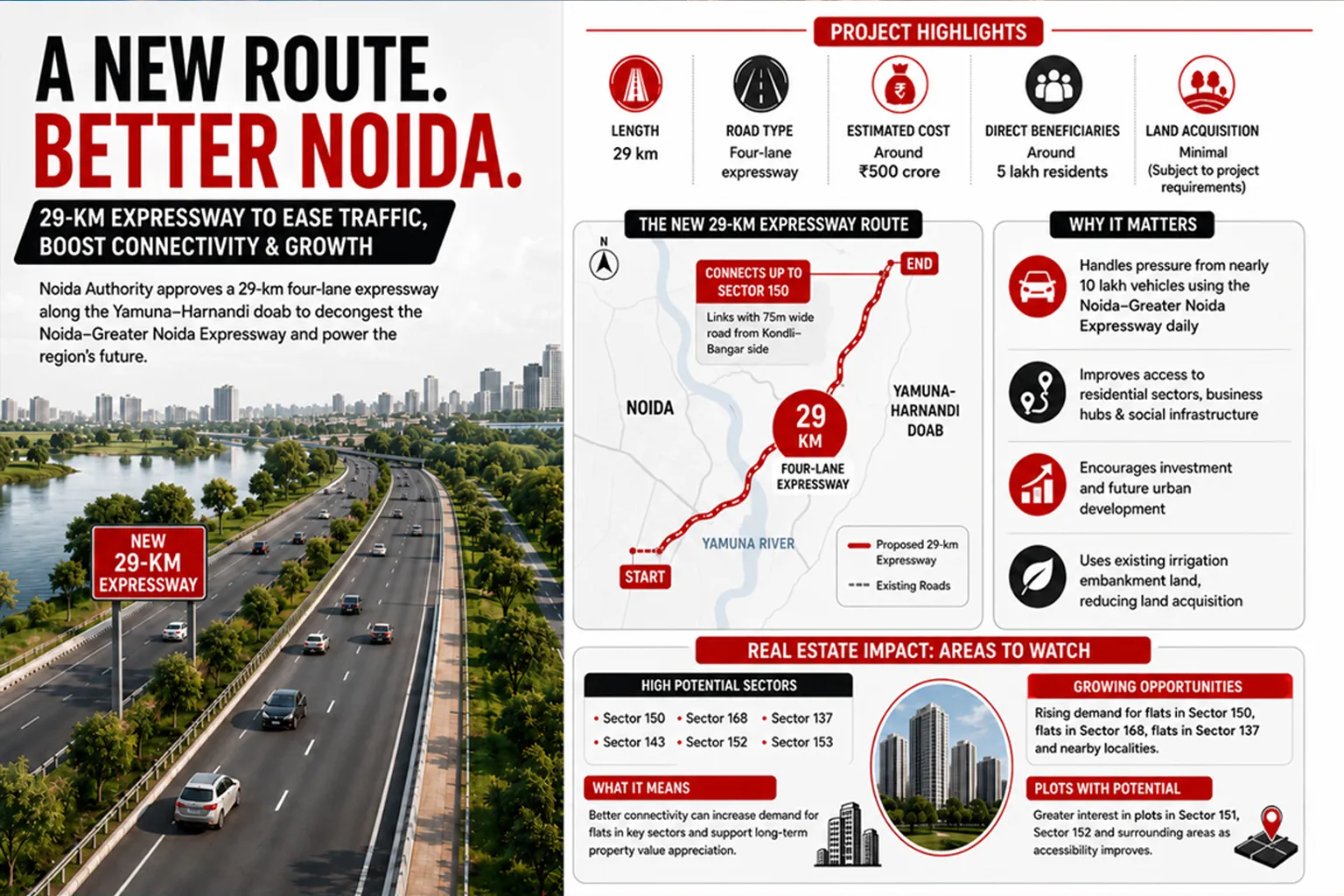
The good news: there's a concrete plan to fix it. The Noida Authority has given in-principle approval to a second expressway running parallel to the existing one — a 29 to 35-kilometre corridor that would trace the Yamuna River's path and connect Delhi, Noida, Greater Noida, and the upcoming Jewar International Airport. The Noida Authority wants to build this in collaboration with the National Highways Authority of India (NHAI), and the proposal has received backing from Union Road Transport and Highways Minister Nitin Gadkari.
For daily commuters, this is long-overdue relief. For property buyers and investors evaluating the Noida-Greater Noida corridor, it's a signal worth understanding carefully — because infrastructure of this scale doesn't just change commute times. It changes property values, rental demand, and the entire logic of where it makes sense to buy.
Table of Contents
- Why the Existing Expressway Can No Longer Cope
- What the New Expressway Actually Proposes
- The Jewar Airport Connection — Why This Project Is Urgent
- The Broader Infrastructure Picture
- What This Means for Property Buyers Along the Corridor
- Which Sectors Are Worth Watching
- A Real-World Observation: How This Pattern Plays Out
- What Buyers Should Be Careful About
- The Bottom Line
Why the Existing Expressway Can No Longer Cope
The Noida-Greater Noida Expressway was designed for a very different version of this corridor. When it was built, Greater Noida West barely existed as a residential destination. Jewar Airport was a proposal on paper. The expressway's residential and commercial catchment was a fraction of what it is today.
Around two lakh vehicles enter the expressway via the DND Flyway daily. Another lakh come in from Chilla Border and Kalindi Kunj. Additional traffic pours in from core Noida sectors — 15, 16, 18, and 37. The numbers have grown year on year as Greater Noida West developed, as more people moved to sectors along the expressway, and as the Jewar Airport project brought new employment and development into the corridor.
The result is predictable: a road that was never designed for this volume is now a daily bottleneck for lakhs of commuters. And with the Jewar Airport expected to open and add significantly more traffic to this corridor, the problem without intervention would only compound.
What the New Expressway Actually Proposes
The Noida Authority currently has two plans under consideration for the new expressway:
Option A: A 35-kilometre eight-lane road running parallel to the Yamuna embankment from Kalindi Kunj Barrage in Delhi to the Yamuna Expressway in Greater Noida.
Option B: A 35-kilometre six-lane elevated road following a similar alignment.
Both options aim to create a signal-free, access-controlled bypass that allows vehicles to travel between Delhi, Noida, Greater Noida, and the Yamuna Expressway without touching the congested sectors of the existing expressway. The route runs along the Yamuna River's path — which is both its advantage (less urban disruption) and its engineering challenge (riverbank alignment requires careful design).
Once complete, travel times between Delhi and Greater Noida are projected to drop to approximately 20 minutes. The new expressway would also serve as a direct bypass route for vehicles heading to Jewar Airport without needing to navigate through the busy Noida Expressway corridor at all.
The Jewar Airport Connection — Why This Project Is Urgent
The Jewar International Airport — officially the Noida International Airport — is the single biggest demand driver for this new expressway, and it's the reason the timeline has sharpened.
When the airport becomes operational, it will dramatically increase passenger traffic through this corridor. Commuters from Delhi, Ghaziabad, and western NCR who choose Jewar over IGI Airport will need a fast, reliable route. The existing expressway simply cannot absorb that additional load on top of its current volume.
BJP MP Mahesh Sharma, who originally proposed the new expressway, was direct about it: "To fully leverage Jewar Airport's potential, building a direct and efficient road link is not just necessary, it's urgent." That framing — urgency, not just convenience — reflects the scale of what's coming and the inadequacy of current infrastructure to handle it.
The Broader Infrastructure Picture
This new expressway doesn't sit in isolation. It's part of a much larger infrastructure transformation happening across Delhi NCR simultaneously.
The 8-lane elevated expressway planned from the DND Flyway — announced in July 2026 — would connect Delhi directly to the Noida Airport in approximately 30 minutes, passing through key areas of Noida before reaching Greater Noida and connecting with the Agra Expressway. When combined with the parallel expressway proposal, the effect is a multi-corridor, signal-free network that fundamentally changes the travel logic between Delhi and the southern NCR.
The Delhi-Mumbai Expressway — entering Delhi via the DND Flyway — adds another layer to this web. Its 9-kilometre Delhi-Noida-Meethapur stretch was expected to be operational by June 2026, which creates a further connection between the expressway network and the national highway grid.
Separately, the Urban Extension Road-II (UER-II) — a 76-kilometre corridor built at ₹7,716 crore — is now operational, cutting travel time from Noida to IGI Airport to approximately 20 minutes. That's a completed project, not a proposal — and it demonstrates what this type of infrastructure actually delivers once it's in place.
What This Means for Property Buyers Along the Corridor
The relationship between major road infrastructure and property values in NCR is well-documented at this point. When a significant expressway, tunnel, or metro project moves from announcement to confirmed approval with visible backing, asking prices in directly affected localities start moving within six to twelve months. By the time the infrastructure is operational, a meaningful portion of the appreciation has already occurred.
The new Noida-Greater Noida parallel expressway is currently at the in-principle approval stage — backed by the Noida Authority board and supported by central government. It's not under construction yet. The alignment hasn't been finalised between the two options. That means the market hasn't fully priced it in — which is precisely where informed buyers have historically found their window.
What changes with this expressway specifically:
Travel time compression. Sectors along the Yamuna embankment that are currently considered inconvenient because of distance from the existing expressway become significantly more accessible. Properties that carry a location discount today may not carry it five years from now.
Rental demand expansion. More connectivity means a larger catchment of potential tenants. Professionals working in Noida's Sector 62 or 63 who currently rule out Greater Noida addresses because of commute predictability will reconsider when a signal-free bypass is available.
Jewar Airport adjacency premium. The expressway strengthens the case for buying along the Yamuna corridor specifically — the zone that sits between the existing expressway and the new one, and that directly benefits from airport proximity combined with improved connectivity.
Which Sectors Are Worth Watching
Greater Noida West — Sectors Along the Yamuna Embankment
The proposed alignment runs along the Yamuna, which means sectors in Greater Noida West that sit closer to the river — rather than deeper into the residential grid — get the most direct benefit. These are often the sectors that currently carry a modest location discount. That discount narrows when the expressway is confirmed and narrows further when it's built.
Sectors Between the Two Expressways
Once both the existing and new expressways are operational, properties in sectors that sit between the two corridors gain a dual-access advantage — reachable from either route depending on traffic. That flexibility has real daily value and tends to be reflected in rental premiums over time.
The Jewar Airport Influence Zone
Plotted developments and early-stage residential projects along the Yamuna Expressway between Greater Noida and Jewar are already seeing investor interest. The new parallel expressway adds another connectivity argument to a zone where the airport thesis was already driving attention. The combined effect — airport proximity plus a new direct road link — is meaningful for long-horizon buyers.
A Real-World Observation: How This Pattern Plays Out
The Noida-Greater Noida Expressway itself is the most instructive case study for understanding what a new road corridor does to property values in this region. When the expressway was built, sectors along it — 137, 150, 168 — were considered peripheral and inconveniently located. Over the decade that followed, they became some of the most actively transacted addresses in Noida. The expressway didn't just change commute times. It changed the mental map of where people were willing to live.
The new parallel expressway has the potential to do something similar for the sectors along the Yamuna embankment — corridors that are currently overlooked not because they lack land or scale, but because they lack the road infrastructure to make daily life practical. That infrastructure is now in the planning pipeline with genuine political and administrative backing.
What Buyers Should Be Careful About
In-principle approval is not the same as under construction. The Noida Authority has given board-level approval and is exploring collaboration with NHAI. That's meaningful. But alignment hasn't been finalised, land acquisition hasn't begun, and a construction timeline hasn't been confirmed. Buying at post-announcement prices with a three-year exit expectation is a risk. This is a five-to-ten-year story.
Not all sectors along the Yamuna benefit equally. The alignment will run through specific zones — once it's finalised, some sectors will be directly adjacent to the new road while others will benefit only indirectly. Waiting for alignment clarity before buying in a specific sector is a reasonable approach for buyers who want more certainty about which zones gain the most.
The Bottom Line
The proposed parallel expressway between Noida and Greater Noida is one of the more consequential infrastructure decisions for this corridor in recent years. It addresses a real, documented problem — the existing expressway simply cannot handle projected traffic growth — with a solution that has credible institutional backing and a clear strategic rationale tied to the Jewar Airport timeline.
For property buyers evaluating the Noida-Greater Noida corridor, the message from Avorix is consistent with what we've seen across every major infrastructure cycle in NCR: the window between confirmed approval and visible construction is when informed buyers act. By the time the expressway is operational, the appreciation it drives will largely have already happened.
The commute is about to change. The question is whether you're positioned before or after that change gets priced in.
Evaluating property along the Noida-Greater Noida corridor or the Jewar Airport influence zone and want to understand which specific sectors and projects make sense for your budget and timeline? Speak with a local expert who tracks this market at the micro-level — not just the headline infrastructure news. #PropertyKaDNA
Tags
Tags
Frequently Asked Questions
About the Author
Admin
Top 5 Best Properties in Delhi NCR This Week
Handpicked properties with best price & location
Popular in Greater Noida
Top-rated residential & commercial projects across Greater Noida