
Occupancy Certificate vs Completion Certificate: Key Differences Explained
Categories
- Guides
- Articles
Recent Posts

Guides / 05 Nov 2026
Property Tax in Delhi vs Noida vs Gurugram: Key Differences Explained (2026)

Guides / 03 Nov 2026
How to Choose the Right Plot Size for Your Dream Home
Articles / 03 Oct 2026
Indexation Benefit on Property: Formula and Worked Examples

Guides / 03 Oct 2026
Noida vs Gurgaon: Which City Is Better for Property Investment?
Most buyers never notice the difference between a Completion Certificate and an Occupancy Certificate until a bank, a utility office, or a buyer's lawyer asks for the one they don't have. Here's what each document actually confirms, why builders blur the two, and what to check before you accept possession.
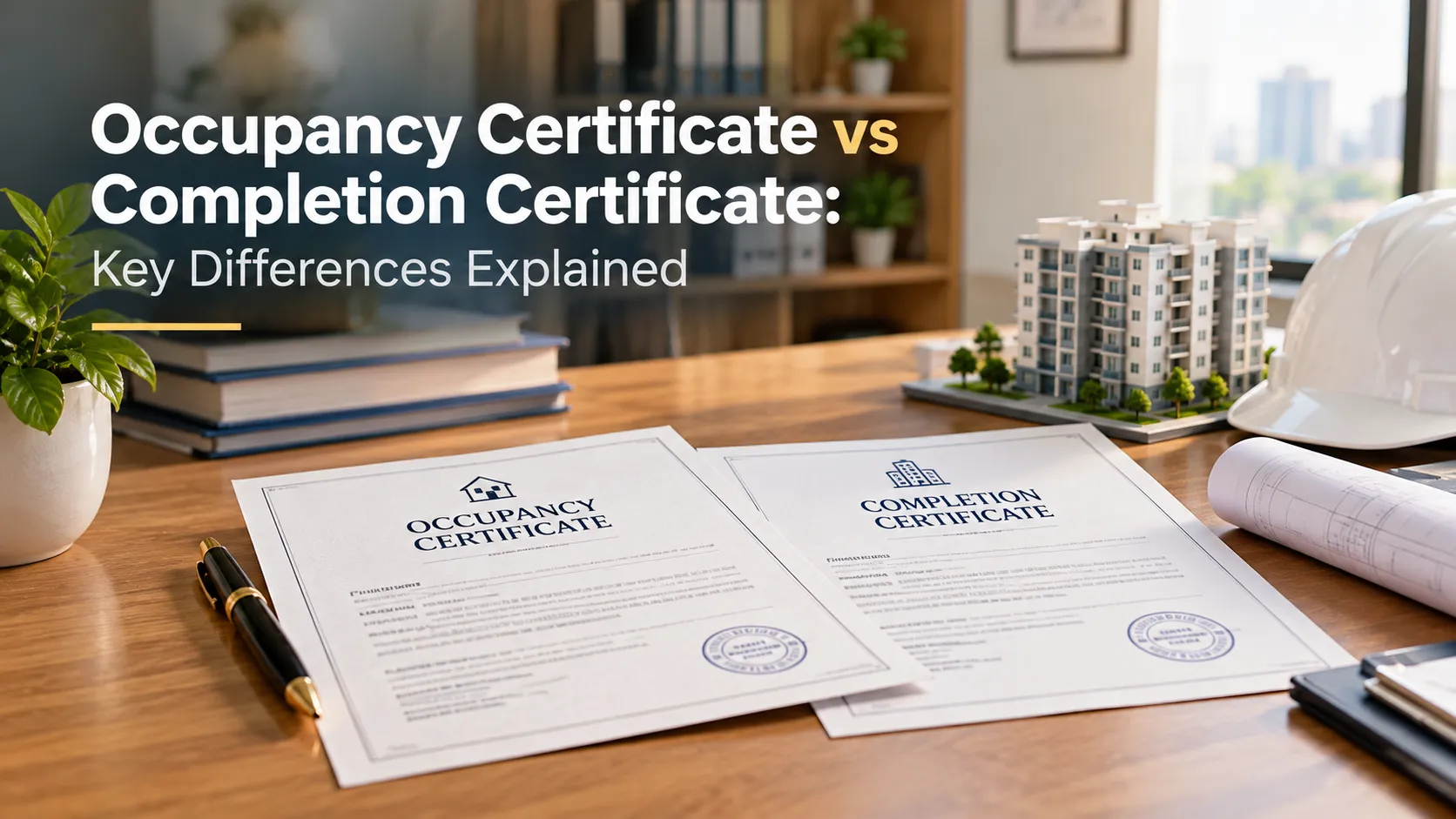
Occupancy Certificate vs Completion Certificate is a question most buyers only start asking after possession, usually when a bank, a utility office, or a buyer's lawyer asks for a document they don't have. The Occupancy Certificate and the Completion Certificate are handed over in the same folder, stamped by the same municipal office, and look almost identical to an untrained eye. Completion Certificate confirms one thing. OC vs CC confusion happens because builders rarely explain that the two documents answer completely different legal questions, and only one of them says you're allowed to actually live there.
Here's what most explainers skip: they define both terms and stop, as if knowing the definitions protects you. It doesn't. What protects you is knowing which one you were actually handed at possession, and what to do if it's the wrong one.
Table of Contents
- The Blur Builders Rely On
- What Is a Completion Certificate?
- What Is an Occupancy Certificate?
- OC vs CC: The Key Differences
- Why This Distinction Matters Before You Buy
- Occupancy Certificate, Completion Certificate, and Your Home Loan
- How Builders Obtain CC and OC
- What to Actually Check Before Possession
- The Bottom Line
The Blur Builders Rely On
Picture collecting your car from a workshop after a repair, and the mechanic hands you a printed sheet confirming the parts were installed correctly. That sheet tells you the work was done as specified. It doesn't tell you the car has passed its roadworthiness test and is legal to drive on the road. Most people would never confuse the two. In real estate, buyers confuse the equivalent constantly, accepting a Completion Certificate at possession and assuming it carries the same legal weight as an Occupancy Certificate, because both arrive from the same municipal office and both have an official-looking seal.
That's the one thing worth remembering from this entire guide: a Completion Certificate says the building was built as approved. An Occupancy Certificate says you're legally permitted to live in it. The first document is about the builder's compliance. The second is about your right to occupy. Confusing them at possession is where most of the downstream trouble starts.
What Is a Completion Certificate?
A Completion Certificate, or CC, is issued by the local municipal authority, MCD in Delhi, BBMP in Bengaluru, GHMC in Hyderabad, MCGM in Mumbai, confirming that a building has been constructed in accordance with the sanctioned building plan: approved layout, height restrictions, setbacks, and structural norms. In plain terms, CC is the municipality confirming that what got built matches what was approved on paper.
A completion certificate typically records the property address and survey details, the builder's name, the date of inspection, confirmation of plan compliance, and the authorising officer's signature. What it does not confirm is whether utilities are functional, whether fire safety systems work, or whether the building has cleared the checks needed for people to actually move in. That's a separate certificate, issued separately, usually later.
What Is an Occupancy Certificate?
An Occupancy Certificate, or OC, is issued by the same municipal authority after the CC, confirming that the building is safe and ready for people to live in. Where the CC checks construction against the plan, the OC checks the building's readiness for habitation: functional firefighting systems, lifts, water and electricity connections, sanitation, and compliance with the fire and safety norms required before occupation is legally permitted.
In most Indian jurisdictions, occupying a building without an OC is not a grey area, it's technically illegal, even if the flat is fully finished, furnished, and the builder has already handed you the keys.
OC vs CC: The Key Differences
| Parameter | Completion Certificate (CC) | Occupancy Certificate (OC) |
|---|---|---|
| What it confirms | Construction matches the approved plan | Building is safe and ready for occupation |
| Issued by | Local municipal authority | Local municipal authority, after the CC |
| Order of issue | Issued first | Issued after CC and safety checks pass |
| What is checked | Floor plan compliance, structure, setbacks | Fire safety, utilities, lifts, sanitation |
| Occupation without it | Building is technically incomplete on record | Occupying is illegal in most jurisdictions |
| Typically required for | Property registration eligibility | Home loan disbursement, utility connections, legal residence |
The relationship between them is sequential, not interchangeable. Without a CC, a project cannot legally obtain an OC. Without an OC, there is no legal permission to occupy the building, regardless of how complete the flat looks or how confidently the builder hands over the keys.
Why This Distinction Matters Before You Buy
Builders sometimes hand over possession the moment the CC arrives, because a Completion Certificate is easier and faster to obtain than an OC, and delaying possession until the OC comes through can mean months of additional holding cost for the developer. Buyers accept this because the document in hand looks official, the flat is move-in ready, and nobody at the sales desk explains that a CC alone doesn't legally clear you to move in.
The consequences of skipping this check surface later, and usually at the worst possible time: denial of a permanent electricity or water connection, refusal of a home loan disbursement, complications during resale when a buyer's lawyer asks for the OC and it doesn't exist, and in some cases, exposure to demolition or sealing action under municipal law for unauthorised occupation. None of this is a rare edge case. Plenty of completed, fully-occupied buildings across Indian cities are still operating years later without a formal OC, quietly accumulating risk for every owner inside them.
Occupancy Certificate, Completion Certificate, and Your Home Loan
Lenders treat these two documents differently at different stages of a purchase. During under-construction disbursement, banks typically work off the sanctioned plan and progress certificates rather than the OC, since the building isn't finished yet. But for a ready-to-move-in property, most lenders will ask for the OC specifically before releasing the final tranche or processing the loan for resale purchases, precisely because the OC is what confirms the building is legally habitable, not just structurally built.
If you're buying a "ready" flat and the seller or builder can only produce a CC, that's worth pausing on, not necessarily walking away from, but pausing on. Ask directly whether the OC has been applied for, and get a written timeline rather than a verbal assurance.
How Builders Obtain CC and OC
- Construction is completed as per the sanctioned building plan submitted at the approval stage.
- The builder applies for the CC, submitting completion drawings and structural certifications for municipal inspection.
- Municipal officials inspect the site, verifying the built structure against the approved plan, and issue the CC if it matches.
- The builder then applies for the OC, which requires additional clearances: functional fire safety systems, lift certification, water and sewage connections, and often a fire NOC and environmental clearance depending on project size.
- A second inspection is conducted specifically for occupation-readiness, and the OC is issued once every requirement is met.
The gap between these two steps is exactly where delays happen, and exactly where some builders choose to hand over possession early rather than wait.
What to Actually Check Before Possession
- Ask specifically for the OC, not just "the completion papers." Builders sometimes use the terms loosely in conversation even though the documents are legally distinct.
- Check the document's date and issuing authority against the project's actual municipal jurisdiction, a mismatch or missing seal is a red flag worth escalating.
- If only a CC exists, get the OC application status in writing, including an expected timeline, before accepting possession or making a final payment tranche.
- For resale properties, request both certificates as part of the standard document set, alongside the sale deed and encumbrance certificate, before finalising the transaction.
If you're unsure how to read or verify these documents against a specific project, running a proper check before you commit is worth the time. Our property verification process covers exactly this, confirming OC and CC status alongside title and approval checks, so you're not relying on a builder's word for something this consequential.
The Bottom Line
A Completion Certificate and an Occupancy Certificate answer two different questions, and only one of them tells you it's legal to live in the flat you're about to buy. The blur between them isn't accidental in every case, it's often convenient for whoever is handing over the keys before the second document exists. Ask for the OC by name, check the date, and don't treat a CC as a substitute simply because it arrived in the same folder.
Next time you're at a possession meeting or reviewing a resale property, ask to see the OC specifically, not just "the certificate." That one question is often the difference between a clean purchase and a problem you discover years later.
Tags
Tags
Frequently Asked Questions
About the Author
Admin