
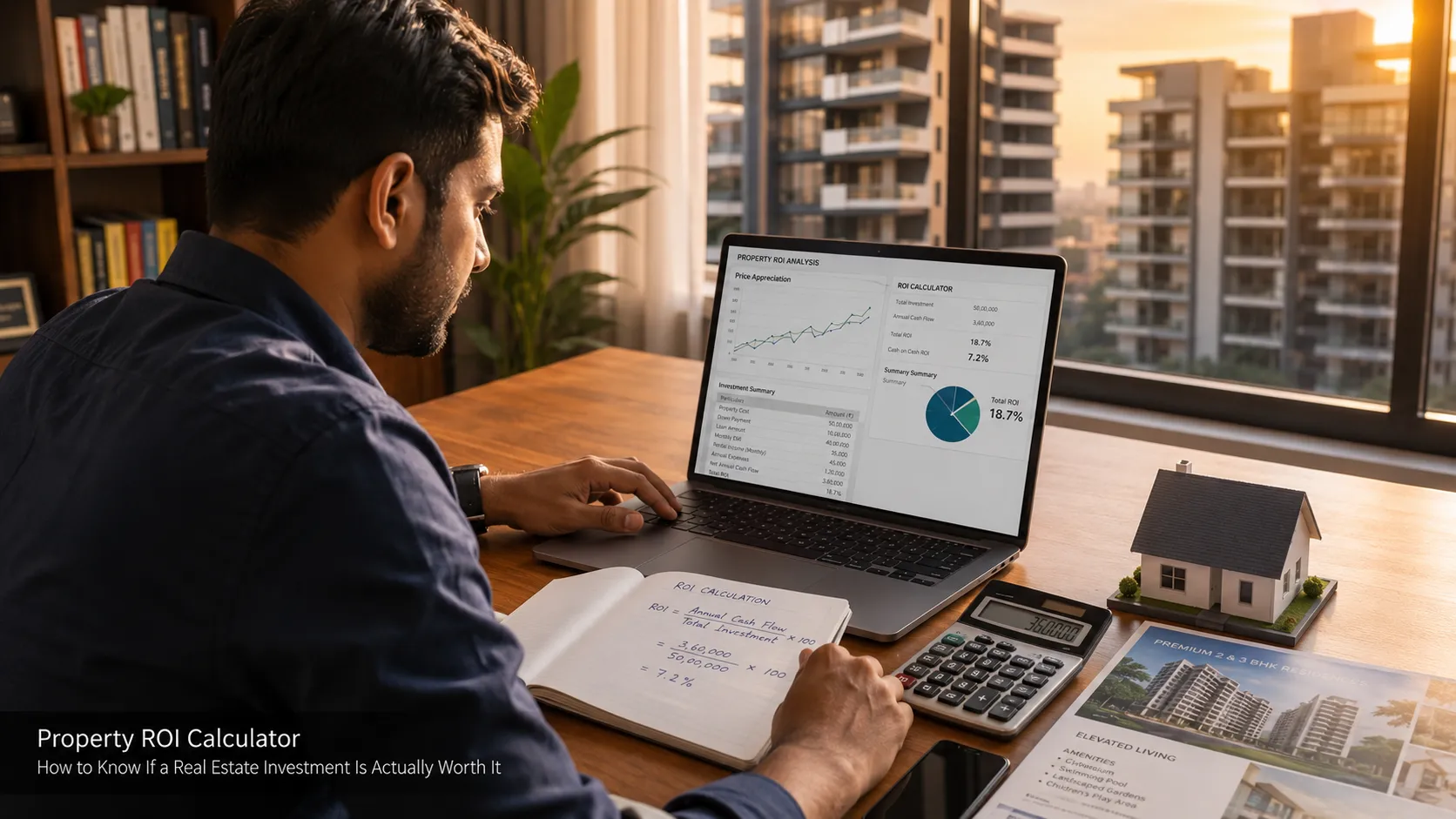
Property ROI Calculator: How to Know If a Real Estate Investment Is Actually Worth It
Categories
- News
- Market Insights
- Tips
Recent Posts

News / 22 Sept 2026
New Noida Land Acquisition 2026: List of 37 Villages in Phase 1

Market Insights / 21 Sept 2026
Registry Charges in Delhi 2026: Full Rate Table & Guide

News / 21 Sept 2026
8 Best Property Hotspots in NCR: Where to Actually Buy

Market Insights / 19 Sept 2026
Cost Inflation Index 2026: Full Table and How to Apply It
Stop guessing your property returns. Learn how a real estate return calculator works, what inputs matter, and how to use ROI data to make smarter investment decisions in NCR.
Most people who buy property in India think of it as a safe bet. And broadly speaking, they're not wrong — real estate has historically been one of the more reliable long-term stores of value in this country. But "safe" and "smart" are two different things, and the gap between them is usually a number that most buyers never actually calculate before signing.
That number is your ROI — return on investment. And the uncomfortable truth is that most property buyers in Delhi NCR, Noida, and across India make purchase decisions based on gut feel, broker enthusiasm, and a rough idea that "property prices go up." Very few sit down and run an actual real estate return calculator before committing what is often the biggest financial decision of their lives.
This isn't a lecture. It's a practical guide to understanding what ROI means in the context of property, what goes into calculating it properly, and why getting this number right — before you buy, not after — changes the quality of the decisions you make.
Table of Contents
- What Does ROI Actually Mean for a Property Investment
- Why Most Investors Only Look at Half the Picture
- How a Property ROI Calculator Works — The Key Inputs
- A Real-World Scenario: Two Flats, One Clear Answer
- Two Mistakes That Quietly Kill Property Returns
- What a Good ROI Looks Like in the NCR Context
- Before You Buy, Run the Numbers
What Does ROI Actually Mean for a Property Investment
Return on investment in real estate is simply the gain you make from a property relative to what you put in. Sounds straightforward. In practice, it has two components that most people treat separately but should evaluate together.
The first is rental yield — the annual rent you earn as a percentage of the property's purchase price. If you buy a flat for ₹60 lakhs and rent it out for ₹18,000 a month, your gross rental yield is roughly 3.6%. That's the income side of your investment.
The second is capital appreciation — how much the property's market value has grown over time. If that same flat is worth ₹80 lakhs five years later, your capital gain is ₹20 lakhs on a ₹60 lakh investment — that's significant, but it's only realised when you sell.
A proper real estate return calculator brings both of these together into a single picture — your total ROI over a defined holding period. That combined view is what actually tells you whether a property is a good investment, not either number in isolation.
Why Most Investors Only Look at Half the Picture
Here's a real-world pattern I've seen repeatedly among first-time investors in Noida and Greater Noida: they buy a flat, rent it out, and feel good about the monthly rent coming in. When asked what their ROI is, they quote the rental income.
But they've ignored the maintenance charges, the property tax, the vacancy months between tenants, and the management overhead. Net rental yield in most NCR localities, once you account for these, tends to be somewhere between 2% and 3.5% — which sounds underwhelming until you add the capital appreciation story on top.
The flip side also happens: buyers in high-appreciation zones like parts of Gurugram or South Delhi focus entirely on price growth and assume the rental income doesn't matter. Then they hold an empty flat for three years, waiting for "the right price" while carrying a home loan EMI, and the real cost of holding starts eating into their returns.
A real estate return calculator forces you to account for both sides simultaneously. That's not a small thing — it's the difference between feeling like an investor and actually behaving like one.
How a Property ROI Calculator Works — The Key Inputs
A good property ROI calculator asks you for a specific set of inputs. Understanding what each one means helps you fill them in accurately rather than optimistically.
Purchase Price and Down Payment
This is your starting point. The total cost should include stamp duty, registration charges, and any brokerage paid — not just the flat's listed price. In Delhi NCR, stamp duty and registration typically add 6% to 8% to the headline price depending on the state and buyer profile. Leaving this out understates your actual investment.
Expected Monthly Rent
This should be a realistic market rent for the specific locality, configuration, and floor — not the best-case scenario. A useful check: look at what similar units in the same society are currently renting for, not what the developer's brochure suggests. In Noida Sector 137, for instance, a well-maintained 2 BHK might fetch ₹16,000 to ₹20,000 per month depending on the society. In Sector 62, the same configuration often commands ₹22,000 to ₹28,000 because of proximity to corporate hubs.
Expected Annual Growth Rate
This is where most people either get too conservative or dangerously optimistic. A realistic long-term annual appreciation rate for established NCR localities sits between 5% and 9% depending on the specific corridor, infrastructure trajectory, and market cycle. Newer localities with confirmed infrastructure projects — like areas along the Delhi-Meerut RRTS — may warrant a slightly higher assumption, but anything above 10% per year as a baseline is speculative rather than conservative planning.
Holding Period
How long you plan to stay invested matters enormously. Property as an asset class typically needs a minimum of five to seven years to produce meaningful real returns after transaction costs are accounted for. If you're thinking three years or less, the numbers usually don't work well unless you bought at a significant discount or the locality is in a sharp appreciation phase.
Ongoing Costs
Maintenance charges, property tax, insurance, and vacancy periods — typically modelled as one to two months of lost rent per year — should all be factored in. A calculator that only shows gross yield without netting these out is giving you a misleading picture.
A Real-World Scenario: Two Flats, One Clear Answer
Consider two buyers evaluating options in Noida in the same month.
Buyer A picks a flat in an emerging sector — purchase price ₹45 lakhs, expected rent ₹12,000 per month, projected appreciation 8% per year over seven years. After running the numbers, gross rental yield of 3.2%, net yield around 2.4% after costs, combined ROI over seven years comes to approximately 68% on total investment.
Buyer B picks a flat in a more established sector — purchase price ₹72 lakhs, expected rent ₹22,000 per month, projected appreciation 6% per year over the same period. Gross rental yield of 3.7%, net yield around 2.9%, combined ROI over seven years comes to approximately 57%.
On gut feel, most people would pick Buyer B's flat — bigger, better area, higher rent. The calculator says Buyer A's investment is likely to generate a better total return on the capital deployed. That's the kind of clarity that only comes from actually running the numbers — not from a broker's pitch or a WhatsApp forward about price trends.
You can run exactly this kind of comparison using the Property ROI Calculator — plug in your actual numbers and see the total return picture before you commit.
Two Mistakes That Quietly Kill Property Returns
Mistake 1: Using Listed Price Instead of Total Cost
The flat costs ₹60 lakhs. By the time you've paid stamp duty, registration, brokerage, and initial maintenance deposit, you're closer to ₹66 or ₹67 lakhs. ROI calculated on ₹60 lakhs looks better than reality. This is one of the most common calculation errors among first-time investors, and it consistently produces overconfident return expectations.
Mistake 2: Ignoring the Cost of Vacancy
A flat that sits empty for two months between tenants has lost roughly 17% of its annual rental income. Over a seven-year holding period, with two or three such gaps, the cumulative impact on net yield is significant. Build it into your model from the start rather than being surprised by it later.
What a Good ROI Looks Like in the NCR Context
There's no single "right" answer — it depends on your investment thesis. But as a rough framework for Delhi NCR in 2026:
A net rental yield of 2.5% to 3.5% on a well-located flat is realistic and healthy. Anything above 4% in an established locality warrants closer inspection — it may be accurate, or the purchase price may be below market for a reason.
A combined ROI (rental + appreciation) of 50% to 80% over seven years is a solid outcome for a mid-segment residential investment in a good NCR corridor. That's not spectacular by equity market standards, but it comes with significantly lower volatility and the optionality of personal use.
If you're comparing property investment against other asset classes or weighing up which part of NCR makes the most sense for your budget, this comparison of city vs suburb investment in Delhi NCR is a useful read before you shortlist.
Before You Buy, Run the Numbers
Property investment rewards the prepared. Not the fastest, not the most enthusiastic — the ones who sat down with a calculator before they sat down with a broker.
The inputs aren't complicated. The math isn't difficult. What's difficult is the discipline of doing it honestly — using realistic rent figures, conservative appreciation assumptions, and actual total costs rather than headline prices.
If you're currently evaluating a property in Noida, Greater Noida, Janakpuri, or anywhere else in NCR, spend twenty minutes with a real estate return calculator before your next site visit. The number you get won't decide for you — but it will make sure the decision you make is based on something real.
And if you want to understand what to look out for before you finalise any deal beyond just the numbers, this guide on important things to check before finalising a property deal covers the due diligence side in practical detail.
Looking at a specific property and want a second opinion on the numbers? Speak with a local expert who can help you stress-test your assumptions before you commit. The best investment decisions are rarely made in a hurry — and rarely made without running the math first. #PropertyKaDNA
Tags
Tags
Frequently Asked Questions
Top 5 Best Properties in Delhi NCR This Week
Handpicked properties with best price & location
Popular in Greater Noida
Top-rated residential & commercial projects across Greater Noida