
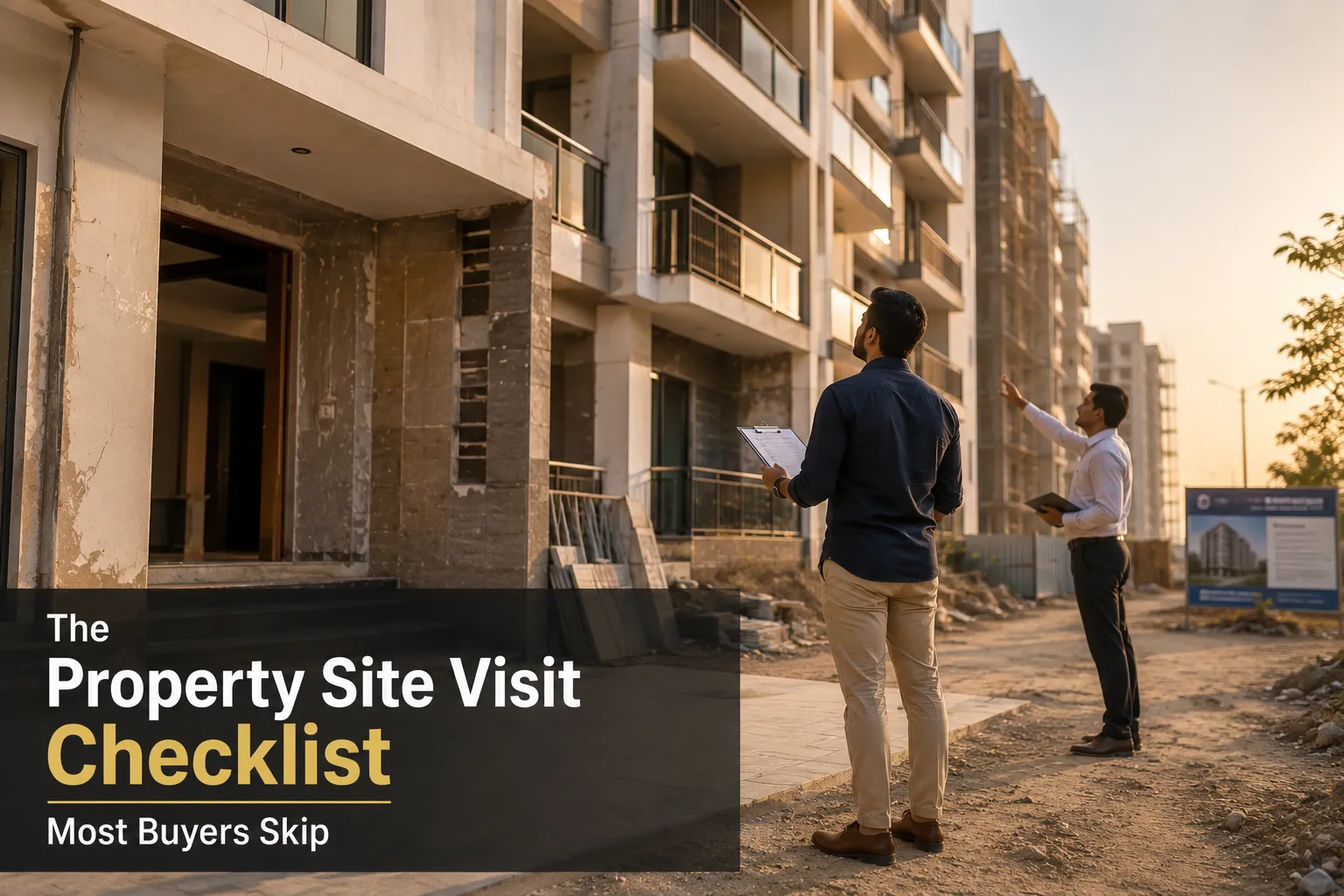
The Property Site Visit Checklist Most Buyers Skip
Categories
- News
- Market Insights
- Tips
Recent Posts

News / 22 Sept 2026
New Noida Land Acquisition 2026: List of 37 Villages in Phase 1
Market Insights / 21 Sept 2026
Registry Charges in Delhi 2026: Full Rate Table & Guide

News / 21 Sept 2026
8 Best Property Hotspots in NCR: Where to Actually Buy

Market Insights / 19 Sept 2026
Cost Inflation Index 2026: Full Table and How to Apply It
A site visit is your one real chance to verify what brochures, floor plans, and virtual tours promise. Here's the complete inspection checklist, from location and construction quality to documents and the red flags that should make you pause before booking.
These are the questions every serious buyer should be asking, and most don't ask thoroughly enough. A site visit isn't a formality. It's your one real opportunity to verify that what you've been shown in brochures, floor plans, and virtual tours actually exists on the ground. And in a market like Delhi NCR, where presentation quality has improved dramatically, but construction quality hasn't always kept pace, what you notice and what you miss during a site visit can make a meaningful difference to the decision you make.
This checklist is built from real site visit experience across Noida, Greater Noida, Gurugram, and Delhi. It covers everything from the moment you step out of your car to the questions you should ask before leaving — organised so you don't miss anything in the adrenaline of seeing a flat you actually like.
Table of Contents
- Before You Go — Prepare, Don't Just Show Up
- 1. The Location Check — What the Surrounding Area Tells You
- 2. The Building and Common Areas
- 3. Inside the Flat — What to Look At Carefully
- 4. Construction Quality — The Details Most Buyers Skip
- 5. Amenities — Promise vs Reality
- 6. Documents to Ask For During the Visit
- 7. Visit at Different Times — This Matters More Than It Sounds
- Red Flags That Should Give You Pause
- A Real-World Scenario: The Detail That Changed the Decision
- A Note From Avorix
Before You Go: Prepare, Don't Just Show Up
The most useful thing you can do before a property site visit is research the project independently — not through the developer's materials. Check the UP RERA portal (for Noida and Greater Noida properties) or the Haryana RERA portal for Gurugram projects. Confirm the registration number, the committed possession date, and whether the developer has filed quarterly construction progress reports. A project with multiple missed quarterly updates is flagging something worth investigating before you arrive.
Also: go with a checklist, not just curiosity. Most buyers visit sites with enthusiasm and leave having missed half the things that matter. The items in this guide are organised in the sequence you'll encounter them during a typical visit — use it on your phone as you walk through.
1. The Location Check: What the Surrounding Area Tells You
Before you enter the gate, spend 10 minutes walking or driving around the immediate neighbourhood. This is the most underused part of any property site visit, and it tells you things no brochure will.
Road quality. Are the internal roads asphalted and maintained, or are they broken and dusty? Internal road quality reflects both the developer's civic commitment and the local authority's maintenance standards. Poor roads that haven't been fixed in an occupied society tell you something about what the next ten years will look like.
Distance to daily essentials. Walk to or at minimum drive to the nearest grocery store, pharmacy, school gate, and hospital entrance. Don't take the developer's claim that "everything is nearby" at face value. Measure it yourself. A 5-minute drive on a map can be 20 minutes in peak-hour reality.
What's being built adjacent to the society. A commercial complex going up next to your bedroom window is something you'd want to know about. A metro station under construction 800 metres away is something worth knowing too. Check what the land use around the project actually is not what the developer's render shows it as.
Noise and air quality. Stand outside for five minutes. Is there a highway directly behind the project? A factory nearby? These aren't deal-breakers for everyone, but they need to be conscious decisions.
2. The Building and Common Areas
Once inside the society, resist the urge to go straight to the sample flat. Spend time in the common areas first — they're a much more honest indicator of how the project is maintained than any dressed-up model unit.
- Are the lifts clean, functional, and well-lit? How many lifts per tower, and is that adequate for the number of floors?
- Is the lobby well-maintained or showing signs of neglect peeling paint, stained floors, broken fixtures?
- Are the stairwells clean and adequately lit?
- Is there visible water seepage or dampness on external walls, particularly near the basement or lower floors?
- How is the parking organised? Is it covered or open? Is the ratio of parking to units reasonable?
- Is the compound wall well-maintained and does the entry gate have functional security infrastructure like CCTV, intercom, boom barrier?
3. Inside the Flat: What to Look At Carefully
If it's a ready-to-move or occupied property, you're looking at the actual flat. If it's a sample flat for an under-construction project, you're looking at a dressed version factor in that the actual flat may differ in finish quality.
Natural light and ventilation. Open every window. Check the cross-ventilation. A flat that feels bright and airy during the visit but has only north-facing windows will be dark in winter. Check the actual orientation not what the floor plan labels say.
Room sizes. Carry a measuring tape or use your phone's measurement app. Developers sometimes show furniture scaled smaller than real-world dimensions to make rooms appear larger. A bed that looks fine in the sample flat may not fit the actual bedroom comfortably.
Kitchen layout and storage. Does the kitchen have adequate counter space, storage, and ventilation? Is there a window or exhaust point? Is there a utility/dry area for washing machine placement?
Bathroom quality. Run every tap. Check water pressure. Check whether hot water provision is in place. Look at the tile grouting early deterioration here is a sign of poor waterproofing that will cause seepage problems later. Check for any existing damp patches on bathroom walls or ceilings.
Balcony size and usability. Is the balcony of a usable size or is it a token 20-square-foot ledge? What does it face?
4. Construction Quality: The Details Most Buyers Skip
This is the section most first-time buyers skip because they don't know what to look for. These are specific, observable indicators that construction quality is either solid or concerning.
- Wall finishing: Run your hand along internal walls. They should be smooth and even. Ripples, patches, or visible brush strokes in the plaster indicate poor finishing that will be costly to correct later.
- Floor levelness: In a ready flat, check whether doors swing freely without resistance. Doors that stick or don't close properly suggest floor settling or poor installation.
- Window and door frames: Check the seal between frame and wall. Gaps here allow water ingress during monsoon. Check that doors open and close without scraping.
- Ceiling height: Standard is 9 to 10 feet. Anything below 9 feet in a premium project is worth querying.
- Electrical points: Are there adequate power points in each room? Check that switches are at consistent heights and properly aligned — sloppy electrical work is a visible proxy for overall construction care.
- Seepage and cracks: Look carefully at ceiling corners, window frames, and bathroom walls for hairline cracks or staining that indicates water ingress. This is one of the most expensive post-possession problems to fix.
5. Amenities: Promise vs Reality
Developer brochures describe amenities. Site visits reveal whether they exist and whether they function. These are non-negotiable things to check.
- Is the clubhouse built and operational, or is it still under construction?
- Is the swimming pool filled and maintained, or is it empty concrete?
- Is the gym equipped with real equipment, or is it a room with a treadmill and a poster?
- Are the children's play areas functional and safely maintained?
- Is there 24x7 power backup for common areas and individual units? Ask to see the DG set.
- Is there a functioning water treatment plant or are residents dependent on external water supply tankers?
In occupied societies, speak to a resident if you get the opportunity. Ask them directly: "Is the maintenance good? Are there water problems? How does the RWA function?" Ten minutes with an actual resident is worth more than an hour with the developer's sales team.
6. Documents to Ask For During the Visit
A site visit isn't only a physical inspection. It's also an opportunity to see key documents that you should verify independently before making any payment.
- RERA registration certificate for the specific project
- Approved building plan and sanctioned layout
- Occupancy certificate (for ready-to-move properties)
- Latest construction progress report
- Sample copy of the Builder-Buyer Agreement
- Maintenance charge structure in writing
Any developer or seller who is reluctant to share these during or after a site visit is giving you important information. Transparency during the sales process is a reasonable proxy for transparency post-possession.
7. Visit at Different Times : This Matters More Than It Sounds
Most buyers visit once typically mid-morning on a weekday or during a developer's organised site visit. That's the best possible version of the site. Visit again on a weekday evening, when residents are home, traffic is at its peak, and the society is functioning under real daily stress. What you observe in these two conditions is often meaningfully different.
Parking availability at 8 PM tells you something about the parking-to-unit ratio that the developer's numbers won't. Noise levels at 6 PM tell you something about the highway or school proximity that a quiet Tuesday morning didn't. Water pressure during peak morning hours tells you something about the building's plumbing that a mid-afternoon visit missed.
Red Flags That Should Give You Pause
Some things observed during a site visit aren't just note-worthy they're genuine caution signals.
- Visible water seepage or dampness on multiple walls or ceilings in a ready project
- A sample flat that is significantly better finished than the actual flats you're shown (ask to see an actual unit, not just the model)
- A developer who cannot produce the RERA registration number on request
- An occupancy certificate that hasn't been obtained for a project that's already been occupied for over a year
- An RWA that doesn't exist or isn't functional in an occupied society
- Promised amenities that are "coming soon" in a project where other phases have already delivered
- Maintenance dues that are significantly in arrears in a society you're evaluating resale inventory in
A Real-World Scenario: The Detail That Changed the Decision
A buyer evaluating a 3 BHK in Greater Noida West had completed two visits and was close to booking. During a third visit — this time in the evening — she noticed that the parking area, which had seemed spacious during her morning visits, was completely full with vehicles parked in the driveway, blocking part of the entrance. She spoke to a resident who confirmed that the society had significantly more cars than covered parking slots, and that the situation had become a recurring friction point with the RWA.
She didn't cancel the purchase on the basis of this alone but she used it to negotiate a lower price (the project had been on the market for some time), and she verified the actual parking allocation in the BBA before signing. That evening visit the one she almost skipped gave her information that two earlier morning visits hadn't.
A Note From Avorix
At Avorix, every property site visit we organise is structured around the buyer's questions — not the developer's pitch. We accompany buyers through the checklist above, help them ask the right questions of on-site staff and residents, and flag anything that doesn't align with what the project has represented in its documentation.
If you're planning a site visit to a property in Noida, Greater Noida, or anywhere else in Delhi NCR and want someone with ground-level knowledge of the project walking through it with you, book a guided site visit with the Avorix team we'll make sure the visit answers the questions that actually matter before you make your decision.
The difference between a good property purchase and a disappointing one often comes down to what you noticed and what you missed during the visit. Don't let it be the latter. #PropertyKaDNA
Tags
Tags
Frequently Asked Questions
Top 5 Best Properties in Delhi NCR This Week
Handpicked properties with best price & location
Popular in Greater Noida
Top-rated residential & commercial projects across Greater Noida