
5 Real Estate Clauses You Should Never Sign Blindly

Categories
- Guides
- Articles
Recent Posts

Guides / 05 Nov 2026
Property Tax in Delhi vs Noida vs Gurugram: Key Differences Explained (2026)

Guides / 03 Nov 2026
How to Choose the Right Plot Size for Your Dream Home
Articles / 03 Oct 2026
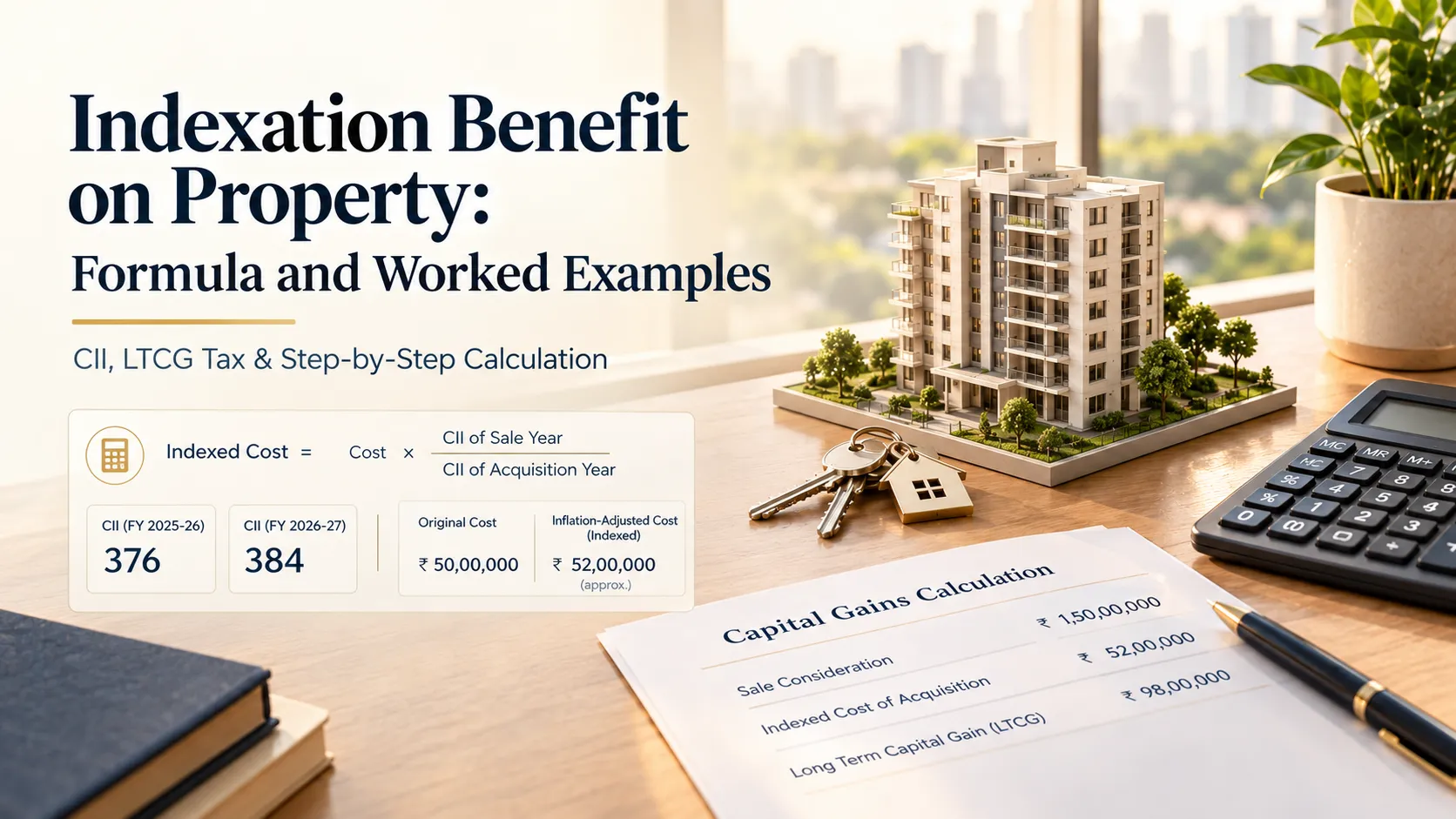
Indexation Benefit on Property: Formula and Worked Examples

Guides / 03 Oct 2026
Noida vs Gurgaon: Which City Is Better for Property Investment?
Five clauses in your property agreement can lock up your money for years, and most buyers sign past them in under an hour. Here's what to look for before you sign.
You read the price. The floor. The facing. You visited twice, liked what you saw, and now there's an agreement in front of you 28 pages, dense with legal language, and the sales executive is telling you it's standard. Everyone signs this.
Here's the thing: a property agreement isn't a receipt confirming you're buying. It's the document that governs every dispute, delay, and deviation between booking and possession. And most buyers sign it in under an hour, having read almost none of it.
Not every clause in that agreement protects you. Some quietly protect the builder. Some create asymmetric penalties where you pay heavily for defaulting, but the builder pays almost nothing for the same behaviour. Some define your flat in a way that gives you measurably less than you thought you were buying.
A ₹50 lakh property deserves more than a 10-minute read. Here are the five clauses that can lock up your money for years: what each one actually means, what a bad version looks like, and what you should insist on instead.
Table of Contents
- Are Buyer and Builder Penalties Actually Balanced in This Agreement?
- Can the Price Increase After You've Booked?
- Do You Actually Know the RERA Carpet Area You're Buying?
- How Much Could You Lose If You Need to Exit?
- What Events Can Legally Delay Your Possession — Indefinitely?
- What to Do Before You Sign Any Property Agreement
Are Buyer and Builder Penalties Actually Balanced in This Agreement?
This is the clause most buyers never think to compare — and it's often the most revealing one in the entire document.
Standard builder-buyer agreements include two penalty structures: one for the buyer defaulting (missing a payment), and one for the builder defaulting (missing possession). In a fair agreement, these should be roughly equivalent. In practice, they frequently aren't sometimes dramatically so.
A buyer missing a payment might face 18% annual interest on the overdue amount, plus the right of the builder to cancel the booking after 30 days. A builder missing possession might owe the buyer ₹5 per sq ft per month as compensation — which on a 1,200 sq ft flat is ₹6,000 per month, or ₹72,000 per year. On a ₹70 lakh flat delayed by two years, that's ₹1.44 lakhs in total compensation — 2% of the property value — against a background where the builder has held your money for years.
The Real Estate (Regulation and Development) Act, 2016 (RERA) has improved this. RERA mandates that if a buyer is liable to pay interest for delayed payment, the builder must pay the same rate of interest for delayed possession. The rate is typically the SBI MCLR plus 2% — currently around 10.65% per annum.
What a bad clause looks like: "In the event of delay in handing over possession, the Company shall pay compensation at ₹5 per sq ft per month."
What it should say: "In the event of delay in handing over possession beyond the committed date, the Company shall pay interest at SBI MCLR + 2% per annum on the amounts paid by the Allottee, for the period of delay."
What to do: Compare the buyer default rate and the builder default rate. If they're not equal, negotiate. RERA-registered projects are legally required to offer parity — if the agreement doesn't reflect this, it may not be RERA-compliant.
Can the Price Increase After You've Booked?
You agreed on ₹65 lakhs. You signed. You paid the booking amount. Six months later, a letter arrives saying the price has been revised due to "increased construction costs" or "government levy changes" — and you owe an additional ₹3.5 lakhs.
This happens. And whether it's legal depends entirely on what the escalation clause in your agreement says.
Some agreements include an explicit escalation clause allowing the builder to revise the price under specific triggers — government levies, GST changes, material cost indices. Others include blanket escalation rights with almost no cap. And some — particularly in RERA-registered projects — explicitly prohibit unilateral price changes after booking, which is how it should work.
The escalation clause is particularly important for under-construction properties with 2 to 4 year possession timelines. A lot can change in construction costs over that period. If your agreement allows open-ended escalation, the final cost of your flat is not fixed — it's a floor, not a ceiling.
What a bad clause looks like: "The Company reserves the right to revise the sale price in the event of changes in government levies, construction costs, or statutory charges."
What it should say: "The total price as agreed shall remain fixed and shall not be subject to any upward revision, except in the case of statutory levies imposed by the government after the date of this agreement, which shall be borne proportionately by the Allottee at actual cost."
What to do: Ask explicitly whether the price is fixed or subject to escalation. Get the answer in writing, not verbally. Check the RERA filing for the project — the declared price per sq ft should be on record and any deviation from it is challengeable.
Do You Actually Know the RERA Carpet Area You're Buying?
This is the clause buyers most consistently get wrong not because the language is tricky, but because the terminology is confusing and sellers know it.
Three different area measurements appear in property marketing: super built-up area (the largest, includes common areas and structural walls), built-up area (slightly smaller, includes your walls), and carpet area (the smallest — the actual usable floor area inside your flat, measured wall to wall). The same flat can be described as 1,500 sq ft (super built-up) or 1,050 sq ft (carpet area). That's a 30% difference in what you're actually buying.
Under RERA, all residential projects must disclose and sell on the basis of carpet area — not super built-up. This is mandatory, not optional. If your agreement is priced on super built-up area, or doesn't clearly state the RERA carpet area, it may be non-compliant — and you're almost certainly getting less usable space than the marketed number suggests.
What a bad clause looks like: "The Allottee agrees to purchase an apartment of approximately 1,450 sq ft in the project."
What it should say: "The Allottee agrees to purchase Apartment No. [X] having a RERA Carpet Area of 1,020 sq ft (One Thousand and Twenty Square Feet) as defined under Section 2(k) of the Real Estate (Regulation and Development) Act, 2016."
What to do: Find the RERA registration for your project online. The carpet area of your specific unit should be declared on the RERA portal. Cross-check it against what's in the agreement. If the agreement doesn't mention RERA carpet area explicitly, ask for it to be added before you sign.
How Much Could You Lose If You Need to Exit?
Life changes. Job transfers happen. Loan eligibility shifts. Family situations evolve. Before you sign, you need to know the answer to a question most buyers never ask: if I need to exit this purchase, how much of my money will I get back?
Cancellation clauses vary wildly across agreements. Some allow exit with a 2% forfeiture of the booking amount. Others allow the builder to forfeit the entire booking amount, retain the EMDs paid, and charge administrative fees on top. Some have a lock-in period during which cancellation isn't permitted at all.
On a ₹70 lakh property with a 10% booking amount (₹7 lakhs) and multiple payment instalments already made — a cancellation clause that allows the builder to forfeit everything paid could mean losing ₹15 to ₹20 lakhs. Understanding this before you sign isn't pessimism. It's risk assessment.
What a bad clause looks like: "In the event of cancellation by the Allottee for any reason, the Company shall be entitled to forfeit the booking amount and all amounts paid as earnest money deposit."
What it should say: "In the event of cancellation by the Allottee, the Company shall refund all amounts paid after deduction of [X]% of the total sale price as cancellation charges, within 45 days of the cancellation request."
What to do: Ask what the total forfeiture risk is — in rupees, not percentage. If the builder says cancellation is "not something we allow," that itself is information worth having before you commit. RERA provides a framework for cancellation rights — check whether the agreement aligns with it.
What Events Can Legally Delay Your Possession Indefinitely?
The force majeure clause is the most quietly powerful clause in any property agreement. It defines the events that allow the builder to delay possession without penalty — and in poorly drafted agreements, that list can be so broad that it effectively means the builder can delay for almost any reason and owe you nothing.
A standard force majeure clause covers genuine acts of God: natural disasters, war, government-imposed lockdowns. A broad, builder-friendly force majeure clause can include "material shortages," "labour disputes," "delayed government approvals," "adverse weather," and "any other event beyond the Company's reasonable control." Under a clause like that, a multi-year delay might be entirely protected — leaving you holding a paid-up flat that you can't take possession of, with no compensation entitlement.
Post-COVID, many builders amended their agreements to include pandemic-related force majeure extensions. Some of those extensions were reasonable. Some were inserted retroactively into agreements that buyers never re-reviewed. The force majeure clause is worth reading carefully — particularly for projects with histories of delay.
What a bad clause looks like: "The Company shall not be liable for any delay in delivery caused by force majeure events, including but not limited to acts of God, war, strikes, government orders, material unavailability, adverse weather, or any other circumstances beyond the Company's control."
What it should say: "The Company shall not be liable for delay caused by events of force majeure, defined strictly as acts of God, war, or government-imposed restrictions directly affecting construction. Such force majeure events must be declared within 30 days of occurrence and shall not extend the possession timeline by more than [X] months in aggregate."
What to do: Ask how many months of force majeure delay are permitted under the agreement. Ask whether any force majeure extensions have already been claimed or invoked on this project. Check the RERA portal for the project's current possession timeline — force majeure claims are sometimes reflected there.
What to Do Before You Sign Any Property Agreement
Reading this blog is a start. Knowing these five clauses exist is better than not knowing. But the most important thing you can do before signing any property agreement is spend two hours with a lawyer who has read property agreements before — not just any lawyer, a property lawyer who can tell you whether what you're looking at is standard, favourable, or quietly unfair.
The sales executive who tells you "everyone signs this, it's standard" is technically often correct — many agreements use standard templates. Standard doesn't mean balanced. Standard means it's been used many times. What it means for you is still worth understanding.
Three questions to ask before you sign anything:
Are the buyer and builder penalty rates for default equal? If not, ask for parity. In a RERA-registered project, you have a legal basis to request it.
What is the RERA carpet area of this specific unit? Not the super built-up, not the approximate area — the specific RERA carpet area as declared on the RERA portal. If the salesperson can't give you this number instantly, look it up yourself before you sign.
If I need to exit this agreement six months from now, what is my maximum financial exposure? Get the answer in rupees. Then decide whether that risk is acceptable for your situation.
Read the consequences. Not just the price. The agreement you sign today is the document you'll quote in every dispute that follows, and whether it protects you or the builder depends entirely on what it says. #PropertyKaDNA
Tags
Tags
Frequently Asked Questions
About the Author
Admin