
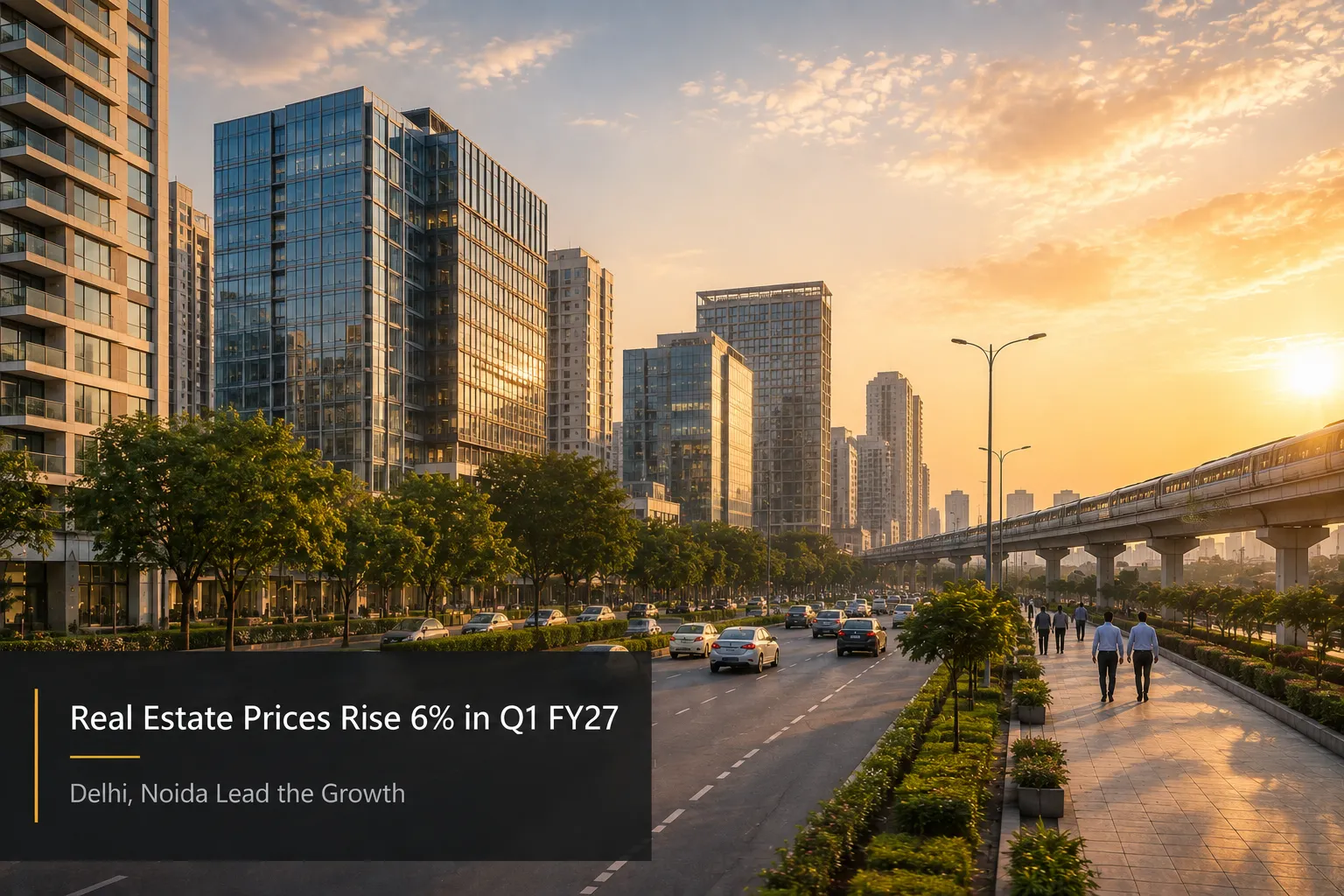
Real Estate Prices Rise 6% in Q1 FY27: Delhi, Noida Lead
Categories
- Tips
- Guides
- Market Insights
- Articles
Recent Posts

Tips / 28 Sept 2026
How to Check Whether a Plot of Land Is Legally Safe to Buy

Guides / 28 Sept 2026
How to Calculate Rental Yield: Formula and Worked Examples

Guides / 26 Sept 2026
How Much Home Loan Can You Get on Your Salary in 2026?

Guides / 25 Sept 2026
10 Things to Check in a Property Sale Deed Before Registration
Real estate prices rose 6% YoY in Q1 FY27 to ₹9,629/sq ft, led by Delhi and Noida, even as new launches fell 14% and sales volume growth stayed modest. Here's why that combination signals genuine demand strength rather than a slowdown, and what it means for buyers right now.
Real Estate Prices Q1 FY27 data from Kotak Institutional Equities tells a more layered story than the headline suggests. Real Estate Price Growth came in at 6% year-on-year nationally, with Delhi Real Estate Prices and Noida Property Prices among the strongest contributors, alongside Chennai, Greater Noida, and Bengaluru. But that same quarter also saw sales volumes moderate and new project launches fall sharply, a combination that's easy to misread if you only look at the top-line number.
At Avorix, this is exactly the kind of report worth unpacking properly rather than repeating as a single statistic. Here's what the data actually shows, what's driving it, and what it means if you're evaluating property in Delhi NCR right now.
Table of Contents
The Headline Numbers: What Kotak's Report Found
Per Kotak Institutional Equities' latest research report, average residential realization across India rose to ₹9,629 per sq. ft. in Q1 FY27, up 6% year-on-year, though down 2% quarter-on-quarter. That price growth was strong enough to drive a 9% year-on-year rise in total sales value, even though the number of homes actually sold grew more modestly.
Average price realization: ₹9,629/sq. ft. (+6% YoY, -2% QoQ)
Sales value growth: +9% YoY (price-driven)
Residential sales volume: 247 million sq. ft. (+3% YoY, -3% QoQ)
New project launches: 242 million sq. ft. (-14% YoY, -16% QoQ)
The growth was led by New Delhi, Noida, Chennai, Greater Noida, and Bengaluru, with the report specifically noting that Gurugram and Bengaluru have posted the strongest price CAGR of any major markets over the past several years.
Why Did Prices Rise While Sales Volume and Launches Fell?
This is the part of the report that's easy to misread as contradictory, but it isn't. New launches contracting 14% year-on-year is the more important number here than it might first appear: developers pulling back on new supply, particularly in a quarter where prices kept climbing, suggests confidence that existing and upcoming inventory can be sold at current, higher price points rather than needing to discount to move volume.
Sales volume growing a modest 3% while sales value jumped 9% confirms this read directly: buyers are transacting at meaningfully higher prices per transaction, not simply because more homes are changing hands, but because each home costs more than it did a year ago. That's consistent with a market where demand is concentrating on quality, well-located inventory rather than spreading evenly across all price points and locations.
City Breakdown: Delhi, Noida, Greater Noida and Beyond
Delhi's inclusion among the top growth markets fits a pattern we've tracked closely: established, well-connected pockets with genuinely limited new supply tend to command premium pricing precisely because scarcity meets sustained demand. Noida and Greater Noida's strong showing in the same quarter lines up with what we've seen at ground level across the Expressway and Extension corridors, sustained infrastructure delivery, from metro expansion to Noida International Airport's operational status, continuing to translate into real buyer confidence rather than speculative pricing.
Chennai's presence in this list is a reminder that this isn't purely an NCR story, price growth in Q1 FY27 was broad enough to span multiple regions with fundamentally different demand drivers, tech-sector employment in Chennai's case, infrastructure and connectivity in NCR's.
What Industry Voices Are Saying
Industry leaders quoted alongside the Kotak data frame this less as a short-term spike and more as an ongoing structural repricing. Pushpender Singh, Managing Director at JMS Group, pointed to the 117% price growth Gurugram has posted since 2019 as evidence that infrastructure delivery, not speculation, is what's actually feeding capital values in specific corridors like Sector 95 and the Dwarka Expressway. Manik Malik, President and CEO of BPTP, made a similar point, tying sustained residential appreciation to buyers increasingly prioritising infrastructure, connectivity, and social ecosystem over simply chasing the cheapest available inventory, alongside improving rental yields that suggest genuine end-user demand rather than pure investor speculation.
Structural Shift or Cyclical Upswing?
We'd broadly agree with the structural framing, with one caveat worth stating plainly: a single quarter's data, even a strong one, isn't proof of a permanent trend on its own. What makes this quarter's numbers more credible as a structural signal rather than a temporary spike is the consistency with data we've cited from other sources across the year: Noida and Gurugram's multi-year appreciation figures, improving rental yields moving in the same direction as prices rather than being squeezed by them, and developers pulling back supply rather than flooding the market to chase volume.
Taken together, that's a market behaving like one where genuine demand is outpacing available quality supply in specific corridors, not one being propped up by short-term sentiment.
What This Means If You're Buying or Investing Now
For buyers, the sharp 14% drop in new launches is worth paying attention to beyond the price data itself, less new inventory entering the market generally means less negotiating leverage over time in the corridors where demand remains strong, particularly the established, well-connected pockets this report specifically calls out. Waiting for a broad pullback in prices based purely on softer sales volume looks like a weaker bet than this data suggests, prices held up despite the volume softness, not because of it.
For investors, the report reinforces a theme we've highlighted repeatedly: infrastructure-backed corridors in Noida, Greater Noida, and comparable NCR markets are showing the kind of price and rental yield co-movement that indicates durable, demand-driven growth rather than a speculative bubble waiting to correct.
The Bottom Line
Kotak's Q1 FY27 data confirms a pattern that's been building for a while: Indian real estate, and Delhi NCR specifically, is seeing prices rise even as transaction volumes and new supply moderate, a combination that generally signals genuine demand strength rather than speculative excess. Delhi and Noida's inclusion among the top-performing markets this quarter is consistent with the broader infrastructure-driven growth story we've tracked across NCR, and it's a data point worth factoring into any near-term property decision in this region.
Trying to figure out which NCR corridor still has room to run given this data? Book a site visit with us, and we'll walk you through the numbers city by city. #PropertyKaDNA
Tags
Tags
Frequently Asked Questions
About the Author
Admin
Top 5 Best Properties in Delhi NCR This Week
Handpicked properties with best price & location
Popular in Greater Noida
Top-rated residential & commercial projects across Greater Noida