
Registry Charges in Delhi 2026: Full Rate Table & Guide
Categories
- Tips
- Guides
- Market Insights
- Articles
Recent Posts

Tips / 28 Sept 2026
How to Check Whether a Plot of Land Is Legally Safe to Buy
Guides / 28 Sept 2026
How to Calculate Rental Yield: Formula and Worked Examples

Guides / 26 Sept 2026
How Much Home Loan Can You Get on Your Salary in 2026?

Guides / 25 Sept 2026
10 Things to Check in a Property Sale Deed Before Registration
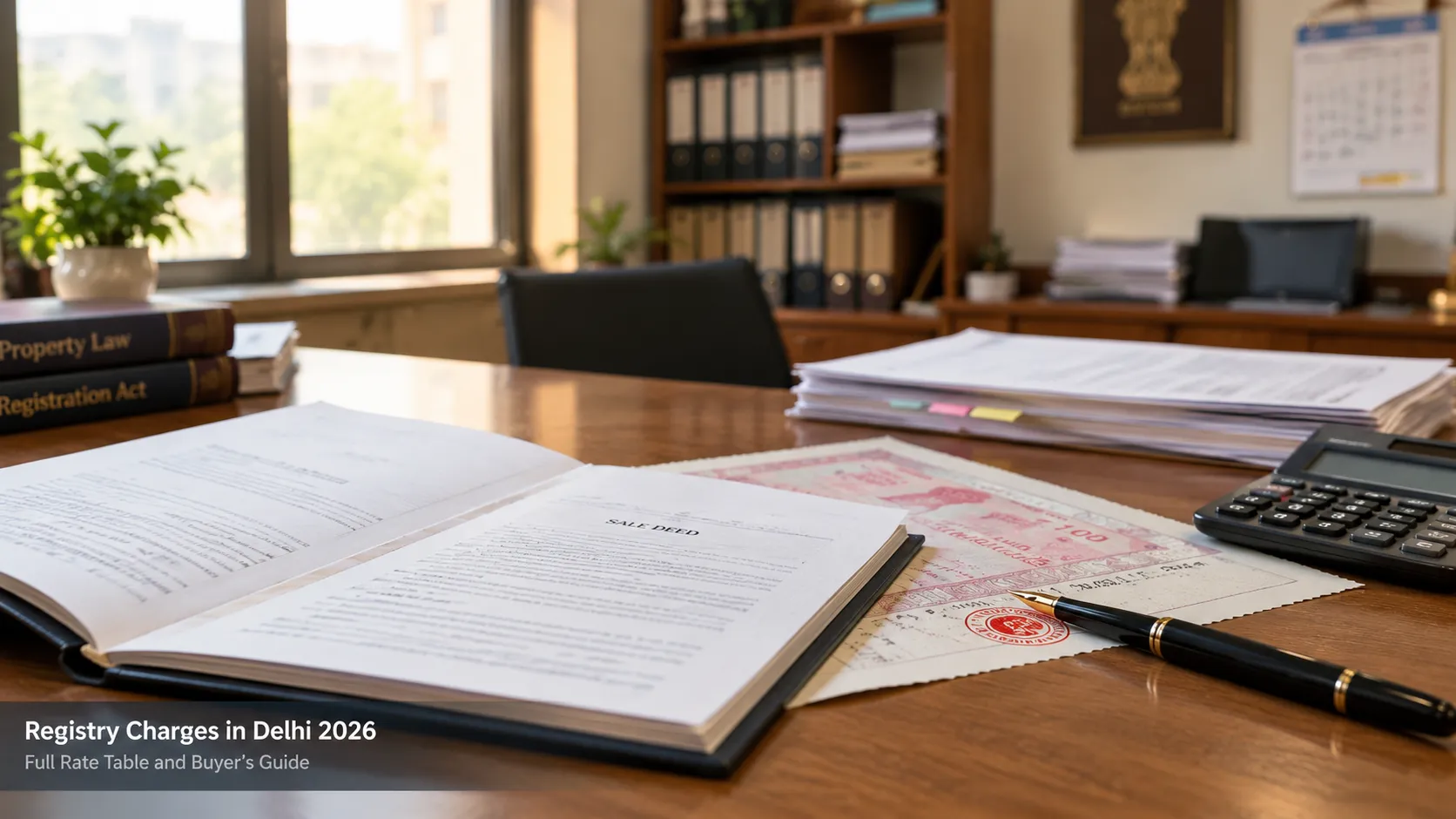
Registry charges in Delhi add 5% to 7% on top of your property price and most buyers only find out after they've agreed on a deal. Here's the full 2026 rate table, real calculations, and the ownership decision worth up to ₹2 lakhs that most people miss.
Here's something that catches buyers off guard more often than it should: you've agreed on a price, arranged the loan, and mentally moved into the flat — and then someone mentions stamp duty and registration. Suddenly there's an additional ₹4 to ₹6 lakhs you hadn't fully accounted for, due before the keys change hands.
The registry charges on a Delhi property aren't a small formality. On a ₹75 lakh flat, they add ₹5.25 lakhs to your total cost if you're a male buyer — or ₹3.75 lakhs if the property is registered in a woman's name. That's a ₹1.5 lakh difference based on one ownership decision you make before registration. Know the numbers before you negotiate the price, not after.
Table of Contents
- What Stamp Duty and Registry Charges Actually Are
- The Full Rate Table — Delhi 2026
- Area-Wise Rates — NDMC, Cantonment, and Other Areas
- Rates for Different Deed Types
- What You Actually Pay — Three Real Examples
- The Circle Rate Rule — The One Thing Most Buyers Miss
- The Women Buyer Advantage — ₹1.5 Lakhs Is Not Nothing
- How to Pay Stamp Duty and Registration in Delhi
- Documents Needed for Property Registration in Delhi
- Before You Register — One Check That Could Save You Money
What Stamp Duty and Registry Charges Actually Are
Stamp duty is a tax levied by the Delhi government on property transactions. It acts as legal evidence that a buyer has formally acquired ownership of a property. Without it, a sale deed has no legal standing in court. This isn't optional — it applies to all property types: residential, commercial, plots, and flats.
Registry charges (also called registration charges or registration fee) are a separate fee paid to legally record the ownership transfer in the government's records. This registration provides legal protection and serves as official proof of ownership. In Delhi, the registration fee is uniformly 1% of the property value across all buyer categories.
The two charges together — stamp duty plus registration fee — are what most people refer to loosely as "registry charges." The total effective rate in Delhi ranges from 4% to 7% depending on who is buying and where the property is located.
The Full Rate Table — Delhi 2026
| Buyer Type | Stamp Duty | Registration Charge | Total Effective Rate |
|---|---|---|---|
| Male Buyer | 6% | 1% | 7% |
| Female Buyer | 4% | 1% | 5% |
| Joint Owners (Male + Female) | 5% | 1% | 6% |
| Joint Owners (Both Female) | 4% | 1% | 5% |
Plus a nominal pasting fee of ₹100 applicable across all categories.
Area-Wise Rates — NDMC, Cantonment, and Other Areas
Delhi's stamp duty rates aren't uniform across the entire city. Three distinct jurisdictions apply different rates:
| Area | Male Buyer | Female Buyer | Joint (Male + Female) | Registration |
|---|---|---|---|---|
| Other Areas (most of Delhi) | 6% | 4% | 5% | 1% |
| NDMC Area | 5.5% | 3.5% | 4.5% | 1% |
| Delhi Cantonment Board Areas | 3% | 3% | 3% | 1% |
The "Other Areas" rate applies to most of Delhi — the large residential colonies, South Delhi localities, East Delhi, West Delhi, and the majority of NCR's Delhi addresses. If you're buying in Lajpat Nagar, Dwarka, Rohini, or Janakpuri, you're in "Other Areas" territory. NDMC rates apply to Lutyens' Delhi and certain central zones. Cantonment rates apply within the cantonment limits only.
Rates for Different Deed Types
| Type of Deed | Stamp Duty Rate |
|---|---|
| Sale Deed (Male) | 6% |
| Sale Deed (Female) | 4% |
| Gift Deed | Male 6%, Female 4% |
| Lease Deed (up to 5 years) | 2% |
| Lease Deed (5–10 years) | 3% |
| Partition Deed | 2% |
| Will | NIL |
| Adoption Deed | ₹50 |
| Indemnity Bond | ₹100 |
| Share Certificate | ₹1 per ₹1,000 |
What You Actually Pay: Three Real Examples
The tables make more sense once you see the numbers applied to real property values. Here are three worked examples.
Example 1: ₹50 Lakh Flat — Female Buyer (Other Areas)
Stamp Duty: 4% × ₹50,00,000 = ₹2,00,000
Registration Fee: 1% × ₹50,00,000 = ₹50,000
Pasting Fee: ₹100
Total: ₹2,50,100
Example 2: ₹80 Lakh Flat — Male Buyer (Other Areas)
Stamp Duty: 6% × ₹80,00,000 = ₹4,80,000
Registration Fee: 1% × ₹80,00,000 = ₹80,000
Pasting Fee: ₹100
Total: ₹5,60,100
Example 3: ₹80 Lakh Flat — Joint (Male + Female, Other Areas)
Stamp Duty: 5% × ₹80,00,000 = ₹4,00,000
Registration Fee: 1% × ₹80,00,000 = ₹80,000
Pasting Fee: ₹100
Total: ₹4,80,100
On the ₹80 lakh flat: a male buyer pays ₹5,60,100. A female buyer pays ₹4,00,100. A joint buyer pays ₹4,80,100. The ownership structure decision saves or costs between ₹80,000 and ₹1,60,000 — on the same property, at the same price, on the same day.
To run your own calculation instantly for any property value, the Avorix stamp duty calculator gives you the exact figure for Delhi based on your buyer category and property value — without needing to do the arithmetic manually.
The Circle Rate Rule — The One Thing Most Buyers Miss
Here's where most buyers get caught off guard. Stamp duty in Delhi is not simply calculated on the agreed sale price. It's calculated on whichever is higher — the agreed transaction value or the government-notified circle rate for that locality.
The circle rate (also called the ready reckoner rate) is the minimum value per square foot set by the Delhi government for each locality. If you agree to buy a flat for ₹70 lakhs but the circle rate for that area puts the minimum property value at ₹78 lakhs — your stamp duty is calculated on ₹78 lakhs, not ₹70 lakhs.
This catches buyers who negotiate the price down significantly and assume their stamp duty will follow. It won't — not below the circle rate floor. Check the circle rate for your specific locality before finalising your budget. The Delhi government's Revenue Department portal publishes updated circle rates by area.
The Women Buyer Advantage — ₹1.5 Lakhs Is Not Nothing
Delhi's 2% concession for female buyers — from 6% to 4% — is one of the most meaningful buyer-category discounts in any Indian state. On a ₹75 lakh property, that 2% difference is ₹1.5 lakhs saved. On a ₹1 crore property, it's ₹2 lakhs.
This isn't a trivial administrative detail. For couples buying jointly, it means the joint registration (at 5%) instead of male-only registration (at 6%) saves 1% — which on a ₹75 lakh property is ₹75,000. For families where the wife is a co-earner and co-borrower on the home loan anyway, registering jointly or in the wife's name is a financially sensible decision that requires no trade-off on legal protection or ownership rights.
Worth discussing with your CA or property lawyer before you go to registration — not after.
How to Pay Stamp Duty and Registration in Delhi
Delhi has moved substantially toward digital payment for stamp duty. The primary method is through e-Stamping via the Stock Holding Corporation of India (SHCIL) or through authorised banks. You can also pay through the Delhi government's revenue portal online.
The process in brief: calculate your stamp duty liability, pay it through the e-Stamping system or an authorised collection centre, obtain the stamped paper, execute the sale deed on that stamped paper, and then present it for registration at the Sub-Registrar Office (SRO) in the jurisdiction where the property is located.
Both buyer and seller must be present at registration, along with two witnesses. Bring original identity documents for all parties. The registered sale deed is typically available within a few days after the appointment.
Documents Needed for Property Registration in Delhi
Come prepared with these at the Sub-Registrar Office:
| Document | Who Needs It |
|---|---|
| Executed Sale Deed (stamped) | Both parties |
| Aadhaar Card | Buyer, seller, witnesses |
| PAN Card | Buyer and seller |
| TDS Challan (Form 26QB) | Buyer (for properties above ₹50 lakhs) |
| NOC from Society / Builder | As applicable |
| Passport-size photographs | Buyer and seller |
| Power of Attorney (if applicable) | Representative of buyer/seller |
| Property Tax receipts (resale) | Seller |
Missing even one of these on registration day typically means rescheduling your appointment — which in busy SROs can mean a delay of two to four weeks. Prepare the full set well in advance.
Before You Register — One Check That Could Save You Money
Before you book your Sub-Registrar appointment, do three things:
Check the circle rate for your locality. The Delhi Revenue Department publishes these. Your stamp duty floor is determined by the circle rate, not your negotiated price. If the circle rate is higher than what you're paying, your stamp duty liability is higher than a simple calculation on the transaction price would suggest.
Decide your ownership structure deliberately. Male-only, joint, or female-primary — the 1 to 2% difference in stamp duty is a real number that should be a conscious decision, not a default. Discuss it with your CA before the deed is drafted.
Budget for TDS if your property exceeds ₹50 lakhs. The buyer is responsible for deducting 1% TDS on the transaction value and depositing it against the seller's PAN via Form 26QB before registration. This is frequently overlooked and is a mandatory requirement — not optional.
Registry day should be a confirmation, not a surprise. The time to understand these numbers is before you agree on a price — not after you've committed. #PropertyKaDNA
Tags
Tags
Frequently Asked Questions
About the Author
Admin
Top 5 Best Properties in Delhi NCR This Week
Handpicked properties with best price & location
Popular in Greater Noida
Top-rated residential & commercial projects across Greater Noida