
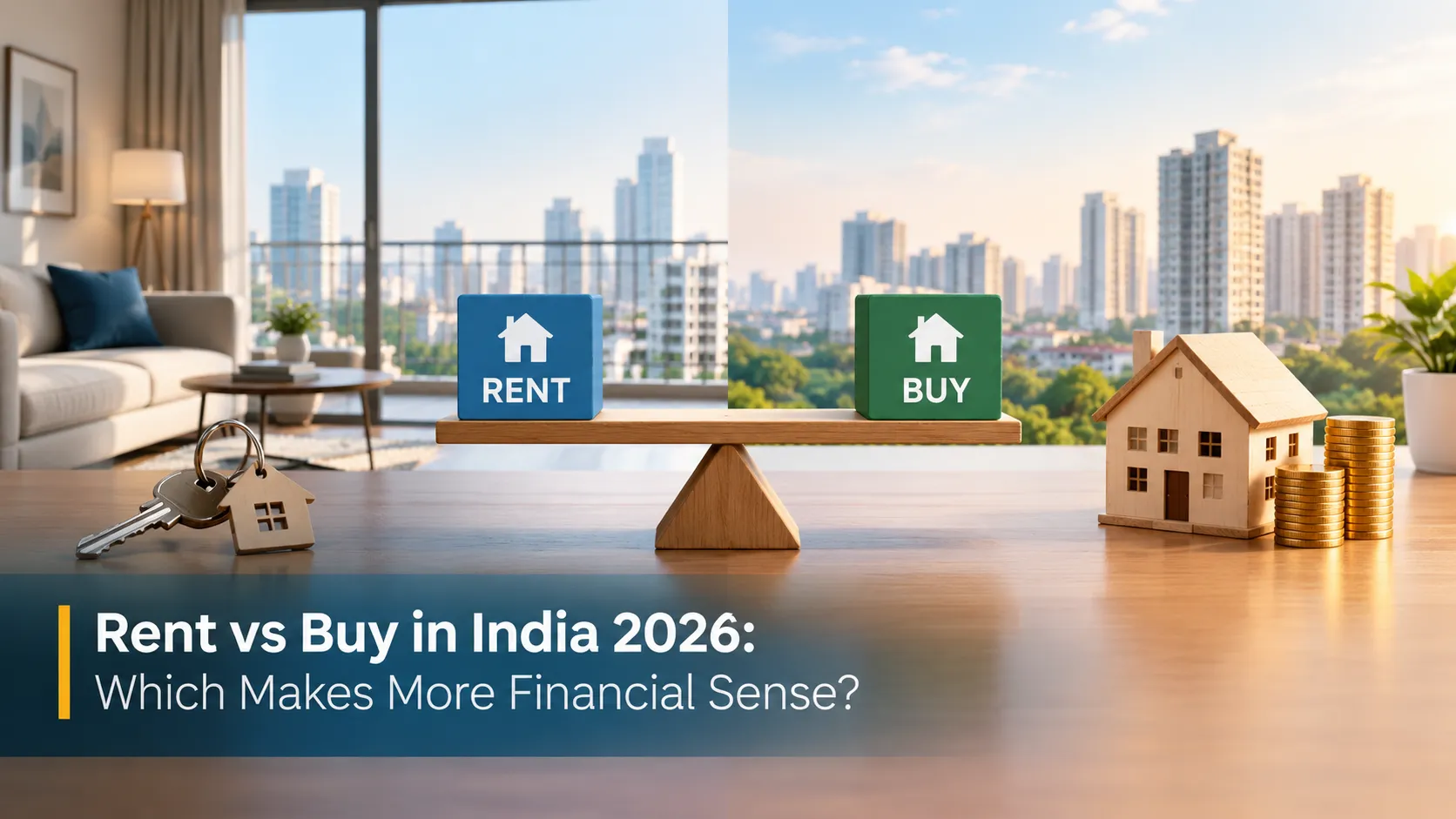
Rent vs Buy in India 2026: Which Makes More Financial Sense?
Rent vs Buy in India 2026: Which Makes More Financial Sense?
Categories
- Tips
- News
- Articles
- Guides
- Market Insights
Recent Posts

News / 17 Sept 2026
Greater Noida Connectivity 2026: Key Infrastructure Developments
Articles / 16 Sept 2026
What Counts as a Good Rental Yield in India?

Guides / 16 Sept 2026
Prepay or Extend: Cut Your Home Loan EMI or Tenure?

Guides / 16 Sept 2026
Home Loan Interest Rates 2026: Compare 15 Major Banks
keep it short and crisp The rent vs buy debate has a right answer but it's yours to calculate, not someone else's to give. Here's the honest financial framework, the numbers that actually matter, and the one calculation that settles it for your situation.
You've probably had this conversation already — with your parents, your partner, maybe a colleague who bought last year and keeps mentioning how much their flat has "appreciated." The pressure to buy is real. So is the financial logic for waiting. And most of the advice you'll find online lands firmly in one camp, cites numbers that support its conclusion, and ignores the ones that don't.
Here's the honest version: there is a right answer to the rent vs buy question — but it's different for every person, and it's determined by your specific numbers, not by a general rule. What this blog does is give you the framework to find your answer, not tell you what it should be.
Table of Contents
- The Question Most People Are Actually Asking (And Why It's Wrong)
- The EMI vs Rent Gap — What It Actually Means
- The Price-to-Rent Ratio — The Number That Cuts Through the Noise
- Two Friends, Same City, Same Income — Different Right Answers
- The Real Cost of Buying That Nobody Totals Up
- The Real Cost of Renting That Nobody Talks About Either
- When Buying Wins — The Specific Conditions
- When Renting Wins — The Specific Conditions
- What Financial Influencers Get Wrong About This
- The One Calculation to Run Before You Decide Anything
The Question Most People Are Actually Asking (And Why It's Wrong)
When someone asks "should I rent or buy," they're usually asking one of two things: either "is buying a good investment right now?" or "can I afford to buy?" These are different questions — and neither of them is quite the right one.
The right question is: over the specific number of years I plan to stay in this city, in this role, at this life stage — does buying or renting leave me in a better financial position?
That question has a specific answer. "Is property a good investment" is a general claim about a market. "Does buying make sense for me, here, now, for this long" is a calculation. One produces opinions. The other produces a decision.
The EMI vs Rent Gap — What It Actually Means
The most direct comparison is between your monthly EMI and the market rent for a comparable property. And in most Indian cities in 2026, the gap between the two is significant — and widening.
A ₹60 lakh home loan at 7.50% per annum over 20 years generates a monthly EMI of roughly ₹48,000. The same apartment in many cities rents for ₹20,000 to ₹28,000 per month. At first glance, renting looks dramatically cheaper. And in cash-flow terms, it is.
This stark comparison shows that the monthly EMI is now typically 2.5 to 3 times higher than the monthly rent for a comparable property in many established micro-markets and city centres. Just two years ago, the gap had narrowed to 1.8 times when rents surged and prices stayed put.
In Noida and Greater Noida — where Avorix operates — the gap is slightly more favourable for buyers than in Mumbai or Bengaluru, because property prices haven't risen to the same extremes relative to rental values. But the basic dynamic holds: the monthly cost of owning is higher than the monthly cost of renting the same property. That's not a reason not to buy. It's a fact that needs to be acknowledged before the rest of the analysis makes sense.
Here's what the gap analysis misses: EMIs also build equity. Every payment reduces your outstanding loan and increases your ownership stake. The renter makes zero progress toward ownership regardless of how many years they pay — and rent increases every year, while an EMI on a fixed-rate loan doesn't.
The Price-to-Rent Ratio — The Number That Cuts Through the Noise
There's a metric that serious property analysts use to evaluate whether a market favours buying or renting at any given time. It's called the Price-to-Rent ratio — property price divided by annual rental income.
A ratio above 20 signals that property is expensive relative to rent, and renting while investing the difference is likely to build more wealth in the medium term. In most Indian metros in 2026, residential rental yields are 2.5 to 3.5%. Mumbai is at the lower end at 2 to 2.5%, Bengaluru and Hyderabad at the higher end at 3 to 4%. A rental yield below 3% means the property is expensive for what it earns.
Applied to Delhi NCR: a 2 BHK in Noida priced at ₹70 lakhs renting for ₹22,000 per month generates an annual rent of ₹2.64 lakhs. Price-to-Rent ratio: 70 ÷ 2.64 = 26.5. That's above 20 — which by the metric suggests renting is financially more efficient in the short term.
But — and this is where the metric's limitation shows up — it doesn't account for appreciation. If that flat appreciates at 8% annually over 10 years, its value moves from ₹70 lakhs to approximately ₹1.51 crore. The renter, paying ₹22,000 per month in rent (rising 8% annually), has paid roughly ₹38 lakhs in cumulative rent and owns nothing at the end. The buyer has paid significantly more in EMI but owns an asset worth ₹1.51 crore with a substantially reduced or cleared loan.
The ratio tells you the current efficiency of renting versus buying. It doesn't tell you the ten-year outcome. Both matter.
Two Friends, Same City, Same Income — Different Right Answers
Arjun and Meghna both earn ₹1.2 lakhs per month take-home and both live in Noida. Both are 29. Both are looking at the same 2 BHK — ₹70 lakhs to buy or ₹22,000 per month to rent.
Arjun is a software engineer at a Noida-based company he genuinely likes. He plans to stay in Noida for at least seven to ten years, possibly longer. He has ₹14 lakhs saved — enough for a 20% down payment. His parents are in Lucknow; he'll never need to move for them. He wants a place that's his, where he can get a dog and put up bookshelves without asking permission.
Meghna works in consulting. She's been in three cities in four years. She has a real possibility of being posted to Bengaluru or Mumbai in the next two years. She's thinking about a master's degree abroad in 2028. She has ₹14 lakhs saved too, but she's been investing it systematically in index funds at roughly 12% annual return.
For Arjun, buying is the right call. The seven-to-ten year horizon is long enough for appreciation to significantly outperform the EMI premium he's paying over rent. He'll build equity, claim home loan tax benefits, and have a stable base for his life.
For Meghna, renting is the right call — for now. Locking ₹14 lakhs into a down payment on a flat she might vacate in two years, paying an EMI on a property she's subletting while paying rent somewhere else, is a recipe for financial stress. Her index funds are doing better than the rental yield argument requires. She should revisit when her geography stabilises.
Same income. Same city. Same property. Different right answers — based entirely on life circumstances, not on a general rule about "the market."
The Real Cost of Buying That Nobody Totals Up
The EMI is the visible cost. These are the costs that appear in the full picture:
Down payment: Typically 20% of the property value. On a ₹70 lakh flat, that's ₹14 lakhs sitting in a property instead of in investments. The opportunity cost of that ₹14 lakhs at 12% annual return over 20 years is significant — roughly ₹1.35 crore in foregone investment growth. This doesn't mean don't buy — it means include this number in your comparison.
Stamp duty and registration: 5 to 7% of the property value in most states. On a ₹70 lakh flat in UP, that's approximately ₹4.2 to ₹4.9 lakhs — paid upfront, non-recoverable.
Maintenance charges: ₹2,000 to ₹7,000 per month depending on the society. Over 20 years, that's ₹4.8 to ₹16.8 lakhs.
Property tax, repairs, and periodic renovation: Real costs that renters don't pay. A rough estimate: 1 to 1.5% of property value annually for maintenance and upkeep over the long run.
None of this means buying is wrong. It means the EMI alone understates the cost of ownership by a meaningful margin.
The Real Cost of Renting That Nobody Talks About Either
The case for renting also comes with costs that are often left out of the "invest the difference" argument.
Rent inflation: Rents in Delhi NCR have been rising at 7 to 10% annually. A ₹22,000 rent today is ₹47,000 in 10 years at 8% annual increase. Over that decade, you've paid approximately ₹38 lakhs in cumulative rent — money that has built zero equity and is entirely gone.
The discipline assumption: Every "rent and invest the difference" argument assumes you actually invest the difference — consistently, in a disciplined way, for 10 to 20 years, through job changes, emergencies, lifestyle upgrades, and market corrections. Most people don't. The EMI enforces discipline in a way that a voluntary monthly investment usually doesn't.
Psychological cost: In the Indian context, a home is not just an asset class or a line item on a balance sheet. It is an emotional anchor. Calculators ignore the missing emotional picture. Security of tenure, the ability to renovate, the end of annual landlord negotiations, and the identity that comes with ownership — these are not nothing. They're not financial metrics, but they're real.
When Buying Wins — The Specific Conditions
Buying makes more financial sense when: you plan to stay in the same city for at least five to seven years; your EMI-to-income ratio stays below 40% (ideally below 35%); you're buying in a location with genuine appreciation potential — expressway adjacency, metro proximity, employment anchor; you have the down payment without depleting your emergency fund; and you're buying for the long term, not timing the market.
Buying is better if you plan to stay for 5 or more years and have a stable income. That's the simplified version. The nuanced version adds: buying in the right location matters more than buying at the right time.
When Renting Wins — The Specific Conditions
Renting makes more financial sense when: your tenure in the city is uncertain or likely under three years; your EMI would exceed 40% of your net income; you're in a life transition — early career, considering further education, or likely to relocate for family or work; or the Price-to-Rent ratio in your target locality is above 25 and appreciation history is weak.
Renting is also the right choice if you genuinely will invest the difference — and have a track record of doing so. For people with that discipline, the financial case for renting in high-price markets like South Delhi or Golf Course Road Gurugram is genuinely strong.
What Financial Influencers Get Wrong About This
The "don't buy, rent and invest" argument that dominates financial content on YouTube and Instagram is mathematically coherent but practically flawed for most Indian households. The logic is seductive: why pay an EMI of ₹60,000 for an apartment that rents for ₹25,000? The math says rent, invest the ₹35,000 surplus in a mutual fund, and retire rich. Mathematically, the influencers are right. But there is a flaw: humans don't live in Excel sheets.
The influencer model assumes perfect investment discipline, no lifestyle inflation, no emergencies that drain the "invested difference," and a holding period long enough for mutual fund returns to outperform property appreciation. In practice, most people in their thirties find that the forced discipline of an EMI produces more actual wealth than the theoretical discipline of investing the difference — because the EMI is non-negotiable and the SIP is.
This isn't an argument against investing. It's an argument against using a spreadsheet model as a stand-in for a plan that requires genuine, sustained behavioural discipline over 15 to 20 years.
The One Calculation to Run Before You Decide Anything
Before you come down on either side of this debate, run one honest number: your break-even horizon.
Take the total upfront cost of buying — down payment, stamp duty, registration — and add the monthly EMI premium over rent (what you'd pay extra each month to own versus rent). Add your opportunity cost on the down payment. Now calculate how many years of property appreciation at a realistic rate (8 to 10% for a well-located NCR property) it takes for the ownership outcome to outperform the renting-and-investing outcome.
In most Noida and Greater Noida scenarios, that break-even is somewhere between five and eight years. If you're staying longer than that, buying wins. If you're staying shorter, renting wins. That's your answer — specific to your numbers, not a general opinion about the market.
The fastest way to run this comparison for your actual situation — with your specific rent, your target property price, your income, and your investment assumptions — is a proper rent vs buy calculator that does the maths across different holding periods. The Avorix buy vs rent calculator does exactly this — put your real numbers in, and see where the break-even falls for your specific situation before you make either decision.
The debate ends when you run your own numbers. Everything before that is just someone else's opinion dressed up as financial advice. #PropertyKaDNA
Tags
Tags
Frequently Asked Questions
Top 5 Best Properties in Delhi NCR This Week
Handpicked properties with best price & location
Popular in Greater Noida
Top-rated residential & commercial projects across Greater Noida