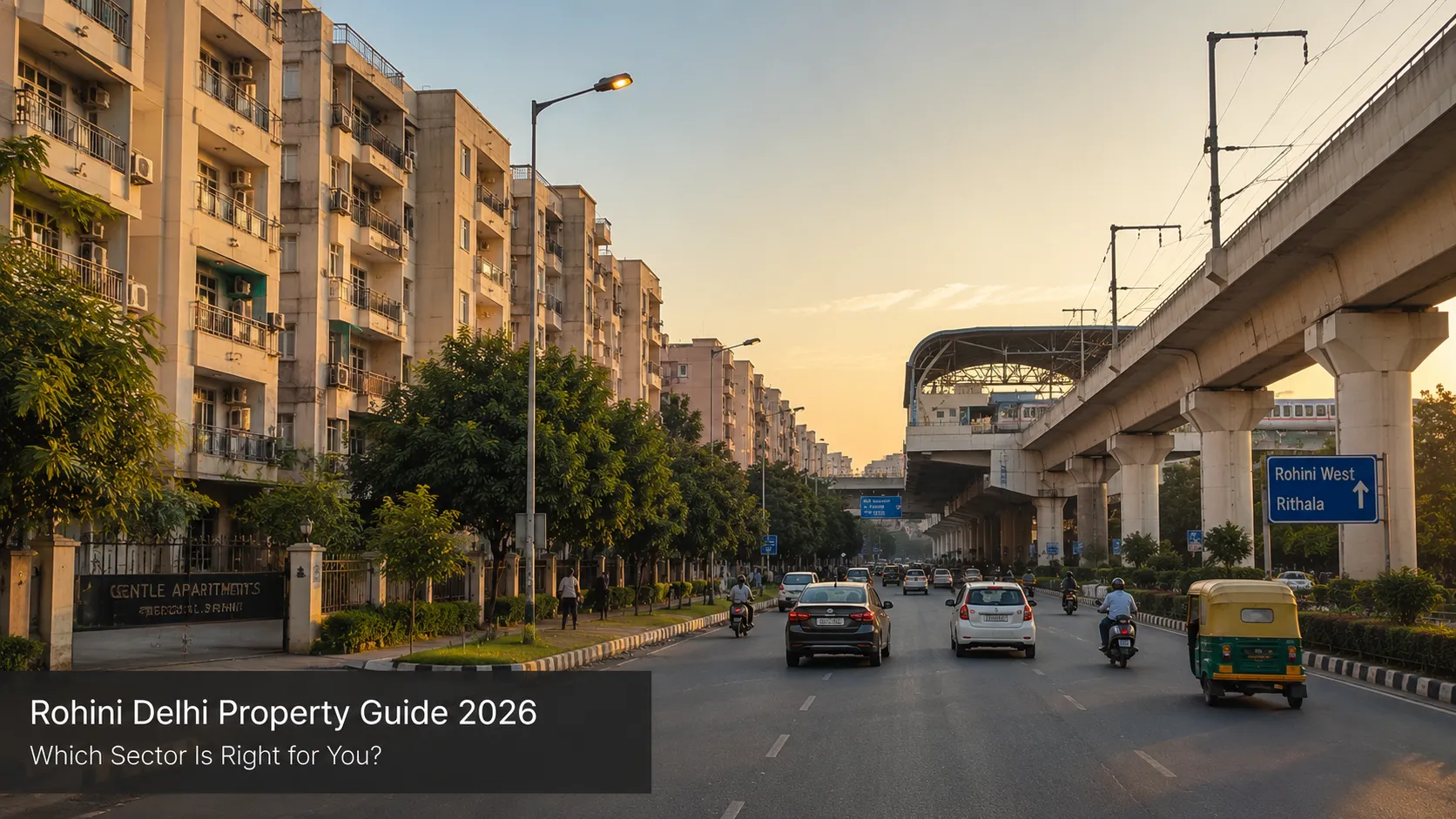
Rohini Delhi Property Guide 2026 — Which Sector Is Right for You?
Categories
- News
- Market Insights
- Tips
Recent Posts

News / 22 Sept 2026
New Noida Land Acquisition 2026: List of 37 Villages in Phase 1

Market Insights / 21 Sept 2026
Registry Charges in Delhi 2026: Full Rate Table & Guide

News / 21 Sept 2026
8 Best Property Hotspots in NCR: Where to Actually Buy

Market Insights / 19 Sept 2026
Cost Inflation Index 2026: Full Table and How to Apply It
Most Rohini property guides hand you a price table and stop there. This one goes further — breaking down which sector actually suits which type of buyer, where you have real negotiation room, what the Pink Line ring completion means for connectivity, and why the NCR Regional Plan 2041 has quietly put Rohini's outer sectors back on the investment radar. If you're seriously considering buying in Rohini in 2026, this is the ground-level picture you need first.
Most property guides on Rohini give you a price table and call it a day. Sector 1 costs this much, Sector 16 costs that much — and you're left staring at numbers without knowing what any of it actually means for your decision. This guide tries to do something different. Instead of just telling you what property prices in Rohini, Delhi, look like in 2026, it tells you which sector makes sense for which kind of buyer — and why that distinction matters more than the per-square-foot rate alone.
Rohini is one of Delhi's largest planned residential areas — over 20 sectors, spanning North-West Delhi, built around a DDA framework that's now several decades old in its earliest phases. That age gap between sectors is important. Sectors 1 to 13 feel and function very differently from Sectors 24 onwards. The metro access is different. The maintenance culture is different. The resale liquidity is different. And the kind of buyer each sector suits is genuinely different.
Here's the honest sector-wise picture for 2026.
Table of Contents
- Rohini in 2026 — What's Changed and What Hasn't
- Property Price Snapshot — What the Numbers Actually Mean
- Which Rohini Sector Is Right for You
- The Pink Line Effect — A Connectivity Upgrade Nobody's Talking About
- NCR Regional Plan 2041 and What It Means for Rohini
- DDA Flat vs Builder Floor vs Resale — The Honest Comparison
- Where You Have Negotiation Room — and Where You Don't
- Rental Yield Reality — Broken Down by Property Type
- The Bottom Line
Rohini in 2026 — What's Changed and What Hasn't
Rohini has always been a practical choice — not glamorous, not in the headlines the way South Delhi or Gurugram corridors are, but consistently in demand from families, government employees, and first-time buyers who want a properly planned locality in Delhi without paying Dwarka or Pitampura prices.
What's changed in the last two to three years is the connectivity story. The Red Line metro has been a fixture here for years — Rohini West, Rohini East, and Rithala are all operational. But the Pink Line's ring completion has added a new dimension, and the NCR Regional Plan 2041's northern corridor proposals have quietly put Rohini back on the investment radar in a way it hasn't been for some time.
What hasn't changed: the outer sectors are still developing, traffic on Rohtak Road remains a daily reality, and premium housing options are limited compared to what you'd find in South or West Delhi. Rohini's appeal has never been about luxury — it's been about value, planning, and liveability. That positioning holds in 2026.
Property Price Snapshot — What the Numbers Actually Mean
The average property rate in Rohini currently sits around ₹13,000 to ₹14,100 per square foot for flats, with a range of roughly ₹9,500 to ₹17,000 depending on the sector, floor, property type, and condition. Builder floors and DDA flats at the lower end of that range are in outer or older sectors. Premium builder floors in Sectors 13, 14, and 24 push toward the higher end.
Plots are a different story — rates vary significantly based on road width, corner status, and sector. Independent houses on plots in established sectors can command significant premiums over flat rates, partly because plot supply in a planned DDA township is finite by design.
Appreciation has been running at roughly 8% per annum in recent years — not spectacular compared to some NCR corridors, but consistent and relatively low-risk. For buyers looking for stability rather than a high-risk appreciation bet, that consistency is actually a feature.
Before you start shortlisting on price alone, it's worth modelling your actual monthly commitment. A Home Loan EMI Calculator will show you how much the tenure and interest rate choices affect your monthly outflow — most buyers are surprised by that number when they actually run it.
Which Rohini Sector Is Right for You
This is the section no other guide gives you. Here's how to think about Rohini's sectors mapped to different buyer situations.
Sectors 1–13 — For Buyers Who Want a Mature, Settled Neighbourhood
These are Rohini's original sectors — the ones that were fully developed decades ago and have since settled into a comfortable, established rhythm. Wide internal roads, mature trees, functioning parks, and a neighbourhood character that comes from decades of the same families and communities living side by side.
Sectors 13 and 14 sit at the premium end of this belt — well-maintained, good resale liquidity and a noticeable quality difference in the overall environment compared to outer sectors. If you're buying for end-use and stability matters more than finding the cheapest entry point, Sectors 8 to 14 are worth the price premium.
The trade-off: these sectors are fully built out, which means most available inventory is resale. You're buying into a market with limited new supply, which is good for value stability but means you need to be thorough on property condition and legal due diligence before buying.
Sectors 14–22 — For Working Professionals and Metro-Priority Buyers
This belt sits in Rohini's mid-zone and benefits from reasonable proximity to multiple Red Line stations. For working professionals whose daily commute goes toward central or south Delhi, metro access is the deciding factor — and this zone delivers it without paying Sectors 13 or 14 prices.
Property rates here are more varied, which means more negotiation room. Builder floors are common alongside DDA flats, giving buyers more configuration options. Rental demand in this zone is stronger than in the outer sectors, which also makes it a reasonable investor choice if rental yield matters to your decision.
Sectors 24–28 and Beyond — For Investors and Budget-First Buyers
The outer sectors are Rohini's developing frontier. Prices are lower — sometimes significantly — but the trade-off is infrastructure maturity. Roads, markets, and social infrastructure in these sectors are still catching up. Some pockets feel complete. Others still feel like a work in progress.
For investors with a five-to-seven-year horizon, the outer sectors have more appreciation headroom simply because they're starting from a lower base. As they fill in and infrastructure matures, the gap between outer and inner sector prices tends to compress — and early buyers in the outer belt capture that compression.
For end-users who need everything working well from day one, the outer sectors require patience. Go in with realistic expectations about what's available nearby, and inspect the specific pocket carefully rather than relying on the sector number alone.
The Pink Line Effect — A Connectivity Upgrade Nobody's Talking About
Here's something that hasn't shown up in most Rohini property guides yet. The Delhi Metro Pink Line's ring completion — which closed the loop from Majlis Park to Maujpur-Babarpur — directly improves Rohini's connectivity picture in a way that isn't immediately obvious.
Majlis Park station on the Pink Line sits at the edge of the Rohini corridor. With the ring now complete, residents in Rohini's inner sectors have an additional metro option that connects through to central and eastern Delhi without the interchange friction they previously faced. This isn't a theoretical future benefit — the ring is operational now.
What this means for property: the localities closest to Majlis Park and the Pink Line's northern stretch have a connectivity story that wasn't there two years ago. Prices in that immediate catchment haven't fully reflected this yet — which is exactly the kind of gap that tends to close over the next 12 to 24 months as more buyers discover it.
NCR Regional Plan 2041 and What It Means for Rohini
The recently reviewed NCR Regional Plan 2041 proposes a "30-Minute NCR" transit network and new development zones across the region. Rohini sits in North-West Delhi — a corridor that falls within the northern development belt that the plan proposes to better integrate with the broader NCR network through new transit corridors and upgraded road infrastructure.
This isn't a direct "Rohini gets a new metro line" announcement — the specifics are still being worked out. But the plan's direction confirms that the northern Delhi belt is being taken seriously as a development zone rather than treated as a peripheral afterthought. For property buyers with a long enough horizon, that macro direction is a supporting argument for Rohini's outer sectors, which have the most to gain from improved regional connectivity.
It also means that the price gap between Rohini and more expensive North Delhi localities — Pitampura, Shalimar Bagh, Ashok Vihar — could continue to compress as the northern belt's infrastructure improves overall.
DDA Flat vs Builder Floor vs Resale — The Honest Comparison
Rohini has all three in meaningful quantities, and the right choice depends entirely on what matters most to your situation.
DDA flats offer legal clarity, standardised construction, and relatively lower entry prices. The trade-off is that DDA layouts are often older and less flexible — smaller kitchens, dated bathroom designs, limited parking. Maintenance quality varies enormously by society. Some DDA societies in Rohini are well-managed and excellent value. Others have struggled with maintenance consistency for years. Visiting the specific block and speaking to existing residents before buying is non-negotiable here.
Builder floors in Rohini offer more configuration flexibility — you can often find better layouts, newer finishes, and independent entrance arrangements that DDA stock can't match. The legal picture requires more careful checking: freehold plot status, builder approvals, and floor-specific ownership documents all need verification. Resale of builder floors is generally liquid in Rohini's established sectors.
Resale apartments in cooperative or group housing societies sit between the two — more amenities than a typical builder floor, clearer legal documentation than some older builder floor transactions, but requiring the same condition and maintenance quality checks as any older property.
There's a useful deeper read on the full picture of reasons to consider Rohini as a buying destination in this guide to buying a home in Rohini Delhi in 2026, which covers the locality's overall case in more detail.
Where You Have Negotiation Room — and Where You Don't
This is the part that's genuinely useful before you walk into a negotiation.
In the outer sectors (24 onwards), the negotiation room is real. Inventory is higher relative to demand, properties sit on the market longer, and motivated sellers — particularly those who've been listing for more than 60 days — will often move meaningfully on price if you come with clean financing and a credible closure timeline.
In Sectors 13, 14, and 24's premium pockets, the market is tighter. Good properties in well-maintained DDA blocks or builder floors with proper documentation move relatively quickly. Pushing hard on price in this belt often just means losing the property to another buyer. Negotiate on possession timeline, including fixtures, or documentation cost sharing rather than headline price.
In the mid-belt (Sectors 15–22), it depends heavily on how long the specific property has been listed and the seller's circumstances. Check listing age before making an offer — it's the single best signal of how flexible a seller is likely to be.
If you want to model how different purchase prices affect your long-term return before deciding where to draw the line in a negotiation, a Property ROI Calculator gives you that clarity in a few minutes.
Rental Yield Reality — Broken Down by Property Type
The headline rental yield figure for Rohini is around 2.8% — which sounds modest, but masks a meaningful spread across property types and sectors.
2 BHK units in the mid-belt sectors close to metro stations consistently outperform the average. Tenant demand from working professionals, government employees posted in North Delhi, and families relocating from outer Delhi keeps vacancy low in this segment. Well-maintained 2 BHKs in Sectors 11 to 16 with good metro proximity can yield closer to 3.2 to 3.5% in the current market.
Larger 3 BHK units and independent floors yield less on a percentage basis but attract longer-tenure tenants — families who stay three to five years rather than one. The lower yield is partly offset by lower vacancy and turnover costs.
DDA flats in outer sectors with weaker social infrastructure yield the least and have higher vacancy risk. If rental income is a meaningful part of your investment case, the mid-belt with metro proximity is where the numbers work best.
The Bottom Line
Rohini isn't trying to compete with South Delhi on prestige or with Noida on scale. It's doing something more specific — offering a well-planned, DDA-structured residential environment in North-West Delhi at prices that still make practical sense for a wide range of buyers. That positioning hasn't changed, and in 2026 it's been quietly reinforced by the Pink Line connectivity upgrade and the northern corridor tailwind from Regional Plan 2041.
The sector you pick within Rohini matters as much as the decision to buy in Rohini itself. A mature inner sector and a developing outer sector are genuinely different propositions — different risk profiles, different tenant markets, different negotiation dynamics. The right one depends on what you're actually trying to achieve.
Thinking about making a move in Rohini? Explore current listings across sectors or speak with someone who knows this market at the street level — the difference between a good buy and an average one in Rohini usually comes down to which specific pocket and which specific property, not just the sector number.
That's the kind of ground-level read we believe in at Avorix Realty — #PropertyKaDNA.
Tags
Tags
Frequently Asked Questions
Top 5 Best Properties in Delhi NCR This Week
Handpicked properties with best price & location
Popular in Greater Noida
Top-rated residential & commercial projects across Greater Noida