Shahberi Double-Decker Flyover: Boost for Greater Noida West
Shahberi Double-Decker Flyover: Boost for Greater Noida West
Categories
- Articles
- Market Insights
- News
Recent Posts

Articles / 07 Sept 2026
How to Check Property Registry Online in UP (Free)

Market Insights / 04 Sept 2026
Noida Circle Rates 2026: Sector-Wise Complete List

Market Insights / 02 Sept 2026
Best Home Loan Rates in India 2026: Full Comparison

Articles / 01 Sept 2026
Free Property Verification: Check Before You Invest
NCR's first double-decker flyover is coming to Shahberi. Here's the ₹900 crore project's route, its latest status, and what it could mean for property values across Greater Noida West and the Ghaziabad-Delhi corridor.
Greater Noida West is about to get NCR's first double-decker flyover, and it's the kind of infrastructure news that genuinely moves the needle for a market like this one. Officially known as the Shahberi Double-Decker Flyover, the project is a ₹900 crore commitment to fixing one of the region's most persistent bottlenecks: the road link between Greater Noida West, Ghaziabad, and Delhi.
This isn't a minor road-widening exercise. It's a structurally unusual project, and the reasons behind that design tell you a lot about how seriously the authorities are treating connectivity in this corridor. Here's what the flyover actually involves, its latest status, and what it could mean for property values in the areas it touches.
Table of Contents
- What Is the Shahberi Double-Decker Flyover?
- Why a Double-Decker Design, and What's the Route?
- What's the Latest Update on the Project?
- Which Areas Stand to Benefit Most?
- How Will This Affect Greater Noida West Real Estate?
- Is Now the Right Time to Invest in Greater Noida West?
- The Bigger Infrastructure Picture
- The Bottom Line
What Is the Shahberi Double-Decker Flyover?
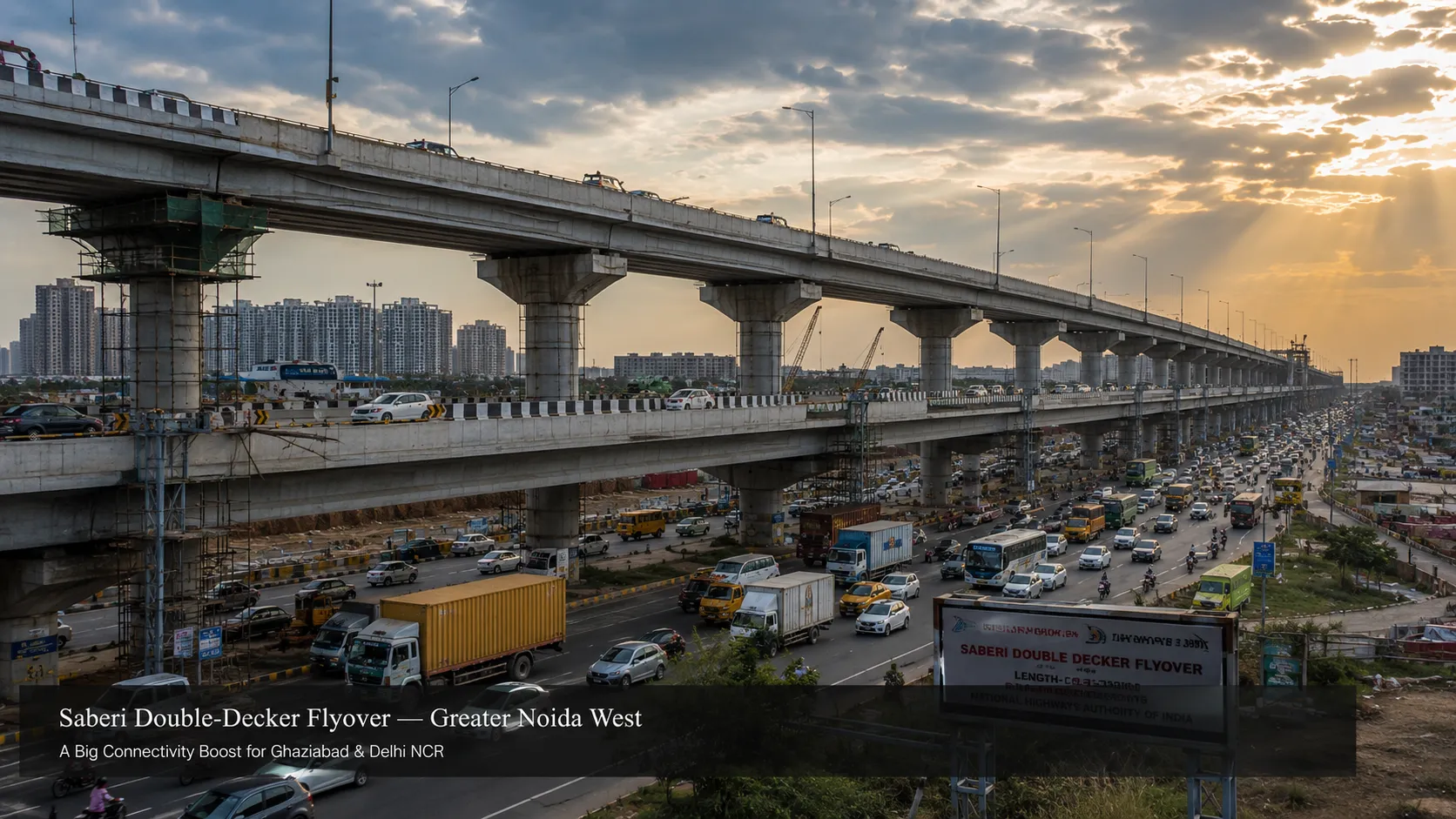
The flyover takes its name from Shahberi, a locality that sits along one of the busiest connecting stretches between Greater Noida West and Ghaziabad. Costed at roughly ₹900 crore, more than double the ₹400 crore originally budgeted for a standard elevated road, this is being built as NCR's first double-decker flyover, with the funding shared between the Greater Noida Industrial Development Authority (GNIDA) and the Ghaziabad Development Authority (GDA).
The core purpose is straightforward: decongest the Shahberi corridor, which has become a serious daily bottleneck as Greater Noida West's population has grown into the hundreds of thousands over the past decade.
Why a Double-Decker Design, and What's the Route?
The double-decker design isn't a stylistic choice, it's a practical solution to a real space constraint. The existing road through Shahberi is only about 14 metres wide, and a standard four-lane elevated road typically needs a minimum width of 15 metres to be built safely. Rather than acquiring more land or narrowing the road further, planners settled on a double-decker structure that fits within a roughly 12-metre-wide corridor without compressing the ground-level road any further.
Project cost: Approximately ₹900 crore
Route: Eteda Roundabout (on the 130-metre road) to Crossings Republik
Design: Two stacked decks, one carrying traffic toward Crossings Republik, the other carrying traffic back toward Greater Noida West
Funding: Jointly shared between GNIDA and GDA
The route connects the Eteda Roundabout, located on the 130-metre road, directly to Crossings Republik, one of the larger residential catchments on the Ghaziabad side of this corridor. Each deck handles traffic moving in a single direction, which is what allows the structure to carry meaningful capacity without needing the extra ground width a conventional flyover would require.
What's the Latest Update on the Project?
As of the most recent project coverage, the Shahberi Double-Decker Flyover is at the proposal and planning stage, with the design finalised around the double-decker structure after a feasibility study ruled out the wider conventional alternative. According to recent industry coverage of the announcement, no official construction timeline or completion date has been released yet, and an official travel-time reduction figure hasn't been published either. What is confirmed is the budget, the route, and the joint GNIDA-GDA funding structure, which suggests the project has moved past early conceptual stages into active planning.
Industry voices have responded positively. Manoj Gaur, CMD of Gaurs Group, called it a long-awaited development that will directly benefit Gaur City, a township home to more than 5 lakh residents, while pointing out that direct connectivity to NH-24 has been a standing requirement for the area for years.
Which Areas Stand to Benefit Most?
Given the route runs from the Eteda Roundabout to Crossings Republik, the areas positioned to feel the most direct benefit are Shahberi itself, Gaur City, and the broader Greater Noida West sectors that currently funnel through this corridor to reach Ghaziabad and Delhi. Crossings Republik on the Ghaziabad side stands to gain as well, since improved two-way flow benefits residents commuting in both directions, not just those heading toward Delhi.
More broadly, the NH-9 corridor and the wider Noida Extension belt are expected to see indirect benefit too, since easier movement through Shahberi reduces pressure on alternate routes that residents currently use to bypass the bottleneck.
How Will This Affect Greater Noida West Real Estate?
Improved connectivity has a fairly consistent effect on residential demand: areas that were previously discounted for poor accessibility tend to see stronger buyer and tenant interest once that friction is addressed. Greater Noida West's real estate market has grown substantially over the past several years, but connectivity to Ghaziabad and Delhi has remained a recurring concern among both residents and property consultants in the area.
Industry voices are already framing this as a demand catalyst. Iqbal Singh Sodhi, Director at Karyan Group, described the project as more than road infrastructure, calling it a transformative development for the corridor that should translate into real relief for commuters travelling between Ghaziabad, Crossings Republik, Greater Noida West, and Delhi. Historically, better accessibility in NCR has tracked closely with higher residential and commercial demand, and there's no clear reason this corridor would behave differently.
Is Now the Right Time to Invest in Greater Noida West?
It's worth being measured here. No official completion date has been announced, and construction on infrastructure projects of this scale in NCR has a track record of running longer than initial expectations. That said, the pattern across NCR has generally held: buying before a connectivity project is fully operational and widely known has historically offered better entry pricing than buying after the benefit is obvious to every buyer in the market.
Greater Noida West already has the fundamentals in place, established townships, active rental demand, and proximity to Noida International Airport at Jewar, which is a separate but complementary tailwind for the region. The flyover adds a specific, tangible connectivity story on top of that, which is the kind of combination that tends to support sustained rather than speculative demand.
The Bigger Infrastructure Picture
The Shahberi flyover isn't happening in isolation. It's arriving alongside the operational Noida International Airport, ongoing metro expansion plans for the Greater Noida West corridor, and continued road-widening work across the broader region. Together, these projects are steadily closing the connectivity gap that has historically kept Greater Noida West priced at a discount to more established NCR markets.
For a corridor connecting one of NCR's fastest-growing residential belts to Ghaziabad and Delhi, that combination of an operational airport, a metro pipeline, and now a dedicated double-decker flyover represents a genuinely stronger infrastructure position than this market has had at any point in the past decade.
The Bottom Line
The Shahberi Double-Decker Flyover is a significant, if still early-stage, infrastructure commitment to fixing one of Greater Noida West's longest-standing connectivity gaps. The unusual double-decker design reflects a real engineering constraint, not just ambition, and the ₹900 crore joint funding from GNIDA and GDA signals this has moved well past the conceptual stage. For anyone tracking Greater Noida West as a location to live in or invest in, this is a project worth watching closely as more construction and timeline details are released.
Curious how this project could affect a specific sector or society you're considering in Greater Noida West? Speak with a local expert who tracks these infrastructure updates closely, from early planning through to completion. #PropertyKaDNA
Tags
Tags
Frequently Asked Questions
Top 5 Best Properties in Delhi NCR This Week
Handpicked properties with best price & location
Popular in Greater Noida
Top-rated residential & commercial projects across Greater Noida