
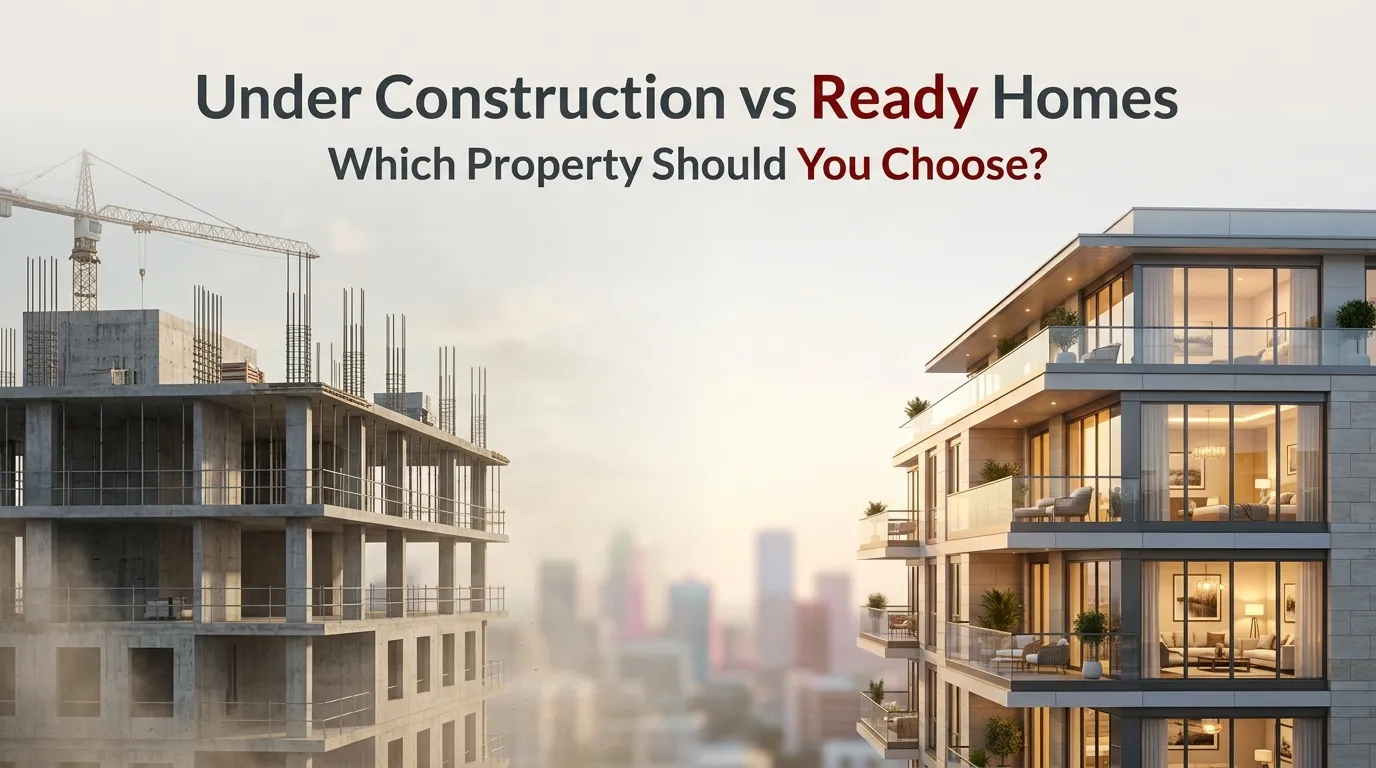
Under Construction vs Ready Homes: Which Property Should You Choose?
Categories
- Tips
- Guides
- Market Insights
- Articles
Recent Posts
Tips / 28 Sept 2026
How to Check Whether a Plot of Land Is Legally Safe to Buy
Guides / 28 Sept 2026
How to Calculate Rental Yield: Formula and Worked Examples

Guides / 26 Sept 2026
How Much Home Loan Can You Get on Your Salary in 2026?

Guides / 25 Sept 2026
10 Things to Check in a Property Sale Deed Before Registration
Choosing between an under-construction vs ready home? This guide breaks down the costs, GST impact, and RERA risks to help you decide which property type fits your budget and lifestyle.
Under Construction vs Ready Homes: Which Property Should You Choose?
Buying a home in India isn't just a financial transaction; it’s an emotional milestone that defines years of hard work. Whether you are browsing through high-rises in Gurgaon, gated communities in Bangalore, or sea-facing apartments in Mumbai, you will eventually face the ultimate dilemma: Should I buy an under-construction property or a ready-to-move-in home?
Here’s the thing—there is no "one size fits all" answer. The right choice depends on your risk appetite, your urgent need for shelter, and most importantly, your bank balance. Most buyers ignore the hidden costs involved in both, focusing only on the sticker price. In this comprehensive guide, we will break down every single detail to help you make the most informed decision of your life.
Table of Contents
- The Fundamental Difference: Dreams vs Reality
- Financial Implications and Cost Gaps
- Tax Benefits and Home Loan Nuances
- The Risk Factor: RERA and Project Delays
- Quality of Construction and Modern Amenities
- GST and Indirect Tax Impact
- Comparative Analysis Table
- Pros and Cons Breakdown
- Practical Tips for Home Buyers
- Common Mistakes to Avoid
- Conclusion
- Frequently Asked Questions
1. The Fundamental Difference: Dreams vs Reality
Under-construction properties allow you to buy into a future vision, while ready homes offer immediate tangible reality. When you walk into a ready-to-move-in apartment, what you see is exactly what you get. You can check the view from the balcony, the sunlight in the bedroom, and the quality of the bathroom fittings. There are no surprises. You can talk to neighbors and find out if the water supply is consistent or if the local grocery store delivers on time.
On the other hand, an under-construction project is a promise. You are usually looking at a sample flat that has been dolled up with expensive interior design that isn't included in your purchase. For example, a buyer in Pune recently shared how the "ample green space" promised in the brochure turned into a parking lot by the time the building was finished. This is why builder reputation is everything when you aren't buying a finished product.
2. Financial Implications and Cost Gaps
Under-construction homes are generally 10% to 25% cheaper than ready homes, but the "price gap" is narrowing in tier-1 cities. The biggest draw for under-construction properties is the price point. If you are on a tight budget, these properties offer an entry into neighborhoods you might otherwise be priced out of. You also get the benefit of staggered payments. Through construction-linked plans (CLP), you pay as the building rises, which is much easier on the pocket than coughing up a 20% down payment and starting full EMIs immediately.
However, ready homes have a "hidden" savings factor: Rent. If you are currently paying ₹30,000 in rent while waiting three years for your home to be built, you are effectively spending over ₹10 lakh just on "waiting." When you add that to the purchase price, the "cheap" under-construction flat suddenly looks a lot more expensive. Many buyers in Noida have waited 8+ years for possession, paying both rent and EMIs—a situation that can lead to a massive financial drain.
3. Tax Benefits and Home Loan Nuances
Home loan tax benefits under Section 24 and 80C are only fully available after you get possession of the property. This is a technicality that catches many first-time buyers off guard. You can claim a deduction of up to ₹2 lakh on home loan interest under Section 24b, but only *after* the construction is complete and you have the possession letter. The interest you pay during the construction phase (Pre-EMI) is capitalized and can be claimed in five equal installments after possession.
For ready-to-move-in homes, these benefits kick in from day one. If you buy a house today and move in next month, you start saving on taxes immediately. For a person in the 30% tax bracket, this can mean an annual saving of roughly ₹60,000 on interest alone. This "immediate tax shield" makes ready homes very attractive for high-income professionals in cities like Bangalore and Hyderabad.
4. The Risk Factor: RERA and Project Delays
While RERA has made the market safer, project delays remain the biggest risk for under-construction buyers. Before 2016, the Indian real estate market was like the Wild West. Today, thanks to the Real Estate (Regulation and Development) Act (RERA), builders are more accountable. Every project must be registered, and builders must keep 70% of the funds in an escrow account. This has significantly reduced the risk of funds being diverted to other projects.
But let's be realistic: delays still happen. Labor shortages, rising cement prices, or legal disputes can stall a project for months or years. If you buy a ready home, you eliminate this risk entirely. You don't have to check the RERA website every month to see if the "revised completion date" has been pushed back again. You get the keys, you get the Occupancy Certificate (OC), and you sleep peacefully.
5. Quality of Construction and Modern Amenities
Under-construction projects usually offer the latest architectural designs and modern amenities that older ready homes might lack. Real estate trends change fast. A project launched today will likely have better EV charging stations, smarter security systems, and more efficient floor plans compared to a building finished ten years ago. If you want a home that feels "new-age," under-construction is the way to go. You also have the chance to request minor structural changes or choice of tiles while the work is ongoing.
Ready homes, especially those in older layouts, might have "dead spaces" or outdated plumbing. However, the advantage is that you can inspect the actual construction quality. You can check for dampness in the walls (especially during monsoons), cracks in the structure, or the quality of the elevators. In an under-construction building, you are trusting the builder's word—and their CGI renders.
6. GST and Indirect Tax Impact
Ready-to-move-in homes with an Occupancy Certificate are exempt from GST, saving you 5% of the total property value. For many, this is the deal-breaker. If you buy an under-construction property, you have to pay GST (usually 5% for standard housing and 1% for affordable housing). On a ₹1 crore flat, that’s an extra ₹5 lakh straight out of your pocket. Ready homes that have already received their OC do not attract GST.
When you combine the GST savings with the immediate rental savings, the "premium" you pay for a ready home often balances out. In expensive markets like South Mumbai or Central Delhi, where property prices are upwards of ₹5 crore, the GST saving alone can fund your entire home's interior design or high-end furniture.
7. Comparative Analysis Table
| Feature | Under-Construction Property | Ready-to-Move-In Property |
|---|---|---|
| Price | Lower (10-25% discount) | Higher (Market Premium) |
| Possession | Future Date (usually 2-5 years) | Immediate |
| Risk | High (Delays, Quality changes) | Zero (Immediate visibility) |
| GST Impact | 5% (Standard) / 1% (Affordable) | NIL (If OC is received) |
| Tax Benefits | Starts only after possession | Starts from the first EMI |
| Amenities | Latest, modern features | Depends on age of building |
| Appreciation | High potential as area develops | Stable, moderate growth |
8. Pros and Cons Breakdown
Under-Construction Pros
- Easy payment plans (CLP/Flexi)
- Better capital appreciation
- Choice of floor/unit placement
- Newer construction technology
- Fresh, unused interiors
Under-Construction Cons
- Risk of project delays
- GST adds to the cost
- No immediate tax benefits
- Uncertainty about final view
- Double burden (Rent + EMI)
Ready-Home Pros
- Immediate move-in/Rent income
- Zero GST impact
- What you see is what you get
- Immediate tax deductions
- Established neighborhood context
Ready-Home Cons
- High upfront down payment
- Higher overall purchase price
- Older design/amenities
- Limited choice of units
- Possible renovation costs
9. Practical Tips for Home Buyers
Doing your homework can save you lakhs of rupees and years of mental agony. If you choose an under-construction property, your first step must be the RERA website. Check the builder's past track record. Have they delivered on time before? For example, Tier-1 builders like Godrej, Prestige, or Tata have higher trust levels, though they might charge a premium. Also, always opt for a Construction-Linked Plan rather than a "Subvention Scheme" or "Possession Linked Plan," as the latter can sometimes be risky if the builder defaults.
For ready homes, the most critical document is the Occupancy Certificate (OC). Do not buy a ready flat without an OC, even if the builder offers a massive discount. Without an OC, the building is technically illegal, you might not get a water connection, and selling it in the future will be a nightmare. Also, check the society’s maintenance history and the corpus fund accumulated.
10. Common Mistakes to Avoid
Most buyers fail because they fall for marketing gimmicks instead of checking the fine print. One of the biggest mistakes is ignoring the "Total Cost of Ownership." The price you see in the newspaper is just the base price. You need to factor in Floor Rise charges, Preferred Location Charges (PLC), club membership, car parking, stamp duty, registration, and GST. For an under-construction property, these can add 15-20% to the base cost.
Another common error is over-leveraging. Just because a bank is willing to give you a ₹1 crore loan doesn't mean you should take it. If you are buying an under-construction home, ensure you have a buffer for at least 12 months of EMIs in case your income is disrupted or the project is delayed. I've seen many families in Bangalore struggle because they assumed the "Pre-EMI" phase would only last two years, but it stretched to four.
11. Conclusion
So, which property should you choose? If you are a young professional with a 5-year horizon, looking for capital growth, and can handle the "rent + EMI" pressure, an under-construction property from a reputable builder is a fantastic investment. You get a brand-new home and the benefit of appreciation as the area develops around you.
However, if you are currently paying high rent, need to move in immediately for family reasons, or simply want to avoid the anxiety of project delays, a ready-to-move-in home is the superior choice. You save on GST, get immediate tax benefits, and most importantly, you get peace of mind. At the end of the day, real estate is about more than just bricks and mortar—it's about where you feel most secure. If you’re still confused between a fresh launch and an older unit, read our detailed guide on new booking vs resale property to understand the pros, cons, and key factors.
Frequently Asked Questions
Tags
Tags
About the Author
kunal
Top 5 Best Properties in Delhi NCR This Week
Handpicked properties with best price & location
Popular in Greater Noida
Top-rated residential & commercial projects across Greater Noida