
16 Essential Real Estate Documents Every Home Buyer Must Know Before Investing in Property
Categories
- Guides
- Market Insights
- Articles
- News
Recent Posts

Guides / 26 Sept 2026
How Much Home Loan Can You Get on Your Salary in 2026?
Guides / 25 Sept 2026
10 Things to Check in a Property Sale Deed Before Registration

Market Insights / 24 Sept 2026
5 Real Estate Clauses You Should Never Sign Blindly
Articles / 23 Sept 2026
Occupancy Certificate vs Completion Certificate: Key Differences Explained
Discover the 16 must-know real estate documents every home buyer needs before investing. Avoid costly mistakes and buy property with full confidence.
The One Mistake That Costs Buyers Lakhs
Let me tell you something I have seen happen far too many times.
A buyer finds the perfect flat. Location is great. Price seems right. The builder sounds convincing. Everything moves fast. Papers get signed. Money changes hands. And six months later, the buyer discovers that the project was never registered under RERA. Or the title was disputed. Or the occupancy certificate was never issued.
By then, the damage is done.
I have worked with real estate content and marketing for over a decade. And if there is one pattern I have noticed among buyers who end up in trouble, it is this — they skip the paperwork. Not intentionally. Most of them simply do not know which documents to ask for.
Property buying is probably the biggest financial decision most people will make in their lifetime. Yet many buyers spend more time choosing wall paint colours than verifying legal documents.
This blog will walk you through the 16 real estate documents that every buyer — whether you are purchasing your first home or your fifth investment property — absolutely must understand before signing anything. If you are buying for the first time, you may also want to check out this detailed first-time homebuyer guide for Delhi NCR 2026 for a complete walkthrough of the buying journey.
No legal jargon. No fluff. Just practical, clear explanations that will save you money, time, and a lot of stress.
Table of Contents
Why Real Estate Documentation Matters More Than You Think
Here is a hard truth. In India, property disputes make up roughly two-thirds of all civil litigation. That is a staggering number. And most of these disputes trace back to incomplete or unverified documentation.
When you buy a property, you are not just buying walls and a roof. You are buying a legal right. And that legal right is only as strong as the documents backing it.
Banks will not approve your home loan without proper documents. You cannot resell the property smoothly without them. And if a dispute arises, your documents are your only defence in court.
So let us go through each one carefully.
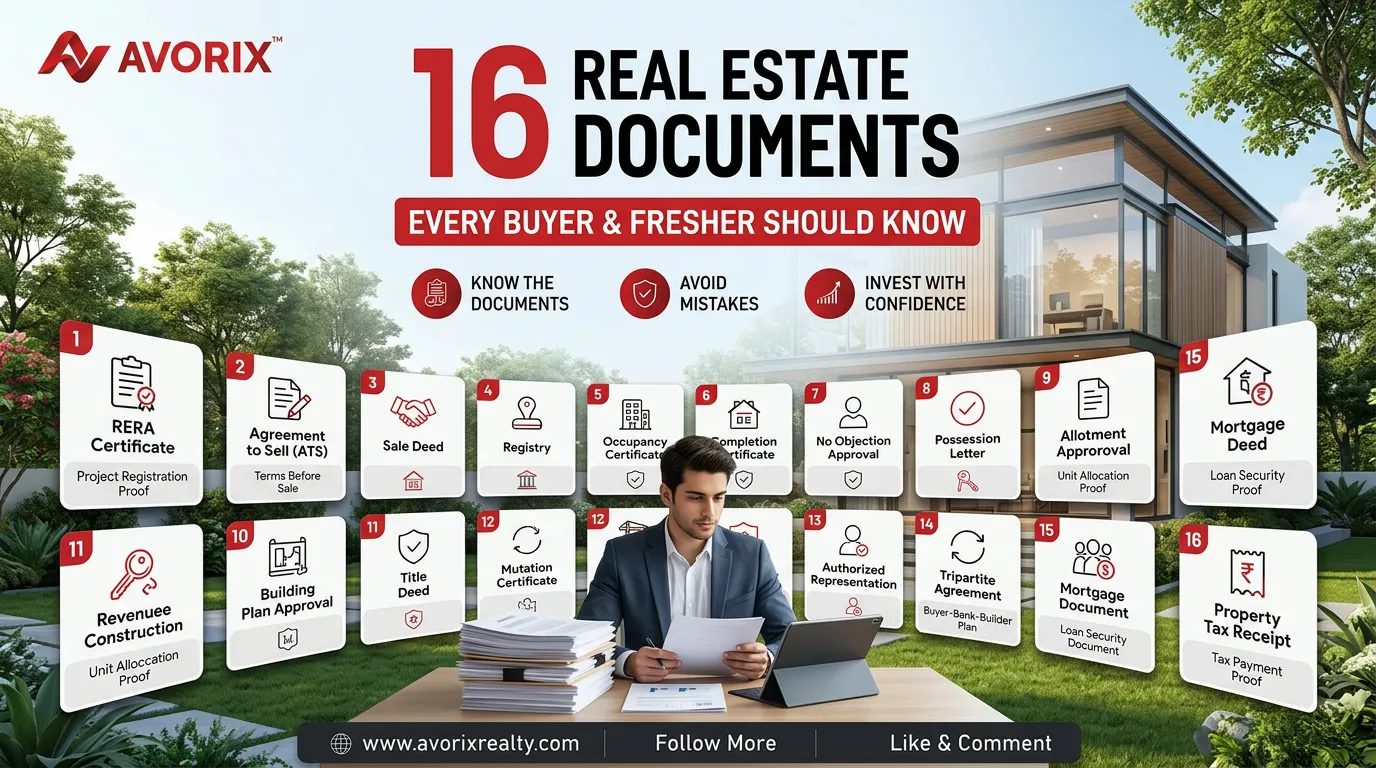
The 16 Documents Every Property Buyer Must Know
1. RERA Certificate
This is your starting point. The Real Estate Regulatory Authority certificate proves that the project is registered under the RERA Act of 2016. If a builder cannot show you a valid RERA registration number, walk away. No exceptions.
Every legitimate project in India must have this. It protects you from delays, false promises, and unauthorised construction.
What to check: Verify the RERA number on your state's RERA website. Do not just take the builder's word for it.
2. Agreement to Sell (ATS)
Before the final sale happens, both parties sign an Agreement to Sell. Think of it as a written promise. It outlines the price, payment schedule, possession date, and what happens if either party backs out.
Many buyers treat this casually. That is a mistake. Read every clause. If something feels off, get a lawyer to review it before you sign.
3. Sale Deed
This is the big one. The Sale Deed is the legal document that officially transfers ownership from the seller to you. Without a registered sale deed, you do not legally own the property. Period.
It must be printed on stamp paper and registered at the Sub-Registrar's office.
4. Registration (Registry)
Signing the sale deed is not enough. You must get it registered. Under the Indian Registration Act of 1908, registration is mandatory for the sale to be legally valid.
This involves paying stamp duty and registration fees, which vary by state. Do not try to undervalue the property on paper to save on stamp duty. That creates bigger problems later, especially during resale or if the tax department audits you.
5. Occupancy Certificate (OC)
Issued by the local municipal authority, the OC confirms that the building is safe and fit to live in. Without it, you might face trouble getting water and electricity connections.
I have seen cases where buyers moved into buildings without an OC and then struggled for years to get basic utilities. Always ask for this document before taking possession.
6. Completion Certificate (CC)
Often confused with the OC, the Completion Certificate confirms that the building was constructed according to the approved plans. The local development authority issues it after inspecting the completed structure.
Quick distinction: CC means the building is complete. OC means it is safe to occupy. You need both.
7. No Objection Certificate (NOC)
NOCs are required from multiple government departments — fire safety, pollution control, water supply, electricity board, and sometimes even the aviation authority if the building is near an airport.
Each NOC confirms that the respective department has no objection to the construction or its use. If any NOC is missing, the project could face legal challenges down the line.
8. Possession Letter
This letter from the builder officially confirms the handover of the property to you. It records the date of possession and serves as proof that you have received the unit.
Keep this safe. You will need it for loan closure, tax filings, and future resale.
9. Allotment Letter
When you book a flat or unit, the builder issues an Allotment Letter. It specifies which unit has been allocated to you — the floor, unit number, carpet area, and payment terms.
This is especially important when dealing with government housing bodies like DDA or MHADA.
10. Building Plan Approval
Before construction begins, the builder must get the building plan approved by the local municipal authority. This sanctioned plan confirms that the construction complies with zoning laws, FSI norms, and building bye-laws.
If the actual construction deviates from the approved plan, the building can be declared unauthorised. That is a risk no buyer should take.
11. Revenue Records
These are government-maintained records that establish land ownership. Depending on your state, they go by different names — 7/12 extract in Maharashtra, Khata certificate in Karnataka, Patta in Tamil Nadu.
Revenue records help verify that the land on which the property stands is legally owned by the seller and is free from disputes.
12. Title Deed
The Title Deed traces the history of ownership of a property. It shows who owned the property before the current seller and whether the title is clear and marketable.
A clear title means no pending legal disputes, no unpaid loans against the property, and no third-party claims.
Pro tip: Always get a title search done by a property lawyer going back at least 30 years. It costs a small fee but can save you from massive headaches.
13. Mutation Certificate
After you buy a property, you need to apply for mutation. This updates the local municipal records to reflect you as the new owner. It is essential for property tax purposes and for establishing your legal ownership in government records.
Many buyers skip this step. Do not be one of them.
14. Power of Attorney (Authorised Representation)
If the property owner cannot be physically present for the transaction, they may authorise someone else to act on their behalf through a Power of Attorney.
Be cautious with properties sold through POA. Verify the POA document thoroughly and confirm that it has not been revoked. There have been numerous fraud cases involving misuse of Power of Attorney in real estate.
15. Tripartite Agreement
When you take a home loan, the bank often requires a Tripartite Agreement — a three-way agreement between you (the buyer), the bank, and the builder. It clearly defines each party's responsibilities regarding loan disbursement, construction milestones, and property handover.
This protects all three parties and is standard practice for under-construction properties.
16. Mortgage Deed
When you mortgage your property to a bank for a home loan, the Mortgage Deed is the legal document that records this arrangement. The property remains as collateral until the loan is fully repaid.
Once you clear the loan, make sure you get the original documents released from the bank and have the mortgage lien removed from government records.
Bonus: Property Tax Receipts
Always ask the seller for recent property tax receipts. These confirm that all taxes have been paid and there are no outstanding dues. Unpaid property tax can become your liability after purchase.
Common Mistakes That Buyers Make
Here are a few patterns I keep seeing:
- Not verifying RERA registration independently. Buyers trust brochures instead of checking the RERA portal themselves.
- Skipping the title search. This is probably the single most expensive mistake a buyer can make. A disputed title can lock up your money in court for decades.
- Ignoring mutation after purchase. Ownership transfer on paper means nothing if government records still show the previous owner's name.
- Rushing through the ATS. Builders sometimes insert clauses that heavily favour them. Read everything. Ask questions. Get legal help.
- Not collecting original documents after loan closure. Banks hold your original documents during the loan tenure. Many buyers forget to collect them after the loan is paid off.
Beyond documentation, there are several other smart practices every buyer should follow. Take a look at these 10 essential tips before buying a property in India to make sure you cover every angle before committing your money.
A Real-World Scenario
I worked with a digital marketing client in Pune — a real estate firm — that had a customer complaint spiral out of control on social media. A buyer had purchased a flat in one of their projects without checking whether the Completion Certificate had been issued. When the municipal authority later flagged the building for deviations in the approved plan, the buyer could not get an OC. No water connection. No electricity in his name. And a flat that was nearly impossible to resell.
The builder was at fault, absolutely. But the buyer could have avoided the entire mess by verifying the CC and OC before signing the sale deed.
Documentation is not just a formality. It is your safety net.
Quick Reference Table
| # | Document | Issued By | Purpose |
|---|---|---|---|
| 1 | RERA Certificate | State RERA Authority | Project registration proof |
| 2 | Agreement to Sell | Buyer & Seller | Pre-sale terms |
| 3 | Sale Deed | Buyer & Seller | Ownership transfer |
| 4 | Registry | Sub-Registrar Office | Legal registration |
| 5 | Occupancy Certificate | Municipal Authority | The building is habitable |
| 6 | Completion Certificate | Development Authority | Construction is complete |
| 7 | NOC | Various Departments | No objections to construction |
| 8 | Possession Letter | Builder/Developer | Handover confirmation |
| 9 | Allotment Letter | Builder/Housing Authority | Unit allocation proof |
| 10 | Building Plan Approval | Municipal Authority | Approved construction plan |
| 11 | Revenue Records | Revenue Department | Land ownership records |
| 12 | Title Deed | Previous Owners/Seller | Ownership history |
| 13 | Mutation Certificate | Municipal Authority | Updated ownership in records |
| 14 | Power of Attorney | Property Owner | Authorized representation |
| 15 | Tripartite Agreement | Buyer, Bank & Builder | Home loan arrangement |
| 16 | Mortgage Deed | Bank & Buyer | Loan security document |
Final Thoughts
Buying property should feel exciting, not terrifying. But it will only feel that way when you know your paperwork is solid.
Every document on this list exists for a reason. Each one protects a different part of your investment. Skip even one, and you leave a gap that could cost you dearly — financially, legally, or both.
My honest advice? Before you fall in love with a property, fall in love with the paperwork first. Hire a good property lawyer. Verify every document independently. Ask uncomfortable questions.
Because at the end of the day, a beautiful home with messy documentation is just an expensive problem waiting to happen.
Ready to Make a Smart Property Investment?
If you are looking for expert guidance on real estate documentation, property verification, or finding the right investment opportunity, the team at Avorix Realty can help. They specialise in making property buying transparent, secure, and hassle-free for first-time buyers and seasoned investors alike.
Visit Avorix Realty to speak with a real estate expert and start your property journey on the right foot. #PropertyKaDNA
Have questions about any of these documents? Drop a comment or reach out — clarity today prevents disputes tomorrow.
Tags
Tags
Frequently Asked Questions
About the Author
Admin
Top 5 Best Properties in Delhi NCR This Week
Handpicked properties with best price & location
Popular in Greater Noida
Top-rated residential & commercial projects across Greater Noida