
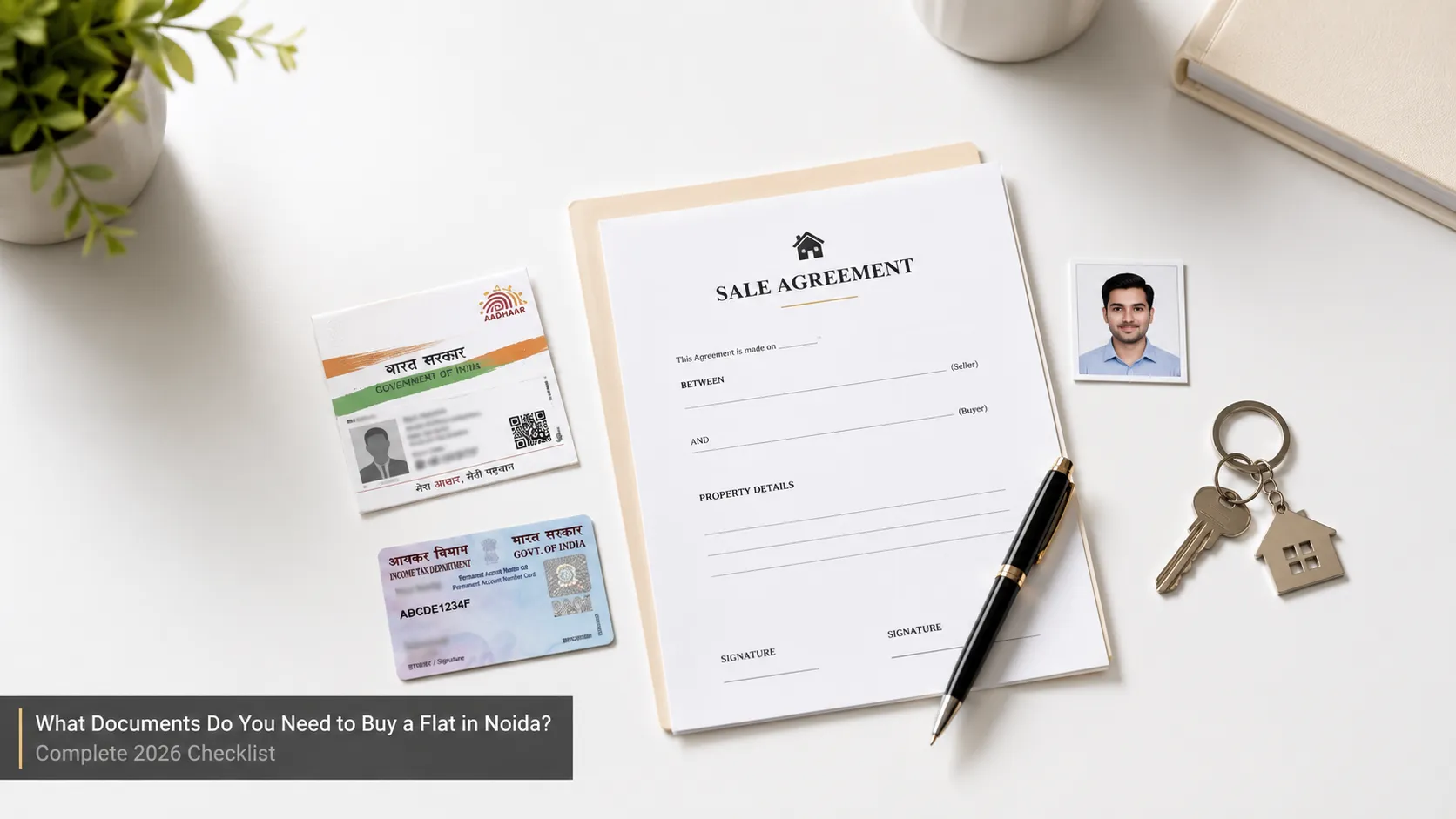
What Documents Do You Need to Buy a Flat in Noida? Complete 2026 Checklist
Categories
- Tips
- Guides
- Market Insights
- Articles
Recent Posts

Tips / 28 Sept 2026
How to Check Whether a Plot of Land Is Legally Safe to Buy
Guides / 28 Sept 2026
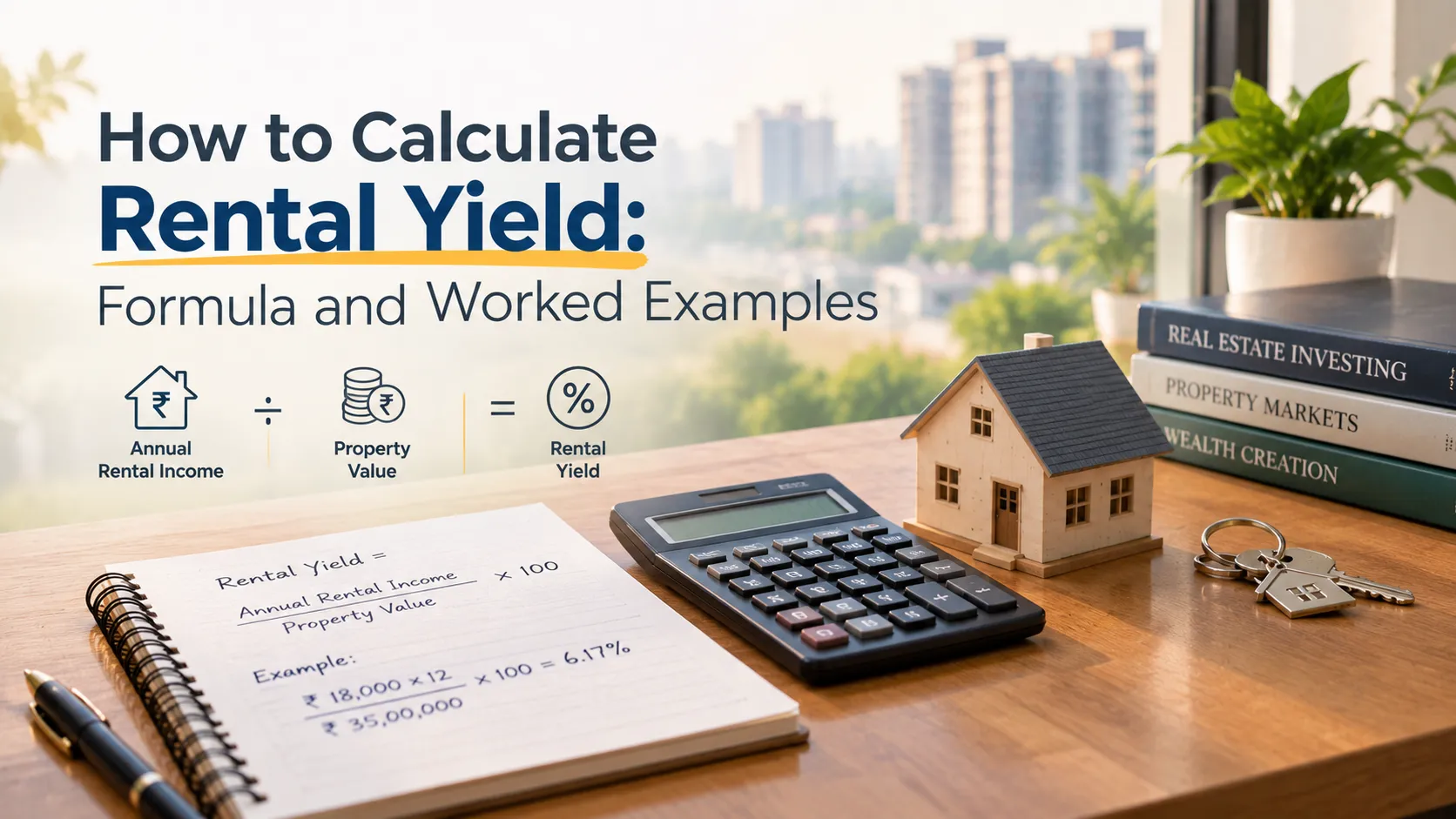
How to Calculate Rental Yield: Formula and Worked Examples

Guides / 26 Sept 2026
How Much Home Loan Can You Get on Your Salary in 2026?

Guides / 25 Sept 2026
10 Things to Check in a Property Sale Deed Before Registration
Buying a flat in Noida in 2026? Here's the complete document checklist — buyer KYC, property papers, registration costs and what to verify before you sign anything.
Buying a flat in Noida feels exciting until the documentation conversation begins. Suddenly there are fifteen things to arrange, three portals to navigate, multiple parties asking for different papers, and a nagging sense that missing even one document could derail the entire process at the worst possible moment.
It doesn't have to be that complicated. But it does require knowing what you need, when you need it, and why each document matters — not just that it's on a list.
This guide breaks the documentation process into three clear stacks: your documents as the buyer, the seller's ownership documents, and the property-specific papers. Get all three organised before you start negotiating seriously, and the process moves considerably faster and with far less stress.
Table of Contents
- Why Documentation Matters More in Noida Than You Might Think
- Stack 1: Your Documents as the Buyer
- Stack 2: The Seller's Documents
- Stack 3: Property-Specific Documents
- The Registration Process — What Happens on the Day
- Two Mistakes That Delay Registration in Noida
- A Note on Digital Verification in 2026
- The Bottom Line
Why Documentation Matters More in Noida Than You Might Think
Noida operates under the Uttar Pradesh Registration framework, governed by the Inspector-General of Registration and Stamps (IGRSUP). Property registration here is managed digitally through the IGRSUP portal — which is actually quite efficient once you understand it — but it requires specific documents in a specific sequence.
Unlike some other Indian cities where documentation norms are loosely enforced, Noida's Sub-Registrar Office in Sector 33 follows a structured verification process. Missing a document on registration day doesn't just cause a delay — it means rescheduling your appointment, which can set the entire transaction back by weeks.
The cost dimension matters too. In 2026, Noida charges 7% stamp duty and 1% registration fee. Women purchasers may receive a 1% rebate on home value up to ₹1 crore, saving up to ₹1 lakh. On a ₹70 lakh flat, that's approximately ₹5.6 to ₹6 lakhs in government charges alone — non-negotiable and non-refundable, which makes getting the process right the first time genuinely important.
Stack 1: Your Documents as the Buyer
These are the KYC and financial documents you need to bring to the table.
Identity and Address Proof
- Aadhaar Card — mandatory for all property transactions in Noida
- PAN Card — required for both buyer and seller; essential for TDS compliance
- Address Proof — recent utility bill (electricity, water, or gas), passport, or voter ID
Financial Documents
- TDS Challan — for properties valued above ₹50 lakhs, the buyer must deduct 1% TDS on the purchase price and submit the challan as proof. This is one of the most commonly forgotten requirements and one of the most consequential to miss.
- Passport-size photographs — typically two to four, depending on the Sub-Registrar's requirements
- Bank statements or payment proof — showing funds transferred or cheque details for the transaction
If you're financing the purchase through a home loan, your lender will have an additional document requirement on their side — but for the purpose of the registration process, the above is your core buyer stack.
Stack 2: The Seller's Documents
This is where due diligence matters most. The seller's documents establish that they actually own what they're selling, that the property is free of encumbrances, and that all dues are cleared before you take title.
Ownership and Title Documents
- Sale Deed / Title Deed — the original document showing the seller's ownership. For a complete title chain, you want to see all previous ownership documents going back ideally 30 years.
- Allotment Letter — the original letter issued by Noida Authority (or GNIDA/YEIDA for Greater Noida) confirming initial allotment to the first owner.
- Possession Letter — proof that the seller has legal possession of the property.
Clearance Documents
- Encumbrance Certificate (EC) — confirms the property is free from any registered mortgage, lien, or legal claim. Available to download from the IGRSUP portal. For Noida properties, an EC covering at least 15 years is the standard requirement.
- Property Tax Receipts — recent receipts showing all municipal taxes have been paid with no outstanding dues. Unpaid dues become your problem after transfer.
- NOC (No Objection Certificate) — from the Noida Authority or relevant body confirming no outstanding dues or objections to the sale. This is mandatory and one of the most common bottlenecks in resale transactions.
- Loan Closure Certificate — if the seller previously had a home loan on this property, you need a formal closure certificate confirming the mortgage has been fully discharged. Not just a bank letter — the release deed should be registered at the Sub-Registrar.
Stack 3: Property-Specific Documents
These relate to the flat itself — its legality, structural compliance, and regulatory status.
For New or Under-Construction Flats
- RERA Registration Certificate — verify this independently on the UP RERA portal. The registration number should match what's in all marketing materials and agreements.
- Builder-Buyer Agreement (BBA) — the registered agreement between you and the developer. This is your primary legal protection during the construction phase.
- Sanctioned Building Plan — the approved layout from the Noida Authority, confirming the building was designed within permitted parameters.
- Completion Certificate / Occupancy Certificate — for ready-to-move properties, this is non-negotiable. It confirms the building was completed according to the approved plan and is legally fit for habitation.
For Resale Flats
- Chain of Title — all previous sale deeds tracing ownership from the original allottee to the current seller. A gap in this chain is a serious red flag.
- Society NOC — from the housing society or RWA, confirming the seller has cleared all maintenance dues and that there are no objections to the transfer.
A real-world scenario that illustrates why this matters: a buyer in Noida Sector 62 had all his personal documents perfectly organised and his loan sanctioned. The process stalled for 47 days because the seller had unpaid maintenance dues of ₹1.8 lakhs and the society hadn't issued an NOC. One phone call to the society before the process began would have surfaced this — instead it became a prolonged negotiation mid-transaction.
For a deeper understanding of which property documents matter most and what each one actually protects you from, the guide on 16 essential real estate documents every home buyer must know covers the full legal picture in detail — particularly useful if this is your first purchase in Noida.
The Registration Process — What Happens on the Day
Once all documents are in order, the process at the Sub-Registrar Office follows a clear sequence. The property registration process in Noida includes document verification, payment of fees (stamp duty and registration charges), and the execution of a sale deed at the Sub-Registrar's Office where the final registration is completed.
Both buyer and seller must be present in person, along with two witnesses. The Registrar verifies all details, confirms payments have been made, and records the transaction in official records. Within a few days, you receive a digitally signed registered Sale Deed — which is your legal proof of ownership.
One step most buyers miss immediately after registration: apply for mutation at the local municipal or revenue office. Mutation updates the ownership records in the authority's database and ensures future property tax bills are correctly addressed to you. It's not automatic — it requires a separate application after registration.
Two Mistakes That Delay Registration in Noida
Mistake 1: Not Verifying the Encumbrance Certificate Independently
Many buyers rely on the seller's assurance that the property is free of encumbrances. The EC is available online through the IGRSUP portal — check it yourself before signing anything. An undisclosed mortgage that surfaces on registration day is one of the most expensive problems in property transactions.
Mistake 2: Ignoring the Circle Rate
The declared sale price in your registration documents cannot be less than the Noida Authority's circle rate for that sector. If your agreed price is below the circle rate, stamp duty is still calculated on the circle rate — not the transaction value. Buyers who discover this only at registration end up paying more than they budgeted for.
A Note on Digital Verification in 2026
In 2026, verifying flat ownership in Noida is a streamlined digital process involving the Noida Authority, UP Bhulekh, and the IGRSUP portal. To ensure a safe investment, buyers must cross-verify the Builder-Buyer Agreement (BBA) with the registered sale deed available on the IGRSUP 'Property Search' tool.
This digital infrastructure is genuinely useful. Before you visit any property for a serious viewing, spend 20 minutes on the IGRSUP portal verifying the ownership history. It's free, fast, and tells you more than a broker's assurance ever will.
The Bottom Line
Buying a flat in Noida is manageable when you understand the document process — what you need, why you need it, and in what sequence. The buyers who move fastest and with the least friction are the ones who have their own KYC organised early, verify the seller's documents independently before negotiating price, and check society NOC status before the process begins rather than after it stalls.
Documents don't make the purchase exciting. But getting them right is what makes the purchase secure.
Ready to start shortlisting flats in Noida and want a clear read on which properties have clean documentation and which ones carry red flags? Speak with a local expert who reviews property papers as a standard part of the transaction process — not an afterthought. #PropertyKaDNA
Tags
Tags
Frequently Asked Questions
About the Author
Admin
Top 5 Best Properties in Delhi NCR This Week
Handpicked properties with best price & location
Popular in Greater Noida
Top-rated residential & commercial projects across Greater Noida