
Home Loan Checklist for Buying a Flat in Delhi NCR 2026
Categories
- Tips
- Guides
- Market Insights
- Articles
Recent Posts

Tips / 28 Sept 2026
How to Check Whether a Plot of Land Is Legally Safe to Buy

Guides / 28 Sept 2026
How to Calculate Rental Yield: Formula and Worked Examples

Guides / 26 Sept 2026
How Much Home Loan Can You Get on Your Salary in 2026?

Guides / 25 Sept 2026
10 Things to Check in a Property Sale Deed Before Registration
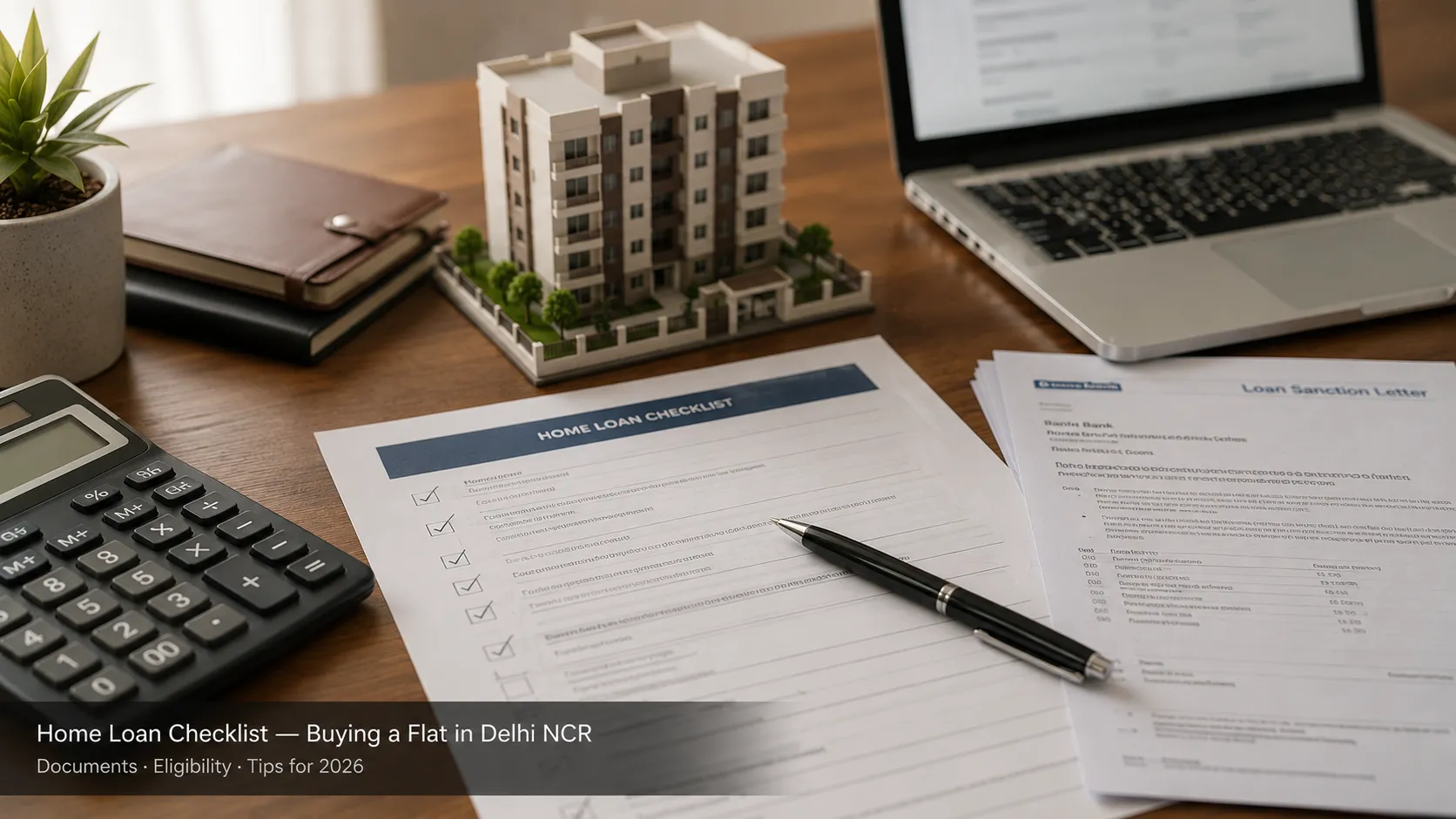
Planning to take a home loan in Delhi NCR? Here's the complete checklist — documents, eligibility, costs and mistakes to avoid before you apply in 2026.
The home loan process in India looks straightforward on paper. Submit documents, get approved, buy the flat. In reality, most buyers in Delhi NCR spend two to three months longer than necessary — either because they started the process without the right documents, discovered a credit issue they didn't know existed, or found that the property they'd fallen in love with wasn't eligible for bank financing.
None of these are unusual situations. They happen to prepared, intelligent people who simply didn't know what to prepare for. This checklist exists to change that.
Whether you're buying a 2 BHK in Noida Sector 62, a builder floor in Janakpuri, or a resale flat in Greater Noida West, the home loan process follows the same broad structure across Delhi NCR — with a few local variations worth knowing about. Here's what to get in order before you walk into a bank or lender.
Table of Contents
- Step 1: Know Your Loan Eligibility Before You Shortlist Properties
- Step 2: Check and Clean Your Credit Score
- Step 3: Gather Your Documents — The Complete List
- Step 4: Understand the Full Cost — Not Just the EMI
- Step 5: Compare Lenders — Don't Just Go to Your Salary Bank
- Step 6: Understand the Disbursement Structure
- A Real-World Scenario: The Missing NOC That Delayed Everything
- Two Mistakes That Delay Home Loans in Delhi NCR
- The Bottom Line
Step 1: Know Your Loan Eligibility Before You Shortlist Properties
This is the step most buyers skip — and it's the one that causes the most pain later.
Lenders in India typically approve home loans of 75% to 90% of the property's value, depending on the loan amount. The upper limit on what you can borrow depends on your income, existing EMIs, employment type, age, and credit score. Most salaried buyers discover that the amount they thought they could borrow and the amount a bank actually sanctions are meaningfully different.
The standard formula most lenders use: your total monthly EMI obligations — including the proposed home loan — should not exceed 40% to 50% of your net monthly income. If you already have a car loan, a personal loan, or credit card dues being repaid, those reduce your eligible home loan amount directly.
Before shortlisting any property, get a pre-qualification or in-principle approval from a lender. It takes a few days, costs nothing, and tells you exactly what budget you're actually working with — not what you hope you're working with.
Step 2: Check and Clean Your Credit Score
Your CIBIL score — or equivalent score from Experian, Equifax, or CRIF — is the first thing a lender checks. A score above 750 typically gets you the best interest rates and fastest processing. Below 700, you'll either face higher rates, lower sanction amounts, or outright rejections depending on the lender.
Check your score before applying. If it's lower than you expected, find out why. Common reasons in Delhi NCR buyers include missed EMI payments on older loans that have since been closed, credit card bills paid late, or — surprisingly common — errors in the bureau's records where someone else's default has been incorrectly linked to your PAN.
Cleaning up errors takes time — typically 30 to 60 days for a bureau correction to reflect. This is why you want to check your score at least three months before you plan to apply, not the week before.
Step 3: Gather Your Documents: The Complete List
This is where the home loan checklist gets specific. Lenders across Delhi NCR require broadly the same set of documents, though some add or remove items based on the loan amount or property type.
For Salaried Applicants
- Last 3 months salary slips
- Last 2 years Form 16 or IT returns
- Last 6 months bank statements (salary account)
- Employment certificate or offer letter if recently changed jobs
- PAN card and Aadhaar
- Passport-size photographs
- Existing loan statements if any
For Self-Employed Applicants
- Last 3 years IT returns with computation
- Last 3 years profit and loss statement and balance sheet (CA certified)
- Last 12 months bank statements (business and personal)
- Business registration proof
- GST returns for the last 12 months if applicable
- PAN and Aadhaar
Property Documents (Required After Shortlisting)
- Sale agreement or allotment letter
- Title deed chain (all previous ownership documents)
- Approved building plan and layout
- RERA registration certificate
- Occupancy certificate if the property is ready-to-move
- No Objection Certificate from the housing society if applicable
- Encumbrance certificate
The property document checklist is where most resale purchases in Delhi NCR hit delays. Title deed chains in older South Delhi localities and some Noida resale properties can be incomplete — missing a link from a previous transfer, or carrying an uncleared mortgage that the seller hasn't disclosed. A lawyer's title verification before you apply for the loan saves significant time and sometimes saves you from the wrong purchase entirely.
Step 4: Understand the Full Cost — Not Just the EMI
This is where buyers consistently underestimate what buying actually costs.
Your home loan covers the property price (up to the sanctioned LTV). It does not cover stamp duty, registration, brokerage, society maintenance deposit, parking charges, or interior work. In Delhi NCR, these additional costs typically add 8% to 12% to the headline property price depending on the state (Delhi, UP, or Haryana) and the transaction structure.
Stamp duty in Delhi is 4% for women buyers and 6% for men. In UP (Noida, Greater Noida), it's 7% for men and 5% to 6% for women. Registration charges are additional. On a ₹70 lakh property in Noida, this means ₹5 to ₹6 lakhs just in government charges — before any brokerage or other costs.
Build this into your planning before you shortlist. A ₹70 lakh budget for a property in Noida is really a ₹62 to ₹64 lakh property budget once you account for these costs, assuming you're funding everything from your own resources beyond the loan. Your eligible loan amount and comfortable EMI depend on your income, existing liabilities, and other costs. For a step-by-step method, refer to our article on calculating your home loan affordability before applying.
For a more detailed assessment of what your investment actually looks like once all costs are factored in, a property ROI calculator helps you model the full financial picture — purchase cost, loan cost, rental income, and long-term appreciation — in one place before you commit.
Step 5: Compare Lenders — Don't Just Go to Your Salary Bank
Most buyers default to their salary bank for a home loan because it feels familiar. That's understandable. It's also often suboptimal.
Interest rates, processing fees, pre-payment penalties, and loan-to-value ratios vary meaningfully across lenders. A 0.25% difference in interest rate on a ₹60 lakh loan over 20 years isn't trivial — it adds up to several lakhs over the loan tenure.
Compare at least three to four lenders before deciding. Public sector banks often offer lower rates but slower processing. Private banks are faster but sometimes more conservative on LTV. Housing finance companies are worth evaluating for self-employed applicants who may find public sector banks less flexible on income documentation.
For under-construction properties in Noida, Greater Noida West, or Gurugram, also check which lenders have approved the specific project — not all lenders will finance all projects, and this can affect your choices.
Step 6: Understand the Disbursement Structure
For ready-to-move properties, the loan is disbursed in a single tranche against the registered sale deed. Straightforward.
For under-construction properties, disbursement happens in stages linked to construction progress — foundation, slab, brickwork, finishing, possession. You pay interest only on the disbursed amount during construction (called pre-EMI), and full EMI begins after complete disbursement.
This matters for your cash flow planning. If you're also paying rent during the construction period, you're effectively paying pre-EMI plus rent simultaneously. Budget for this honestly — it catches many buyers off guard, particularly those with tighter monthly cash flows.
A Real-World Scenario: The Missing NOC That Delayed Everything
A buyer I know — a salaried professional, excellent credit score, all income documents in order — applied for a home loan on a resale flat in Noida Sector 62. The loan was sanctioned quickly. Then it stalled.
The housing society hadn't issued a No Objection Certificate because the seller had unpaid maintenance dues of ₹1.8 lakhs. The seller disputed this. The bank wouldn't disburse without the NOC. The whole process — including negotiations, dues settlement, and fresh paperwork — added 47 days to a process that should have taken two weeks.
The moral: always verify society dues, pending maintenance, and NOC status with the housing society directly — not just through the seller — before you apply for the loan. It costs one phone call and saves weeks.
Two Mistakes That Delay Home Loans in Delhi NCR
Mistake 1: Applying to Multiple Lenders Simultaneously
Multiple hard inquiries on your credit report in a short period lower your CIBIL score and signal credit hunger to lenders. Compare lenders first — through pre-qualification and soft inquiries — and apply formally to one or two at most.
Mistake 2: Changing Jobs Between Application and Disbursement
Lenders verify employment at multiple points during the process. Changing jobs after sanction but before disbursement can trigger a re-assessment or outright cancellation of the sanctioned loan. If a career move is on the horizon, time it carefully relative to your loan disbursement.
The Bottom Line
A home loan in Delhi NCR is manageable if you prepare for it rather than react to it. The buyers who move fastest and with least friction are the ones who check their credit score early, gather documents before they need them, understand the full cost picture upfront, and verify property documents independently rather than taking the seller's word.
None of this is complicated. It's mostly about sequencing — doing the right things in the right order, before the clock starts.
If you're a first-time buyer and the overall purchase process still feels unclear beyond just the loan, the first-time homebuyer guide for Delhi NCR 2026 walks through the entire journey — from shortlisting to registration — in practical, step-by-step terms that make the process significantly less intimidating.
Ready to start your home loan process and want guidance on which lenders, properties, and localities make the most sense for your specific situation in Delhi NCR? Speak with a local expert who works with buyers across Noida, Greater Noida, Janakpuri, and the broader NCR market. Getting the process right from the start saves months of back-and-forth and sometimes a great deal of money. #PropertyKaDNA
Tags
Tags
Frequently Asked Questions
About the Author
Admin
Top 5 Best Properties in Delhi NCR This Week
Handpicked properties with best price & location
Popular in Greater Noida
Top-rated residential & commercial projects across Greater Noida