
10 Home Loan Terms Every Homebuyer Should Know in 2026
Categories
- Tips
- Guides
- Market Insights
- Articles
Recent Posts

Tips / 28 Sept 2026
How to Check Whether a Plot of Land Is Legally Safe to Buy
Guides / 28 Sept 2026
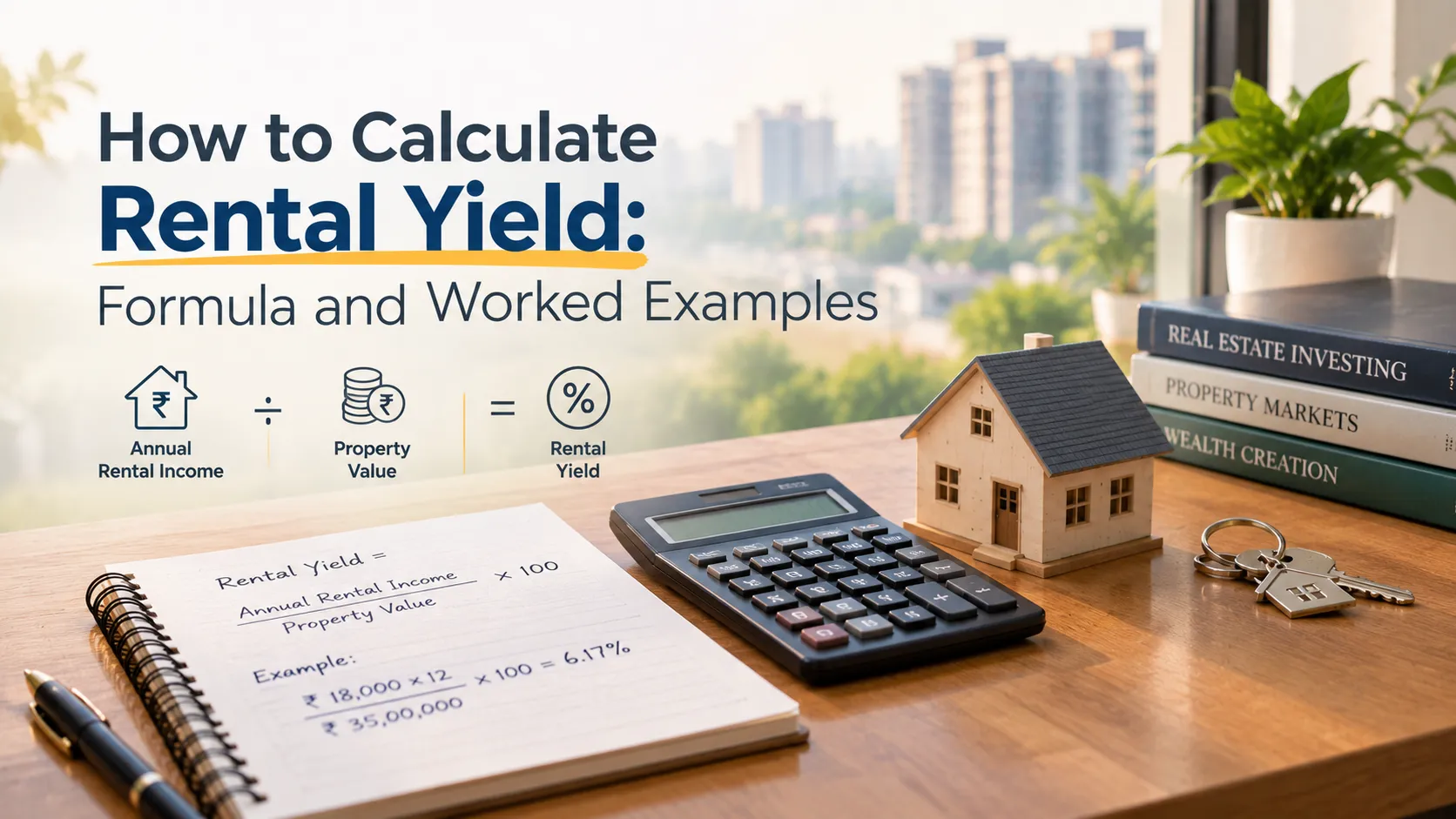
How to Calculate Rental Yield: Formula and Worked Examples

Guides / 26 Sept 2026
How Much Home Loan Can You Get on Your Salary in 2026?

Guides / 25 Sept 2026
10 Things to Check in a Property Sale Deed Before Registration
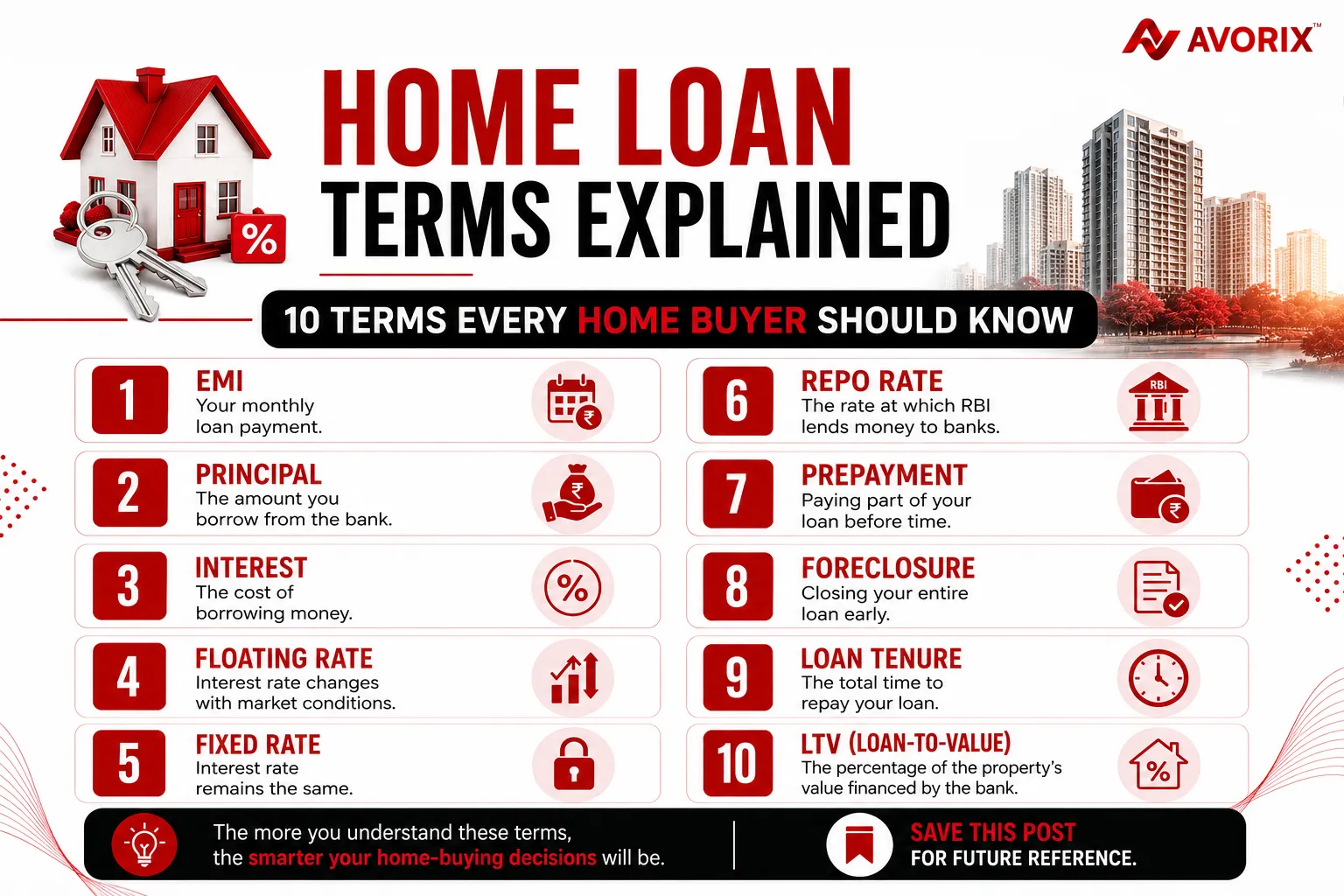
Home loan terms explained: EMI, LTV, repo rate, fixed vs floating rate, tenure, prepayment and foreclosure, in plain language before you sign anything.
Most first-time buyers sign their home loan documents having understood maybe half of what's actually in them. That's not a knock on anyone; banks aren't exactly known for plain language, and terms like "LTV ratio" or "floating rate reset" don't come up in everyday conversation. But these terms directly decide what you pay every month for the next 15 to 20 years, so it's worth ten minutes to actually understand them before you're sitting across from a loan officer.
This guide breaks down the ten home loan terms that matter most, in plain language, with real numbers from where things stand in 2026.
Table of Contents
- 1. What Is EMI (Equated Monthly Installment)?
- 2. Principal vs Interest: What Are You Actually Paying?
- 3. What Is Loan Tenure, and How Should You Choose It?
- 4. What Is a Fixed Interest Rate?
- 5. What Is a Floating Interest Rate?
- 6. What Is the Repo Rate, and Why Does It Move Your EMI?
- 7. What Is LTV (Loan-to-Value) Ratio?
- 8. What Is a Processing Fee?
- 9. What Is Prepayment of a Home Loan?
- 10. What Is Home Loan Foreclosure?
- The Bottom Line
1. What Is EMI (Equated Monthly Installment)?
EMI is the fixed monthly amount you pay to repay your home loan, made up of two parts: principal and interest. It's called "equated" because the total amount stays the same every month, even though the split between principal and interest changes over time.
Here's the part most first-time buyers miss: in the early years of your loan, most of your EMI goes toward interest, not principal. On a 20-year loan, you might be three or four years in before the principal component even crosses the interest component. This is exactly why prepaying early in the loan tenure saves so much more interest than prepaying later, a point worth remembering when we get to prepayment further down.
2. Principal vs Interest: What Are You Actually Paying?
Principal is the actual amount you borrowed. Interest is what the bank charges you for lending it. Every EMI payment splits between the two, and the ratio shifts gradually across your loan tenure.
A practical way to think about it: if you take a ₹50 lakh loan at 8% for 20 years, you'll end up paying close to ₹47-48 lakh in interest alone over the full tenure, nearly as much as the loan itself. That's not a reason to avoid a home loan, it's simply the cost of spreading a large purchase over two decades, but it's exactly why the interest rate and tenure you choose matter as much as the property price.
3. What Is Loan Tenure, and How Should You Choose It?
Tenure is the total number of years you take to repay the loan, typically ranging from 5 to 30 years for home loans in India. Longer tenure means lower EMI but more total interest paid. Shorter tenure means higher EMI but significantly less interest overall.
A common mistake here: buyers pick the longest tenure available purely to keep the EMI low, without checking whether they could comfortably afford a shorter tenure and save lakhs in interest. A useful middle ground is choosing a tenure your EMI can handle comfortably, then using prepayments to shorten it further as your income grows, rather than locking into 25-30 years by default.
4. What Is a Fixed Interest Rate?
A fixed interest rate stays the same for a set period, sometimes the entire loan tenure, regardless of what happens to market interest rates. Your EMI stays predictable, which is genuinely valuable if you want zero surprises in your monthly budget.
The trade-off is cost: fixed rates in India typically run higher than floating rates at the time of borrowing, since the bank is taking on the risk of rates rising later. True fixed-for-tenure loans are also less common than they used to be, many "fixed" home loan products are actually fixed for an initial period, say 2-3 years, before reverting to floating.
5. What Is a Floating Interest Rate?
A floating interest rate moves up or down based on a benchmark, most commonly the repo rate in India today. When the benchmark changes, your interest rate, and therefore your EMI or loan tenure, adjusts accordingly.
Most home loans in India today are floating rate loans linked to the External Benchmark Lending Rate (EBLR), which itself tracks the RBI's repo rate. As of mid-2026, home loan interest rates across banks range roughly from 7.10% to around 12%, depending heavily on your credit score, income profile, and lender. Public sector banks tend to offer the lowest starting rates, often in the 7.10%-7.25% range for well-qualified borrowers.
6. What Is the Repo Rate, and Why Does It Move Your EMI?
The repo rate is the rate at which the Reserve Bank of India lends money to commercial banks. When the RBI cuts the repo rate, banks' borrowing costs drop, and that saving typically gets passed on to floating-rate home loan borrowers as a lower interest rate. When the RBI raises it, the opposite happens.
Current repo rate (as of June 2026): 5.25%, held steady across the February, April, and June 2026 MPC meetings
Home loan interest rates (mid-2026): Roughly 7.10% to 12%, depending on credit profile
EMI reset time after a repo rate change: Usually 1-3 months, depending on your lender's reset cycle
Practically, this means your EMI on a floating-rate loan isn't fixed for life; it moves with monetary policy. If your loan is on EBLR, changes tend to reflect fairly quickly. If it's on the older MCLR benchmark, the transmission is slower. Worth checking which one your loan is actually linked to.
7. What Is LTV (Loan-to-Value) Ratio?
LTV is the percentage of the property's value that a bank is willing to lend you. If a property is valued at ₹1 crore and the bank offers an LTV of 80%, they'll lend you up to ₹80 lakh, and you'll need to arrange the remaining ₹20 lakh yourself, commonly called the down payment or margin money.
RBI guidelines generally cap LTV at around 75-90% depending on the loan amount; lower-value loans can get higher LTV, while larger loans typically see the ratio capped closer to 75%. A real-world scenario: a buyer assumes they only need to save 10% of the property price as a down payment, based on what a friend mentioned, and gets caught off guard when their specific loan slab only qualifies for 75% LTV. Confirming the applicable LTV for your exact loan amount before you start shopping for a property avoids this exact situation.
8. What Is a Processing Fee?
The processing fee is a one-time charge the bank takes for evaluating and approving your loan application, typically ranging from 0.25% to 1% of the loan amount, sometimes with a minimum flat charge regardless of loan size. It covers the bank's cost of verifying your documents, checking your credit history, and processing the paperwork.
This fee is usually negotiable, particularly if you have a strong credit profile or are consolidating your banking relationship with that lender. It's also worth checking whether it's refundable if your loan application is rejected; policies vary by bank.
9. What Is Prepayment of a Home Loan?
Prepayment means paying off part or all of your outstanding loan amount before the scheduled tenure ends, either as a lump sum or through periodic extra payments. Because floating-rate home loans in India generally carry no prepayment penalty for individual borrowers, this is one of the most underused tools for reducing your total interest outgo.
Remember the point from earlier about EMI composition: the earlier in your loan tenure you prepay, the more interest you save, because a larger share of your remaining EMIs was still interest-heavy. Even a modest annual prepayment, say one extra EMI a year, can shave two to three years off a 20-year loan tenure.
10. What Is Home Loan Foreclosure?
Foreclosure is closing out your entire home loan in one go, before the tenure ends, by paying the full outstanding balance. It's essentially a full prepayment rather than a partial one. For floating-rate loans taken by individual borrowers, RBI rules prohibit banks from charging a foreclosure penalty, which makes this a genuinely useful option if you come into a windfall, an inheritance, a bonus, or proceeds from selling another asset.
One thing to check before foreclosing: get a written no-dues certificate and confirm the property documents, especially the original sale deed if it was held by the bank, are returned to you promptly. This is also the point at which you should confirm the lien on your property has actually been released with the sub-registrar, not just assume it happens automatically.
The Bottom Line
None of these ten terms are complicated on their own, but together they determine what your home loan actually costs you over its lifetime, not just the headline interest rate advertised in a bank's brochure. Understanding EMI composition, choosing the right tenure, knowing whether you're on a fixed or floating rate, and using prepayment strategically can be the difference between paying your loan off comfortably and feeling stuck with it for two decades.
If you're getting ready to apply, it's worth working through a proper home loan checklist for buying a flat in Delhi NCR before you approach a lender, so you're walking in with your documentation and numbers already in order.
Not sure which loan structure or lender fits your specific situation? Speak with a local expert who can walk you through the numbers before you commit to anything. #PropertyKaDNA
Tags
Tags
Frequently Asked Questions
About the Author
Admin
Top 5 Best Properties in Delhi NCR This Week
Handpicked properties with best price & location
Popular in Greater Noida
Top-rated residential & commercial projects across Greater Noida