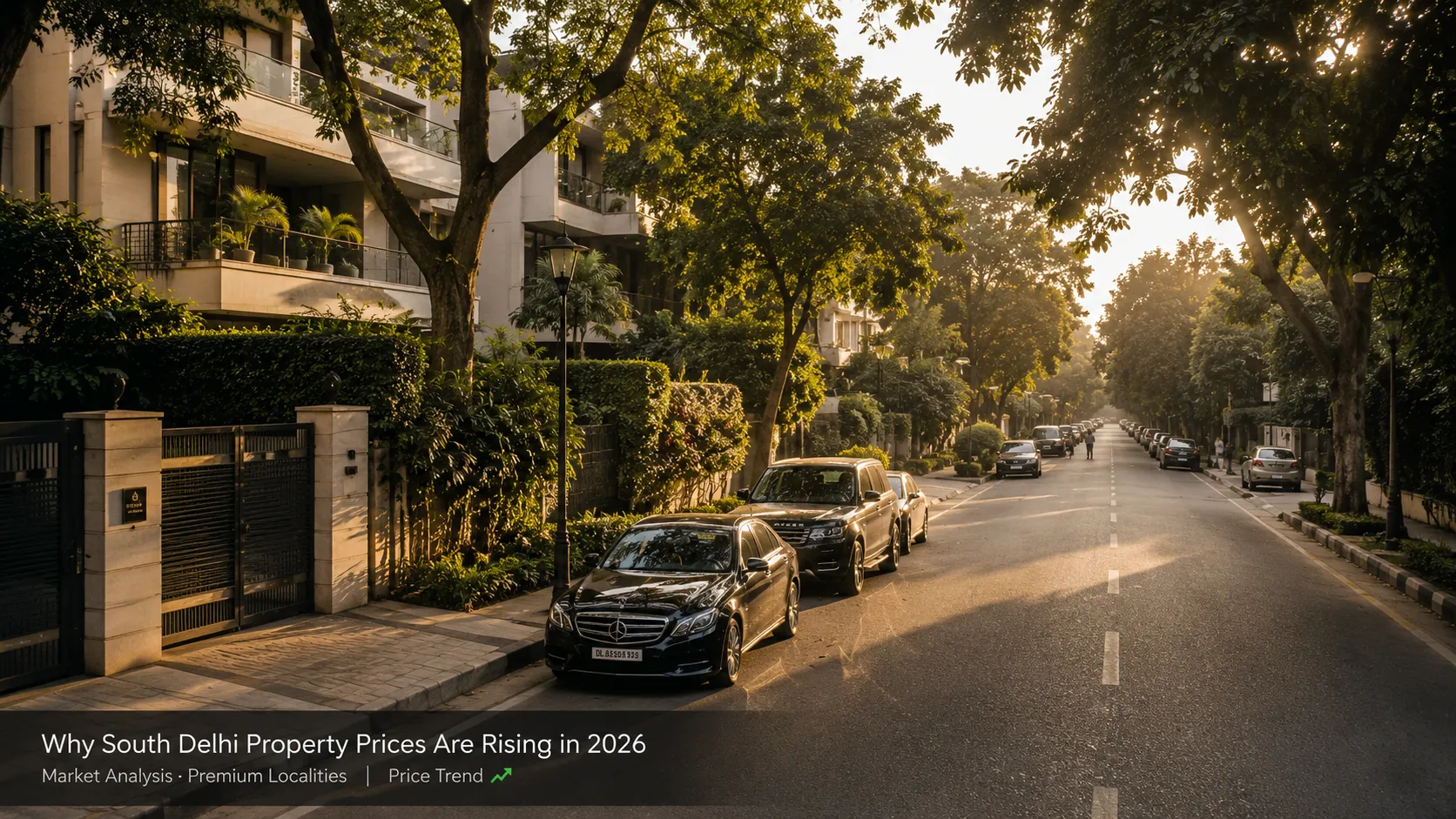
Why South Delhi Property Prices Are Rising in 2026 — And What It Means for Buyers
Categories
- Tips
- Guides
- Market Insights
- Articles
Recent Posts

Tips / 28 Sept 2026
How to Check Whether a Plot of Land Is Legally Safe to Buy

Guides / 28 Sept 2026
How to Calculate Rental Yield: Formula and Worked Examples

Guides / 26 Sept 2026
How Much Home Loan Can You Get on Your Salary in 2026?

Guides / 25 Sept 2026
10 Things to Check in a Property Sale Deed Before Registration
South Delhi property prices are climbing in 2026. Here's what's driving the rise, which micro-markets are moving fastest, and what buyers should do about it.
South Delhi has always been expensive. That's not news. But what's happening in 2026 is slightly different from the usual story of premium addresses commanding premium prices. The rise being seen across several South Delhi micro-markets right now isn't just inflation or sentiment — it has specific, identifiable drivers that are worth understanding if you're a buyer, a seller, or an investor trying to make sense of this market.
Some of it is structural. Some of it is cyclical. And some of it is the kind of localised demand pressure that doesn't show up in city-wide statistics but becomes very obvious the moment you start seriously trying to buy in these areas.
Let's go through what's actually happening and what it means for the decisions you're making right now.
Table of Contents
- The Baseline: Why South Delhi Was Always Different
- What's Specifically Driving the 2026 Price Rise
- Which South Delhi Micro-Markets Are Moving the Fastest
- What This Means for Different Types of Buyers
- A Real-World Scenario: The GK II Flat That Got Away
- Two Mistakes Buyers Make in This Market
- The Bottom Line
The Baseline: Why South Delhi Was Always Different
South Delhi — covering areas like Greater Kailash, Defence Colony, Hauz Khas, Saket, Vasant Kunj, Malviya Nagar, and the various Lajpat Nagar extensions — operates on a different set of fundamentals than most of NCR.
Land is genuinely scarce here. Unlike Noida or Gurugram, where developers can acquire land and build new inventory relatively easily, South Delhi's residential fabric is largely built out. New construction happens through redevelopment — older houses replaced by builder floors or small apartment buildings — rather than greenfield development. That structural scarcity keeps supply tight even when demand fluctuates.
The buyer profile is also different. South Delhi attracts a significant proportion of buyers who are upgrading from elsewhere in Delhi, NRIs returning or investing from abroad, and established professionals who want Delhi's best schools, hospitals, and social infrastructure within walking or a short driving distance. These buyers are less rate-sensitive than first-time buyers and less likely to exit the market when conditions get slightly less favourable.
What's Specifically Driving the 2026 Price Rise
Limited New Supply Meeting Growing Demand
Redevelopment in South Delhi has accelerated — but not fast enough to meet the demand that's come into the market over the last 18 months. The result is the classic supply-demand squeeze: more buyers competing for fewer listings, which pushes asking prices up and reduces the negotiating room that buyers had even two years ago.
Several pockets that were previously considered second-tier within South Delhi — parts of Khanpur, Tughlakabad Extension, and some stretches near Saket — are seeing price movement precisely because buyers priced out of their first-choice localities are moving down the hierarchy. That pressure cascades through the market.
Return of NRI and HNI Demand
Post-pandemic, there was a notable return of NRI investment interest in Indian real estate. South Delhi, with its established neighbourhoods and relatively clear property documentation compared to newer corridors, has been a beneficiary of this trend. NRI buyers typically move faster, are less fazed by current pricing, and often buy without the usual rounds of negotiation that characterise end-user purchases.
The rupee's relative movement against major currencies has also made Indian property more attractive in dollar or pound terms than it was four or five years ago. That external demand factor is real and is contributing to the price floor staying firm even when domestic buyer activity softens.
Infrastructure Improvements Feeding Into Valuations
The Pink Line metro ring completion has meaningfully improved connectivity for several South Delhi localities that previously had poor metro access. Areas around the new northern loop stations — and the ripple effect this has had on how buyers value specific addresses — are showing up in asking prices in ways that weren't visible 18 months ago.
The ongoing development around the Delhi-Mumbai Industrial Corridor and broader infrastructure upgrades feeding into south and southwest Delhi are also part of a longer-term valuation story that serious investors are tracking closely.
Which South Delhi Micro-Markets Are Moving the Fastest
Not all of South Delhi is rising equally. Understanding which pockets are seeing the sharpest movement helps buyers make more targeted decisions.
Malviya Nagar and Shivalik
This belt has seen some of the sharpest price movements over the last 12 months. Proximity to IIT Delhi, good school infrastructure, and relatively accessible pricing compared to GK or Defence Colony have brought in a wave of professional buyers. Builder floors in Malviya Nagar that were trading at ₹2 to ₹2.5 crore two years ago are now seeing asking prices of ₹2.8 to ₹3.5 crore — with genuine transactions closing at the higher end.
Saket and Its Fringes
Saket's position between the commercial spine of South Delhi and the Select City Walk retail hub has kept demand consistently strong. The fringe localities feeding into Saket — Sheikh Sarai, Chirag Delhi — are seeing secondary demand as buyers who want Saket adjacency without Saket prices look for alternatives.
Vasant Kunj and Vasant Vihar
These two have always commanded premium pricing, but the price increase here in 2026 is being driven partly by limited DDA flat availability and partly by the airport expressway connectivity advantage that's becoming more relevant as buyer profiles shift toward those with frequent travel requirements.
Greater Kailash — The Perennial Premium
GK I and GK II remain aspirational addresses that have seen consistent demand from HNI buyers and NRIs. Prices here are less about yield and more about status and scarcity. Gross rental yields in GK are often below 2.5% — which makes it a poor pure-investment buy but a strong long-term hold for buyers who want capital preservation in a scarce, high-demand address.
What This Means for Different Types of Buyers
For End-Users
If you're buying in South Delhi to live in, the rising price environment means the longer you wait, the less your budget gets you. That's not a sales pitch — it's basic arithmetic in a market where supply is structurally constrained and demand isn't going away.
The practical question is whether your budget works now. Before you start visiting properties, it's worth running the full cost picture — stamp duty in Delhi runs at 4% for women buyers and 6% for men, plus registration charges. The stamp duty calculator for Delhi NCR 2026 gives you an instant read on what your total acquisition cost looks like before you start negotiating.
For First-Time Buyers
South Delhi as a first purchase is a stretch for most budgets at 2026 prices — but not impossible if you know which pockets to target and how to structure your financing. The first-time homebuyer guide for Delhi NCR 2026 covers the loan eligibility, documentation, and cost structure you need to understand before approaching any South Delhi property seriously.
For Investors
The yield story in South Delhi is not compelling at current prices. If pure rental return is your goal, this is not the market. What South Delhi offers investors is capital preservation, low vacancy risk, and long-term appreciation in a market where supply is permanently constrained.
To model this honestly — including realistic rental income, appreciation assumptions, and your actual holding period — a property ROI calculator is a more useful tool than any developer projection. Run your specific numbers before deciding whether South Delhi makes sense for your investment thesis versus alternatives elsewhere in NCR.
A Real-World Scenario: The GK II Flat That Got Away
A mid-career professional I know — a doctor based in South Delhi, budget ₹2.8 crore — was looking at a 3 BHK builder floor in GK II in early 2025. The asking was ₹2.65 crore. He took three weeks to decide, came back with an offer of ₹2.5 crore, and the seller had already accepted another offer at asking price in the interim.
Six months later, comparable units in the same block were being quoted at ₹2.9 to ₹3.1 crore.
He eventually bought elsewhere, at a price that was closer to his budget — but the lesson is specific to this market: in South Delhi, good properties at reasonable prices move quickly and don't wait for buyers who need extended deliberation time. That's not pressure selling. It's a function of how tight supply actually is in well-located blocks.
Two Mistakes Buyers Make in This Market
Mistake 1: Comparing South Delhi Prices to NCR Averages
South Delhi doesn't behave like the rest of NCR. Using Noida or Gurugram pricing logic to negotiate in GK or Defence Colony leads to unrealistic offers that waste everyone's time and close doors. Research this market specifically — what similar properties sold for in the last 90 days in that specific locality.
Mistake 2: Underestimating Total Acquisition Cost
Stamp duty, registration, brokerage, society transfer charges, and any pending maintenance dues from the seller add up to a meaningful sum on top of the agreed purchase price. Buyers who plan only for the headline price often find themselves stretching uncomfortably at the last stage. Calculate the all-in cost before you start negotiating, not after.
The Bottom Line
South Delhi prices are rising in 2026 for reasons that are structural, not temporary. Limited supply, NRI and HNI demand, improving connectivity in previously underserved pockets, and a buyer profile that's less price-sensitive than most NCR markets combine to create a pricing environment that's unlikely to reverse significantly in the near term.
For buyers, that means moving with more preparation and less deliberation than you might in other markets. Know your numbers before you visit. Understand the total acquisition cost before you negotiate. And accept that in this market, the best properties don't sit around waiting.
Considering a purchase in South Delhi and want a clear read on what your budget actually gets you in 2026? Speak with a local expert who tracks transactions in specific South Delhi blocks — not just locality-level averages. The difference between a good South Delhi buy and an overpriced one often comes down to knowing which streets are worth the premium and which ones just sound like they are. #PropertyKaDNA
Tags
Tags
Frequently Asked Questions
About the Author
Admin
Top 5 Best Properties in Delhi NCR This Week
Handpicked properties with best price & location
Popular in Greater Noida
Top-rated residential & commercial projects across Greater Noida