
10 Hidden cost of buying a home in 2026
10 Hidden cost of buying a home in 2026
Categories
- Articles
- Market Insights
- News
Recent Posts

Articles / 07 Sept 2026
How to Check Property Registry Online in UP (Free)
Market Insights / 04 Sept 2026
Noida Circle Rates 2026: Sector-Wise Complete List

Market Insights / 02 Sept 2026
Best Home Loan Rates in India 2026: Full Comparison

Articles / 01 Sept 2026
Free Property Verification: Check Before You Invest
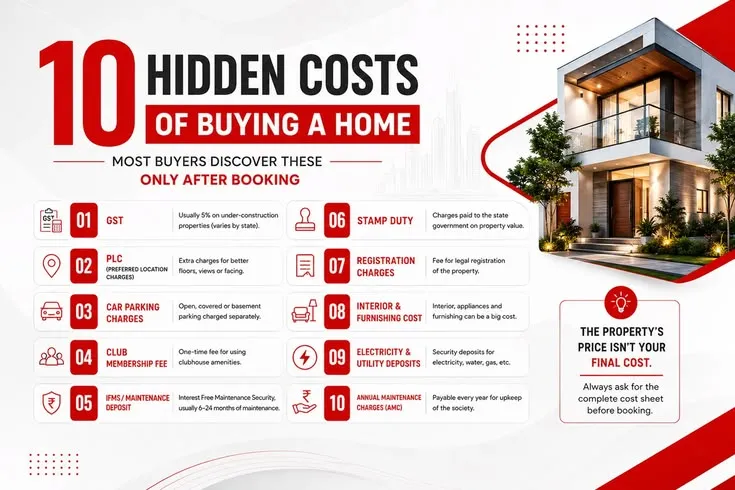
GST, PLC, club membership, IFMS, stamp duty, registration, interiors, utility deposits, and AMC: the 10 costs that never make it into the "starting from" price, and what they actually add up to before you sign the cost sheet.
Most first-time homebuyers focus on the property's base price and stop there. Then the actual cost sheet arrives, and it's carrying GST, PLC, club membership, an IFMS deposit, and half a dozen other line items that never made it into the sales brochure. By the time everything's added up, the total can run well above what the "starting from ₹X" advertisement led you to expect.
Before you book your dream home, here are the ten hidden costs worth understanding, and what they typically run to.
Table of Contents
1. GST (Where Applicable)
If you're buying an under-construction flat, GST applies at 5% of the agreement value, or 1% for affordable housing priced at ₹45 lakh or below with qualifying carpet area. Resale flats and ready-to-move properties with a completion certificate are exempt entirely, since the transaction is a transfer of an existing asset rather than a construction service.
On a ₹1 crore under-construction booking, that's ₹5 lakh in GST alone, a cost that's easy to miss when a sales team quotes a per-square-foot rate without spelling out what sits on top of it.
2. PLC Charges
PLC, or Preferential Location Charges, is what developers charge for a "better" unit within the same project: a park-facing flat, a corner unit, a specific floor, or a particular direction considered favourable. There's no standard formula across the industry, some developers charge a flat rate per sq. ft., others charge a percentage of the base price, and the definition of "preferential" varies by project and even by city. In Delhi-NCR, lower floors sometimes attract PLC in high-rises, while in cities like Mumbai it's often the upper floors that carry the premium.
PLC isn't optional once you've picked a specific unit, and it can add anywhere from a modest sum to several lakh rupees depending on the project and the exact unit. RERA requires developers to disclose PLC upfront in the Agreement for Sale, so ask for this figure in writing before you finalise a specific flat, not after you've fallen in love with the view.
3. Car Parking
Covered or basement parking is very often sold separately from the flat itself, and in many projects it isn't optional either, if you own a car, you're expected to buy a slot. Costs vary widely by city and project, and in premium developments a single covered parking slot can run into several lakh rupees, particularly for larger or stilt-level spots.
Ask specifically whether parking is included in the quoted price, optional, or mandatory, and get the exact allotted slot confirmed in writing rather than a general assurance that "parking is available."
4. Club Membership
Most gated communities and townships now come with a clubhouse, gym, swimming pool, and similar amenities, and membership to use them is frequently charged as a separate one-time fee at possession, on top of the flat's base price. This is easy to overlook because it's presented as part of the "lifestyle" pitch during the sales process rather than as a line item on the cost sheet.
Confirm whether club membership is mandatory or optional, what it actually costs, and whether there are additional annual renewal charges once you've paid the one-time fee.
5. IFMS / Maintenance Deposit
IFMS, or Interest-Free Maintenance Security, is a one-time, non-interest-bearing deposit collected by the developer at possession to fund the upkeep of common areas before the Resident Welfare Association is formally handed over. It's different from your monthly maintenance charges and different from the token amount or booking advance, it's a distinct line item, and RERA requires it to be disclosed clearly in the Agreement for Sale alongside PLC.
IFMS: One-time, refundable-in-spirit security deposit for common-area upkeep, collected at possession
Often bundled alongside: Advance maintenance (CAM) for 12-24 months, plus a separate corpus fund contribution
Combined impact: Can run from tens of thousands to a couple of lakh rupees depending on project size and amenities
Some developers separate IFMS, advance maintenance, and the corpus fund into three distinct charges rather than one bundled figure, so ask for each one broken out individually rather than accepting a single combined "possession charges" number.
6. Stamp Duty
Stamp duty is a state government levy, typically 5-7% of the property's value in most Indian states, applied to whichever is higher: the declared transaction value or the government-notified circle rate. In Uttar Pradesh, for example, it's 7% for male buyers and 6% for female buyers. This applies identically whether you're buying resale or new construction, it's not something that varies based on the type of purchase.
On an ₹80 lakh flat, stamp duty alone can run close to ₹5.6 lakh, one of the single largest costs on the entire cost sheet, and one that's genuinely easy to underestimate if you've only budgeted for the down payment.
7. Registration Charges
Separate from stamp duty, registration charges are typically a flat 1% of the property value (some states have moved this closer to 1-2%), paid to register the sale deed with the sub-registrar's office. It's a smaller amount than stamp duty on its own, but it's still a real cost that needs to be budgeted alongside it, not folded into a vague "taxes and duties" estimate.
8. Interior and Furnishing
Most flats, even "ready to move in" ones, are handed over as a bare or semi-finished shell: no modular kitchen, no wardrobes, often no false ceiling or additional lighting. Buyers routinely treat this as a "later" expense rather than part of the real cost of moving in, and it can add anywhere from 5% to 15% of the property's value depending on the finish level you choose.
A real-world scenario worth knowing: a buyer budgets carefully for the base price, stamp duty, and registration, moves in on possession day, and only then realises the flat has no kitchen cabinets, no wardrobes, and bare walls, pushing another several lakh rupees of spending into the first few months of ownership rather than the original purchase budget.
9. Utility Deposits
Getting your electricity, water, and piped gas connections activated typically requires a refundable security deposit to the respective utility provider, on top of any developer-side External Electrification Charges (EEC) or water connection charges already built into the cost sheet. These deposits are usually modest individually, but they're another cost that shows up after possession, not before, and catches buyers who assumed the "development charges" line item already covered everything utility-related.
10. Annual Maintenance Charges
Once you're living in the property, Annual Maintenance Charges (AMC), sometimes called Common Area Maintenance (CAM), become a recurring cost, typically billed monthly or quarterly by the RWA or the developer's facility management team, covering security, housekeeping, common-area electricity, and upkeep of shared amenities. This is separate from the one-time IFMS deposit and the advance maintenance collected at possession, it's the ongoing cost of actually living in the society, and it continues for as long as you own the flat.
Ask for the current per-square-foot AMC rate and how frequently it's been revised historically, since this number tends to increase over time as a project ages and its amenities need more upkeep.
The Bottom Line
None of these ten costs are hidden in the sense of being secret, they're just scattered across the Agreement for Sale, the possession letter, and conversations with the sales team, rather than presented together in one place upfront. That's exactly why so many first-time buyers only discover the real total cost after they've already committed.
Always ask for the complete cost sheet before paying the token amount. A proper cost sheet should itemise the base price, GST, PLC, parking, club membership, IFMS, stamp duty, registration, and any other charges individually, not as a single bundled number.
If you're financing this purchase, it's worth first getting comfortable with the home loan terms every homebuyer should know, and if this is your first property purchase, our first-time homebuyer guide for Delhi NCR walks through the full process end to end.
Not sure what your actual all-in cost looks like for a specific property? Speak with a local expert who can break down every charge on the cost sheet before you commit to anything. #PropertyKaDNA
Tags
Tags
Frequently Asked Questions
Top 5 Best Properties in Delhi NCR This Week
Handpicked properties with best price & location
Popular in Greater Noida
Top-rated residential & commercial projects across Greater Noida