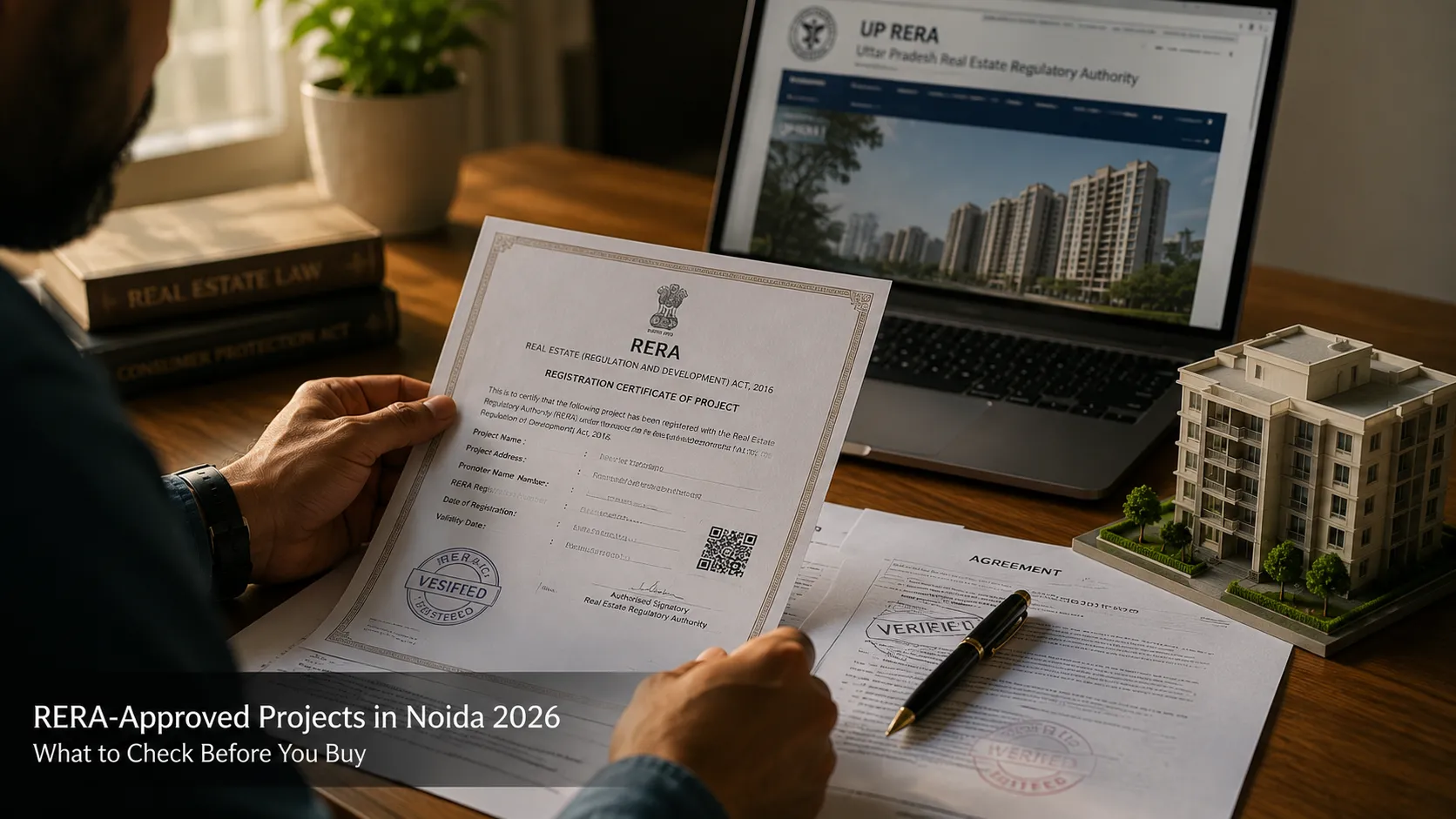
RERA-Approved Projects in Noida 2026 — What to Check Before You Buy
Categories
- Tips
- Guides
- Market Insights
- Articles
Recent Posts

Tips / 28 Sept 2026
How to Check Whether a Plot of Land Is Legally Safe to Buy
Guides / 28 Sept 2026
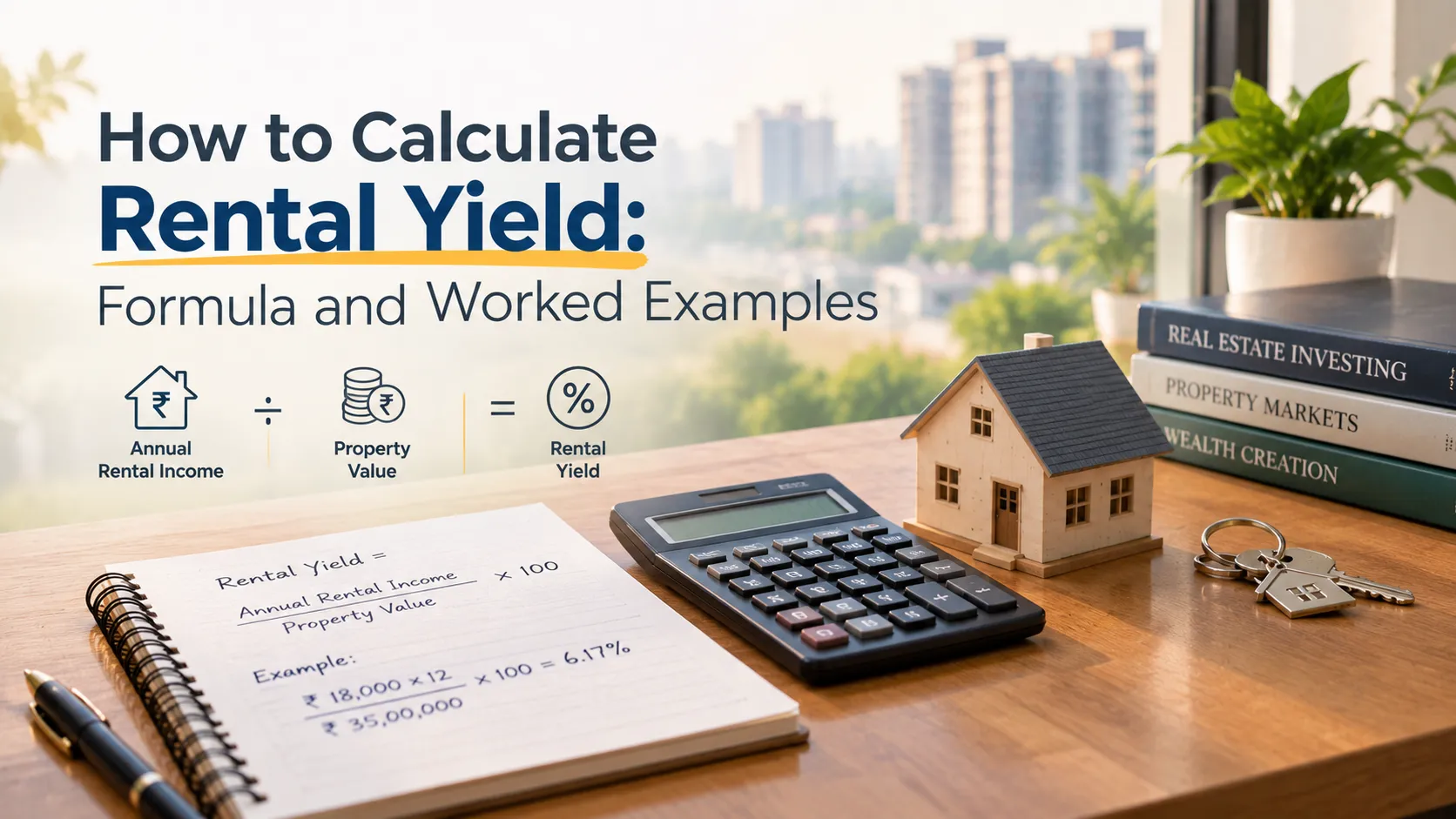
How to Calculate Rental Yield: Formula and Worked Examples

Guides / 26 Sept 2026
How Much Home Loan Can You Get on Your Salary in 2026?

Guides / 25 Sept 2026
10 Things to Check in a Property Sale Deed Before Registration
Buying a RERA-approved project in Noida in 2026? Here's what registration actually means, what to verify beyond the certificate, and the mistakes most buyers make.
There's a version of this story that plays out more often than it should. A buyer shortlists a project, the broker shows them the RERA registration number, and that becomes the end of the due diligence conversation. RERA approved so it's safe. Move forward.
Except that RERA registration is not a safety certificate. It's a disclosure mechanism. It means the project has been registered with the Uttar Pradesh Real Estate Regulatory Authority and that certain information about it is publicly available. What it doesn't mean is that the project will be delivered on time, that the builder has a clean track record, or that the flat you're buying will look anything like the sample unit when possession eventually arrives.
Understanding what RERA actually covers — and more importantly, what it doesn't — is one of the most useful things a property buyer in Noida can do before signing anything in 2026.
Table of Contents
- What RERA Registration Actually Means
- How to Actually Check a RERA-Registered Project in Noida
- What RERA Doesn't Tell You — And What You Need to Find Out Yourself
- RERA-Approved Projects in Noida 2026 — Sectors Worth Watching
- A Real-World Scenario: What the Registration Doesn't Catch
- Two Mistakes Buyers Make With RERA
- Before the Numbers, Before the Floor Plan, Check RERA
What RERA Registration Actually Means
The Real Estate (Regulation and Development) Act, 2016 — commonly called RERA — made it mandatory for developers to register their projects with the state regulatory authority before marketing or selling them. In Uttar Pradesh, this is handled by UP RERA, accessible at up-rera.in.
When a project is RERA registered, the developer is required to disclose the project layout, sanctioned plan, estimated completion date, details of the land title, and quarterly construction progress updates. Buyers who book units have legal recourse if possession is delayed beyond the committed date — including the right to a refund with interest or compensation.
That's meaningful protection. Compared to the pre-RERA era, when buyers had almost no formal recourse against delayed or abandoned projects, this is a genuine improvement.
But here's what RERA does not do: it does not verify the accuracy of what the developer submits. It does not audit construction quality. It does not guarantee the builder has the financial capacity to complete the project. It registers and discloses. Enforcement — when things go wrong — requires the buyer to file a complaint and pursue the process, which takes time and energy most buyers don't anticipate needing.
How to Actually Check a RERA-Registered Project in Noida
Checking RERA registration is a three-minute exercise that most buyers skip entirely. Here's how to do it properly.
Step 1: Verify the Registration Number Independently
Every RERA-approved project in Noida and Greater Noida should have a UP RERA registration number. Don't just take the number from the developer's brochure or the broker's WhatsApp message — go to the UP RERA portal directly and search for the project by name or registration number.
Confirm that the registration is active and hasn't lapsed. Check the registered project name against what the developer is marketing — occasionally there are discrepancies between the registered name and the marketed one.
Step 2: Read the Completion Date
The UP RERA listing will show the committed possession date. Compare this against what the developer told you verbally or put in the booking agreement. If the RERA-registered date is significantly earlier than what you're being told now — and the project isn't delivered yet — that's a project that's already running behind. Factor that in.
Step 3: Check Quarterly Progress Reports
Developers are required to submit quarterly construction progress reports on the RERA portal. In practice, compliance varies. But if a project has multiple missed quarterly updates or shows minimal construction progress despite being years into its timeline, that's information worth having before you book.
Step 4: Look at Complaints Filed Against the Project
The UP RERA portal shows complaints filed against registered projects. A project with zero complaints on a 2,000-unit development that's been running for four years is unusual — it may mean buyers haven't engaged the process, not necessarily that nothing went wrong. But a project with dozens of active complaints is a clear signal.
What RERA Doesn't Tell You — And What You Need to Find Out Yourself
This is the part most buyers miss.
Builder's financial health. RERA registration says nothing about whether the developer has the funding to complete the project. In Noida's history, several registered projects stalled mid-construction because developers ran out of money or diverted funds. Before booking in any under-construction project, research the developer's track record — specifically, have they completed previous projects on time and to specification?
Construction quality. RERA doesn't inspect or certify construction quality. The only way to assess this is to visit completed projects by the same developer, speak with residents who already live in their previous developments, and if possible, have an independent structural assessment done before taking possession.
Legal title of the land. RERA requires developers to submit land title documents, but it doesn't guarantee clear title. A separate legal verification of the land ownership, encumbrance certificate, and sanctioned plan is still advisable — particularly for plotted developments or projects on land with complicated ownership history.
Actual carpet area. RERA mandated that flats be sold on carpet area basis rather than a super built-up area, which was a significant consumer win. But the carpet area declared in the RERA registration should be cross-checked against what's in your booking agreement. Discrepancies — even small ones — affect your actual cost per square foot.
RERA-Approved Projects in Noida 2026 — Sectors Worth Watching
Within the Noida market, RERA-compliant inventory is concentrated across several corridors with different risk-return profiles.
Established sectors — Sector 62, Sector 93, Sector 137. Most projects in these mature corridors are either ready-to-move or in the final stages of completion. RERA compliance here is less of a concern because possession risk is lower — what matters more is the resale market dynamics, maintenance quality, and current pricing. Before evaluating any of these as investments, it's worth understanding how to calculate actual returns — the guide on how to calculate real estate investment returns walks through the inputs that most buyers miss.
Noida Extension — Sectors 1, 4, 16B, Techzone 4. Greater Noida West has a more mixed RERA compliance picture. There are well-registered, progressing projects here alongside older registrations from developers who've had delivery issues. The corridor has been through significant buyer-developer disputes over the last decade, and while things have improved, due diligence here needs to go a layer deeper than just checking RERA registration.
New launches — Sector 150 and the Yamuna Expressway belt. Fresh launches in these areas are actively registering under RERA and marketing the registration prominently. For under-construction purchases in these zones, the RERA checklist above is essential — not optional. The appreciation potential is real, but so is the completion risk on longer-timeline projects.
A Real-World Scenario: What the Registration Doesn't Catch
A buyer approached me after booking a flat in a RERA-registered project in Greater Noida West. The project had a valid registration, a clear possession date two years out, and a developer with several other registered projects under their name.
What the RERA portal didn't show: the developer had missed possession on two of their previous projects by 18 months and 24 months, respectively. This came out only when the buyer spoke directly to residents of those projects — not from the RERA portal, not from the broker, and not from the developer's sales team.
The new project eventually delivered — but 14 months late. Not catastrophic, but costly in terms of continued rent payment, EMI without possession, and general stress.
The lesson isn't that RERA is useless. The lesson is that RERA is the starting point, not the finishing line. Every check on the portal should be followed by offline verification that no digital system can substitute for.
Two Mistakes Buyers Make With RERA
Mistake 1: Treating RERA Registration as the End of Due Diligence
Registration means the project exists in the system. It doesn't mean it will complete, comply, or deliver what was promised. Use the portal as a tool — not as a verdict.
Mistake 2: Not Checking Registration Before Paying the Booking Amount
Booking amounts are sometimes collected before a project is formally RERA-registered, particularly in pre-launch phases. Paying before registration gives you significantly weaker legal protection. Always confirm active registration before any money changes hands.
If you're a first-time buyer navigating this process, the first-time homebuyer guide for Delhi NCR 2026 covers the full purchase journey — from loan eligibility to registration costs — in plain terms that make the process considerably less overwhelming.
Before the Numbers, Before the Floor Plan, Check RERA
RERA registration in 2026 is the baseline. Every serious project in Noida should have it. The question isn't whether a project is RERA-registered — it's what the registration tells you and what it doesn't.
Spend twenty minutes on the UP RERA portal before your next site visit. Read the completion date. Check the complaint history. Then verify everything that the portal can't tell you through offline research, resident conversations, and — for investment purchases — a clear-eyed look at the numbers using a property ROI calculator before you commit.
Looking at RERA-approved projects in Noida and want help separating the solid options from the ones that look good on paper? Speak with a local expert who knows the delivery track records in these corridors — not just the registration numbers. That ground-level knowledge is what the portal can't give you. #PropertyKaDNA
Tags
Tags
Frequently Asked Questions
About the Author
Admin
Top 5 Best Properties in Delhi NCR This Week
Handpicked properties with best price & location
Popular in Greater Noida
Top-rated residential & commercial projects across Greater Noida